Landslides, Land Subsidence and Avalanches
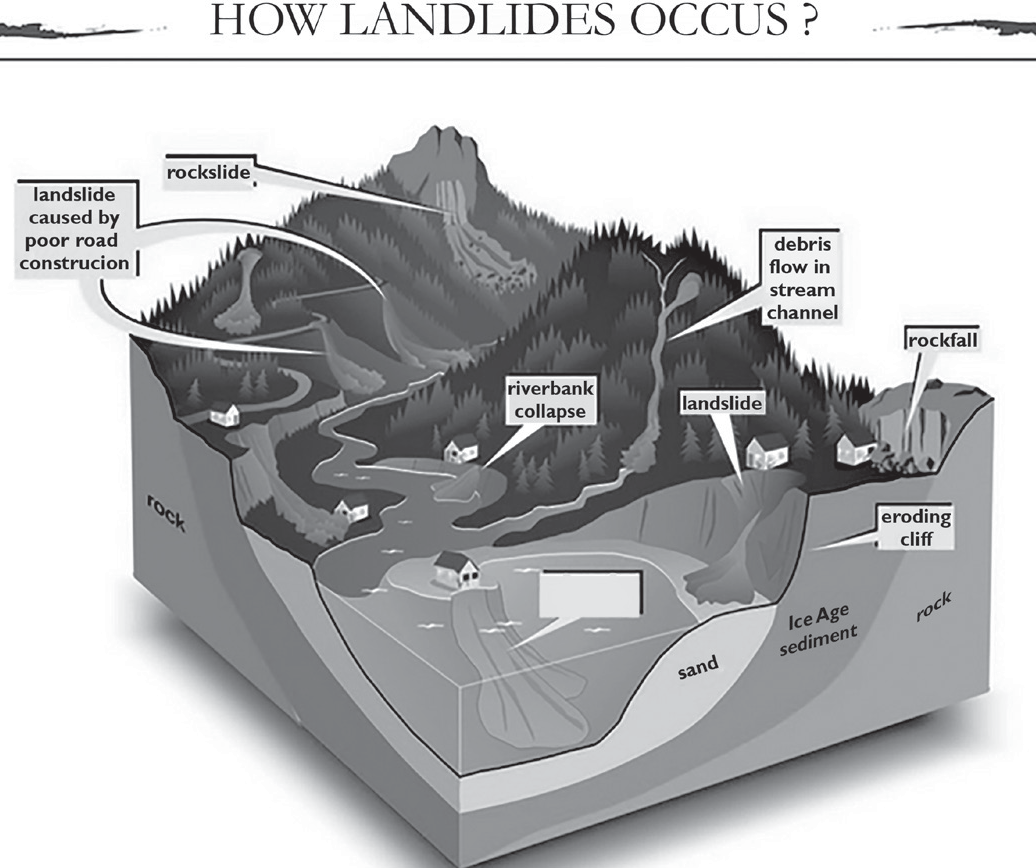
• Landslides refer to the downward movement of rocks, debris, or soil along mountain slopes or riverbanks.
• These movements can be gradual, but sudden and unexpected sliding may also occur.
•
Landslides often coincide with natural disasters such as earthquakes, floods, and volcanic eruptions.
• In some cases, prolonged heavy rainfall triggers significant landslides that obstruct river flow for an extended period. When these blockages give way, they can cause severe destruction to downstream settlements.
• Landslides occur due to gravitational force, leading to both downward and outward displacement of slope materials.
• India's hilly regions, particularly the Himalayas and the Western Ghats, are highly susceptible to landslides.
• The Himalayan mountain range consists of young, geologically unstable formations, often resulting in massive landslides, such as the Malpa landslide of 1998.
• On the other hand, the Western Ghats and Nilgiri Hills are geologically stable but have elevated plateau edges influenced by neotectonic activity. Landslides in these regions are typically surface- level events that do not disturb the bedrock but occur mostly during monsoons, impacting the densely populated areas more severely.
• It is estimated that the Himalayan region accounts for 30% of the world's landslides. In the Nilgiris, heavy rainfall in 1978 led to severe landslides. Overall, landslides impact approximately 15% of India's total land area.
• Land Subsidence: It refers to the vertically downward movement or sinking of earth's surface, gradually or suddenly, caused by natural or man-made reasons like removal of water, oil or natural resources, earthquakes, soil erosion, soil compaction etc. e.g. 2023 Joshimath disaster.
• The regional variation in the incidences of landslides at national level can be seen in the following table.
| Region | Incidences of Landslides |
| Himalayas | High to very High |
| North eastern Region | High |
| Western Ghats and Nilgiris | Moderate to High |
| Kerala, Eastern Ghats and Vindhyachal | Low |
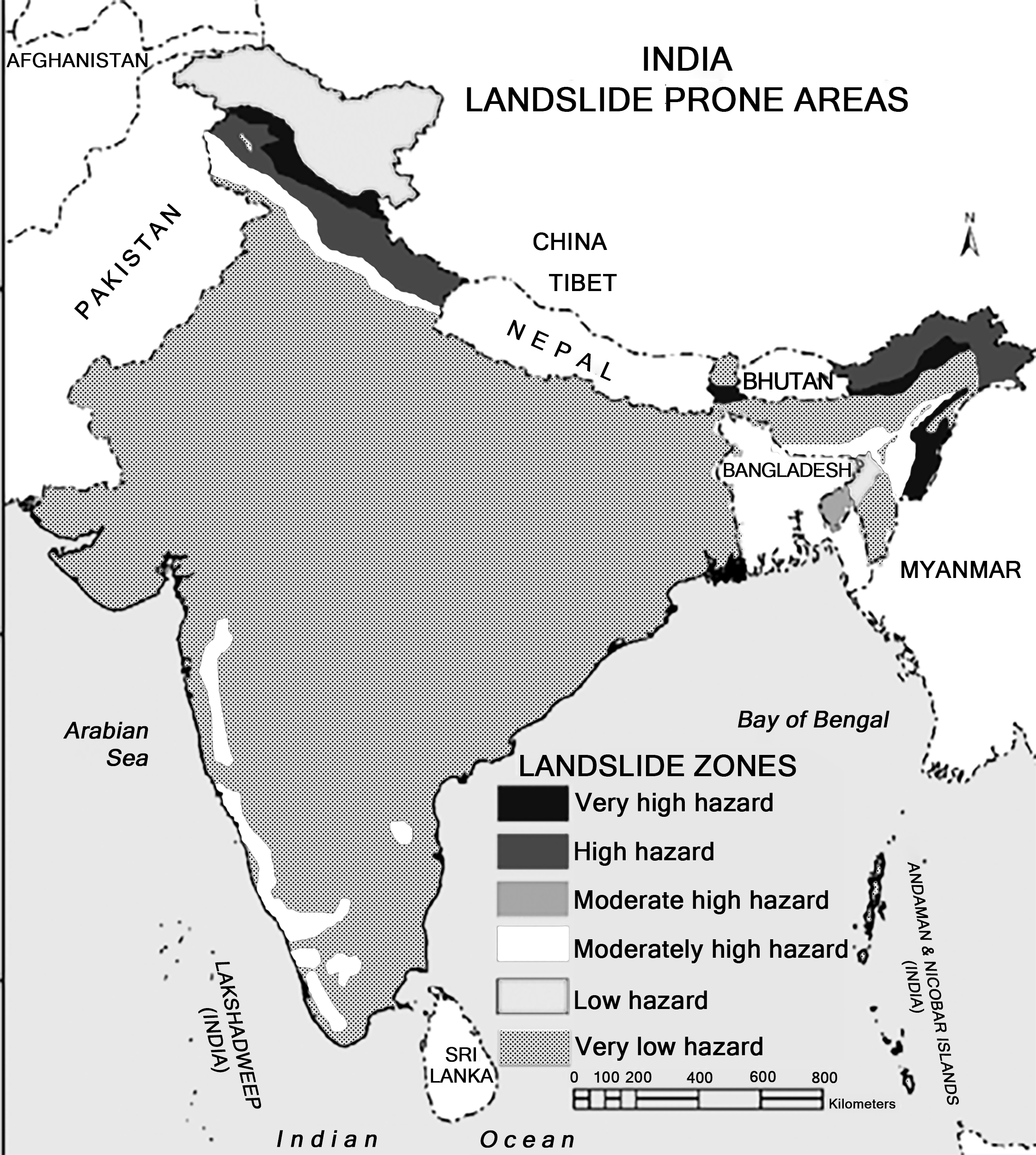
Map: Landslide prone areas of India
Causes of landslides
• Intense Rainfall: One of the primary triggers of landslides is heavy rainfall.
• Loss of Vegetation Cover: Deforestation is another significant factor contributing to landslides. Trees, shrubs and grasses help bind soil particles together, maintaining stability. When trees are cut down, mountain slopes lose their protective layer, allowing rainwater to flow rapidly and uncontrollably, increasing the risk of landslides.
• Seismic Activity and Volcanic Eruptions: Earthquakes are frequent in the Himalayan region, causing tremors that destabilize mountains, leading to rockfalls and landslides. Similarly, volcanic eruptions can trigger landslides in mountainous areas.
• Road Construction: Infrastructure development in mountainous regions often requires road construction, which involves removing large amounts of rock and debris. This process weakens the natural rock structure and alters slope angles, making landslides more likely.
• Shifting Cultivation: In northeastern India, the practice of shifting agriculture has contributed to a rise in both the frequency and intensity of landslides.
• Urbanization and Tourism Development: The growing population and expanding tourism industry have led to increased construction of houses, hotels, and other buildings. The excavation and accumulation of construction debris further destabilize slopes, triggering landslides.
Impact of landslide
• Degrading of environment: Landslides are degrading the environment of mountains. Natural beauty is diminishing slowly and slowly.
• Sources of water are drying up.
• Flooding in rivers is increasing.
• Roads are blocked.
• Life and property are lost.
• The grasses of industrial importance should also be planted so that there is some economic return to the farmers as well.
Use the Surface Vegetative Cover to protect the land from raindrop’s beating action, bind the soil particles and decrease the velocity of flowing water.