INTRODUCTION
The ability to speak and communicate with each other by using language was acquired by human beings around 200000 years
ago. Neanderthals were the first human the ability to speak by using a proper coherent language.
The language spoken around India belong to several language families and most of them belong to Indo-Aryan group of languages. There are some languages groups which are indigenous to the Indian subcontinent.
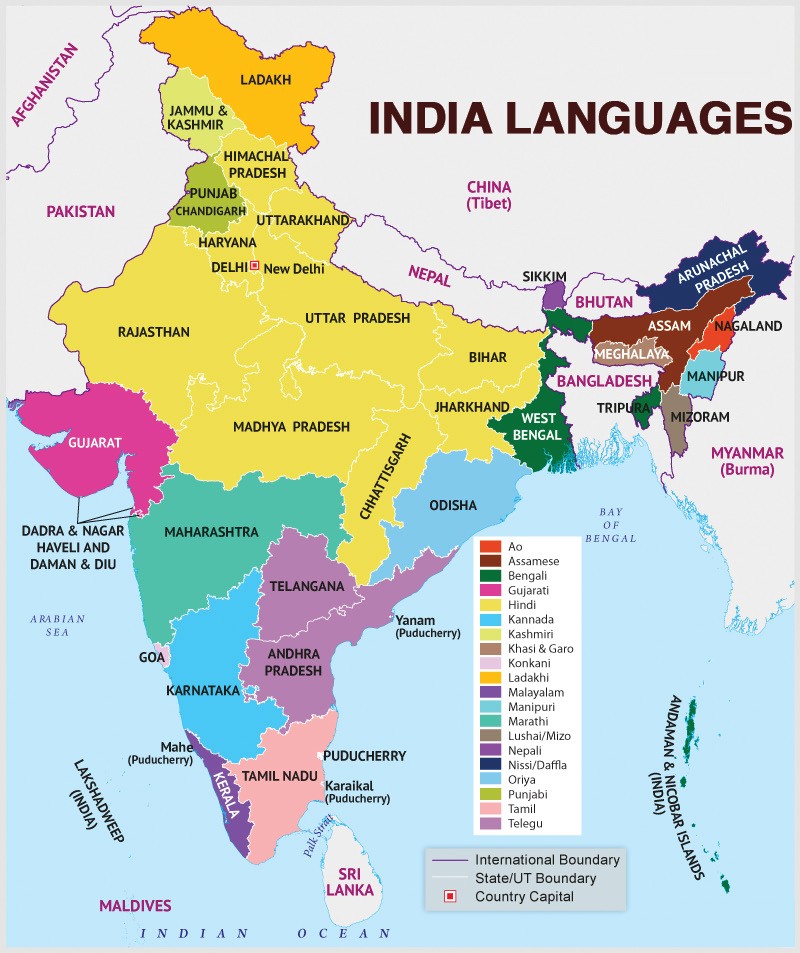

CLASSIFICATION OF INDIAN LANGUAGES
Movement of different groups of people speaking different languages resulted in the emergence of thousands of languages in India. Languages in India are classified into following major sub groups:

INDO ARYAN GROUP OF LANGUAGES


This group is also known as the Indic language group. It is a part of Indo-European language family. It comprises the maximum group of languages in the Indian subcontinent. The evolution of this branch started with the arrivals of Aryans in India around 1500 BC. It is the largest language group of India and around 74 percent of the Indians speak languages belonging to this group. This language group is again divided into three subgroups depending upon the time period of their origin.
Old Indo-Aryan
This group belongs to early vedic age and earliest known literature belongs to this race. From this period Sanskrit developed as an indigenous language for culture, religion, court and theatre. Many of the Indian languages originated from this language. It is the most ancient language of our country and is one of the 22 scheduled languages listed in the Constitution.
Middle Indo –Aryan
Prakrit emerged as vernacular language during the post Vedic period. Prakrit also the basis of other languages such as Apabhramsha, Pali and Ardha Magadhi. The oldest reference of Prakrit is found in Jain and Buddhist texts. Prakrit is a broader term under which all the Middle Indo-Aryan Group languages are generally clubbed together. Prakrit incudes:
• Pali: It was widely spoken in Magadha. It was popular during 5th–1st century BC. It is closely related to Sanskrit, and the texts in Pali were written generally in Brahmi script. The Tripitaka of Buddhism were also written in Pali. It serves as the lingua franca of Theravada Buddhism. It is believed that Buddha himself did not speak in Pali but gave his preachings in Ardha-Magadhi language.
• Magadhi Prakrit or Ardha- Magadhi: It is the most important kind of Prakrit. Its literary use increased after the decline of Sanskrit and Pali. Buddha and Mahavira perhaps spoke in Ardha-Magadhi. It was the court language of few Mahajanapadas and also the Mauryan dynasty. Several Jain texts and Rock edicts of Ashoka were also written in Ardha-Magadhi. It later evolved into many languages of Eastern India namely Bengali, Assamese, Odia, Maithili, Bhojpuri, etc.
•
Shauraseni: It was widely used to write dramas in the medieval India. It is also called Dramatic Prakrit. It was the predecessor to Northern Indian languages. Jain monks wrote mainly using this version of Prakrit. The oldest text of Digambara Jains, ‘Shatkhandgama’ is written in Shauraseni.
• Maharashtri Prakrit: Spoken till 9th century AD, it was the predecessor to Marathi and Konkani. It was used widely in Western and Southern India. It was the official language of Satavahana Dynasty. Several dramas were written in it like ‘Gaha Kosha’ by King Hala, ‘Gaudavaho’ (slaying of the King of Gauda) by Vakpati.
• Elu: Ancient form of modern Sinhala Language of Sri Lanka (it is similar to Pali).
• Paishachi: It is also called ‘Bhuta-Bhasa’ (dead language). Often regarded as Prakrit, it is considered as an unimportant dialect. Gunadhya’s Brihatkatha, an ancient epic is written in Paishachi.
Apabhramsa
By the sixth and seventh centuries, the development of ‘Apabhramsa’ had occurred. Apabhramsa is also a catch- all term for dialects other than Sanskrit or Prakrit. It marks the transition from the Middle to the Modern Indo-Aryan Group of languages. Apabhramsha gradually evolved into a literary language, and it was used to write a variety of texts, legends, and other works. Apabhramsa had developed its own identity by the 7th century. This is demonstrated by the fact that Bhamaha, a renowned poet of Kashmir in the sixth or seventh centuries, divided poetry into Sanskrit, Prakrit, and Apabhramsha.
Dandin also stated that Apabhramsa is the common people’s dialect. Pushpadanta’s Mahapurana (Digambara Jain text) and Dhanapala’s Bhavisayattakaha were some major texts written in Apabhramsa.
Modern Indo Aryan
This group of languages is widely spoken in western, northern and eastern parts of India. Hindi is the main language belonging to this group. Other languages like Kashmiri, Sindhi, Lahnda, Marathi, Gujarati, Oriya,
Bengali, Assamese and Maithili are also included in this group.

DRAVIDIAN GROUP OF LANGUAGES


This group comprises mainly of the languages spoken in the southern part of India. Around 25 percent of the Indian population is covered under this group. Proto Dravidian gave rise to 21 Dravidian Languages. They can be broadly classified into three groups: Northern group, Central group and Southern group.
• Northern Group: It is made up of three languages: Brahui, Malto, and Kurukh. Brahui is spoken in Baluchistan, Malto in Bengal and Odisha’s tribal areas, and Kurukh in Bengal, Odisha, Bihar, and Madhya Pradesh.
• Central Group: It is made up of eleven different languages: Gondi, Khond, Kui, Manda, Parji, Gadaba, Kolami, Pengo, Naiki, Kuvi, and Telugu. Only Telugu has evolved into a civilized language and is spoken in the states of Andhra Pradesh and Telangana, while the others are tribal languages.
• Southern Group: This category includes seven languages. Kannada, Tamil, Malayalam, Tulu, Kodagu, Toda, and Kota are among them. Tamil is the oldest of these.
SINO-TIBETAN GROUP OF LANGUAGES
This group belongs to Mongoloid family. They have spread to all over Himalayas, North Bihar, North Bengal, Assam and up to the North Eastern frontiers of India. These languages are considered to be older than the Indo-Aryan Languages and are referred to as Kiratas in the oldest Sanskrit literature. Languages belonging to this group are spoken by 0.6 percent of the Indian population.
The Sino-Tibetan group is further subdivided as follows:
• Tibeto-Burman
• Siamese-Chinese
Tibeto-Burman: Languages under Tibeto-Burman are further divided into four groups:
• Tibetan: Sikkimese, Bhutia, Balti, Sherpa, Lahuli and Ladakhi
• Himalayan: Kinnauri and Limbu
• North Assam: Abor, Miri, Aka, Dafla and Mishmi
• Assam Burmese: Kuki, Garo, Bodo, Mikir, Naga, etc.
Meitei is the most important language spoken under this sub-group and is mainly spoken in Manipur.
Siamese-Chinese: Ahom is one of the languages included in this category. However, this language is now extinct in the Indian subcontinent.
AUSTRO-ASIATIC GROUP OF LANGUAGES
Languages under this group belong to Austro-Asiatic sub- family which are represented by the languages of Munda or Kol Group and are spoken in Central, Eastern and North- Eastern India. Some of them also belong to Mon Khmer Group, vig. Khasi and Nicobarese. The existence of these
languages has been much before the advent of the Aryans and were referred to as Nisadas in ancient Sanskrit literature. Santhali is the most important language under this group which is spoken by Santhal tribals of Jharkhand, Bihar and Bengal. With the exceptions of Khasi and Santhali, all Austro- asiatic languages in Indian territory are endangered.
OFFICIAL LANGUAGE COMMISSION
Article 344 of the constitution states that upon the expiration of 5 years from the commencement of constitution and thereafter at the end of years of its commencement, the President must appoint an official Language Commission.
It shall be the duty of the Commission to make recommendations to the President as to:
The progressive use of the Hindi language for the official purposes of the Union;
Restrictions on the use of the English language for all or any of the official purposes of the Union;
The language to be used for all or any of the purposes mentioned in Article 348;
The form of numerals to be used for any one or more specified purposes of the Union;
Any other matter referred to the Commission by the President as regards the official language of the Union and the language for communication between the Union and a State or between one State and another and their use.
The first Official Language Commission was constituted under the chairmanship of B G Kher in 1955 by government of India. On the basis of the recommendation of this commission, Parliament of India enacted Official Language Act in 1963. This act provided Hindi shall be official language of Indian Union and English shall continue as the second official language of the union for period of 15 years (till 25 January 1965). This act was amended in 1967 to provide for the continuation of English as the second official language of Indian union for an indefinite period.
CLASSICAL LANGUAGE
In 2004, classical language category was created by the parliament of India through a constitutional decree. It was declared that language which meet a certain specific criterion can be accorded the accreditation as a classical language of India.
Criteria: The following criteria were laid down to determine the eligibility of languages to be considered for classification as a “Classical Language”:
High antiquity of its early texts/recorded history over a period of 1500-2000 years;
A body of ancient literature/texts, which is considered a valuable
heritage by generations of speakers;

The literary tradition be original and not borrowed from another speech community;
The classical language and literature being distinct from modern, there may also be a discontinuity between the classical language and its later forms or its offshoots.
The Union Cabinet has recently approved the recognition of five more languages as "classical," expanding the nation's list of culturally significant tongues.
| ‘Classical Language’ status to the following languages: | |||
| Tamil | 2004 | Marathi | 2025 |
| Sanskrit | 2005 | Pali | 2025 |
| Telugu | 2008 | Prakrit | 2025 |
| Kannada | 2008 | Assamese | 2025 |
| Malayalam | 2013 | Bengali | 2025 |
| Odiya | 2014 |
As of October 2025, a total of 11 Indian languages hold the status of Classical Language
Ancient Scripts of India
Benefits
Government of India’s resolution states that the following benefits will accrue to a language declared as a “Classical Language”:
Classical languages receive various government benefits to promote their study and preservation.
Two prestigious international awards are given annually to scholars for their significant contributions to classical Indian languages:
Presidential Award of Certificate of Honour
Maharshi Badrayan Samman Award
The University Grants Commission (UGC) supports the establishment of Professional Chairs in central universities and research institutions, focusing on classical Indian languages.
To safeguard and promote these languages, the government established the Center of Excellence for Studies in Classical Languages at the Central Institute of Indian Languages (CIIL) in Mysore.
A script is referred to as a writing system or orthography. It is a method of representing the different parts of a spoken language by making specific marks on a medium (Paper, rocks, birch-bark, etc).


| SCRIPT | FEATURES |
| Indus Valley Civilisation | The oldest evidence of Indus valley script was found on the pot shreds discovered at Rahman Dheri located in Pakistan. The script is not deciphered till today. The people of Harappan civilization used a pictographic language in which 396 different symbols were used. It was written right to left and left to right orientation are followed in alternate lines. |
| Brahmi Script | It is the oldest deciphered script of India. Indian scripts such as Devanagari, Tamil, Malayalam and Bengali have originated from Brahmi script. This script developed into 2 major types in the regions of northern and southern India. In northern regions, the script is more angular and in southern regions, it is more circular. This script was most commonly in Ashokan inscriptions. A syllabic writing system is used in Brahmi script. It was used essentially for writing Pakrit language. |
| Kharosthi Script | The Kharosthi script (3rd Century BC – 3rd Century AD) is an ancient script used to write Gandhari Prakrit and Sanskrit in ancient Gandhara (present-day Afghanistan and Pakistan). It is a sister script to Brahmi and was deciphered by James Princep. It includes numbers similar to Roman numerals. It is mostly written from right to left. Some samples of this script have been discovered from major rock edicts of Ashoka located at Shahbazgarhi and Mansehra in Pakistan. |


| Gupta Script | It is also known as late Brahmi Script. It was used to write Sanskrit and belonged to the Gupta Empire. The Nagari, Sharada, and Siddham scripts all descended from the Gupta script, which descended from Brahmi. These scripts gave rise to many of India’s most important scripts, including Devanagari, Gurmukhi script for Punjabi, Assamese script, Bengali script, and Tibetan script. |
| Nagari Script | This script is believed to be the eastern version of Gupta script. This script was used to write both Sanskrit and Pakrit language. It is ancient version of Devanagari script and is written from left to right. Nagari script is used to compose standard Nepali and Hindi literature at present. |
| Sarada Script | The Sarada or Sharada Script is an abugida writing system of the Brahmic family developed around the 8th century AD. It was used for writing Sanskrit and Kashmiri. Originally more widespread, its use became later restricted to Kashmir, and it is now rarely used except by the Kashmiri Pandit community for ceremonial purposes. |
| Gurmukhi Script | It is an alphabetic script that evolved from Lahnda script. Gurmukhi is developed from the Sarada Script and was standardised during 16th century AD by Guru Angad. The whole of the Guru Granth Sahib is written in this script, and it is the script most commonly used by Sikhs and Hindus for writing Punjabi language. |
| Modi Script | Modi is a script that is used to write Marathi. Modi was the official Marathi script until the twentieth century, when the Balbodh style of the Devanagari script was promoted as the standard Marathi writing system. Although Modi was primarily used to write Marathi, it is also known to have been used to write Urdu, Kannada, Gujarati, Hindi, and Tamil. |
| Devanagari Script | Devanagari is an abugida writing system of India and Nepal. It is written from left to right. The Devanagari Script is used for over 120 languages, including Hindi, Marathi, Nepali, Pali, Konkani, Bodo, Sindhi and Maithili among other languages and dialects, making it one of the most used and adopted writing systems in the world. The Devanagari Script is also used for classical Sanskrit texts. |
| Grantha Script | It is one of the oldest south Indian scripts that originated from Brahmi script. It is further categorized into Malayalam and Tamil scripts. Sanskrit Granthas were written in this script in the region of Tamil Nadu. It is still existing in the traditional Vedic schools. The Malayalam script, like the Tigalari and Sinhala alphabets, is a direct descendant of Grantha. |


| Vatteluttu Script | The Vatteluttu alphabet is a South Indian abugida writing system. Vatteluttu is one of the three main alphabet systems developed by Tamil people to write the Granthi or Pallava alphabet and the Tamil script. It is derived from Tamil-Brahmi. |
| Kadamba Script | The Kadamba Script marks the birth of a dedicated script for writing Kannada. It is also a descendant of the Brahmi Script which developed during the reign of the Kadamba Dynasty in the 4th-6th century AD. The script later became Kannada-Telugu Script. |
| Tamil Script | This script is used to write Tamilian language in India and Sri Lanka. Tamil is the oldest and purest Dravidian language. It was developed from Grantha script. The script is syllabic in nature. |
| Telugu Script | It is evolved out of Bhattiprolu script. Bhattiprolu script was derive from Brahmi script and was used by southern Mauryan rulers. By the 5th century AD, Bhattipolu Brahmi script developed itself into Telugu script. |
| Santhali Script | Santhali language is spoken by Munda sub-family belonging to Austro-Asiatic language group. This group is linked to Mundari and Ho lingual groups. Until the 19th century, Santhali was mainly an oral language, but recent developments under Pandit Raghunath Murnu have led to creation of separate Ol Chiki script, especially for Santhali speaking people belonging to Jharkhand and Odisha. |
| Urdu Script | The Urdu alphabet is the Urdu language’s right-to-left alphabet. It is a modification of the Persian alphabet, which is derived from the Arabic alphabet and dates back to the 13th century. It is linked to the evolution of the Nastaliq style of Perso-Arabic script. In its extended form, Urdu script is known as Shahmukhi script, and it is used to write other Indo-Aryan languages of the North Indian subcontinent, such as Punjabi and Saraiki. |

Gyan Bharatam Mission
It is announced during Union Budget 2025-26, a flagship initiative of the Ministry of Culture (MoC) to digitization