Man-Made Hazards: Chemical Disasters
• Chemical disasters involve the release, fire, or explosion of hazardous chemicals during industrial operations, storage, or transportation, or as a result of natural events. These incidents can have severe consequences both within and beyond the affected site, leading to loss of life, property damage, and environmental harm.
• Given the critical role of chemicals in modern industries, managing chemical disasters has become a significant concern for governments, the private sector, and communities. Such disasters can have devastating effects on people, nature, and infrastructure. The most vulnerable elements in a chemical disaster include industrial facilities, workers, vehicles transporting
hazardous chemicals, nearby residents, adjacent structures, and the surrounding community. Chemical disasters can occur through various means :
• Process and safety systems failures
• Human errors
• Technical errors
• Management errors
• Induced effect of natural calamities
•
Accidents during the transportation
• Hazardous waste processing/ disposal
• Terrorist attack/ unrest leading to sabotage
Status of Chemical Disaster Risk in India
• India experienced the world's worst industrial disaster, the Bhopal Gas Tragedy in 1984. This catastrophic incident involved the accidental release of the highly toxic gas Methyl Iso Cyanate (MIC), leading to thousands of deaths and making it one of the most devastating chemical accidents in history.
• Chemical accidents have far-reaching consequences, causing injuries, loss of life, and extensive damage to property and the environment. Despite the lessons from Bhopal, India has continued to face chemical disasters.
• Over the past decade alone, the country has recorded 130 major chemical accidents, resulting in 259 fatalities and 563 serious injuries.
• Currently, India has approximately 1,861 Major Accident Hazard (MAH) units spread across 301 districts in 25 states and 3 Union Territories. In addition, numerous registered hazardous factories and unorganized sectors handle dangerous materials, presenting significant and complex disaster risks across the country.
Causative factors
• The aging infrastructure of process plants and the slow adoption of modern technologies in India's chemical industry have heightened the risk of chemical disasters.
• Fire, explosions, toxic releases, or a combination of these hazards can occur during transportation, storage, or processing due to various factors such as temperature and pressure deviations, runaway reactions, mixing
of incompatible substances, catastrophic failures of reactors or storage vessels, leaks, hardware malfunctions, inadequate agitation, improper reactor vent designs, and insufficient process hazard analysis.
• Organic solvents remain the leading cause of fires and explosions in the chemical sector.
• A significant number of industrial accidents are attributed to human error, often resulting from non-compliance with Standard Operating Procedures (SOPs) established by the company.
• Chemical disasters have also stemmed from design flaws, lack of SOPs for early warning systems, and poor coordination among departments within chemical
facilities.
• Additionally, risks have escalated due to threats such as
terrorism and sabotage.
• Natural disasters like earthquakes and floods have also played a major role in triggering chemical accidents.
• Another prevalent cause of such disasters is poor maintenance of equipment, which compromises safety and operational efficiency.
• Non-availability of an emergency response team to mitigate accidents during the transportation of hazardous chemicals have also resulted in major disasters in several locations in India.
Impact
The consequences of such emergencies can be severe, encompassing loss of life injuries, psychological and physiological health impacts, and extensive damage to environmental resources such as land, soil, water bodies, air quality, and ecosystems. These incidents can also disrupt local climate patterns, agriculture, forests and biodiversity, leading to the degradation of environmental services like water supply, sanitation, waste management, and public health. Additionally, structural damage to buildings, machinery and facilities may occur, resulting in financial burdens, including insurance claims, economic setbacks, loss of productivity, wages and incentives. Such disasters can also heighten vulnerability to other hazards, whether natural or environmental, and contribute to social unrest, legal disputes, governance challenges, and instability in law and order.
Prevention and Response
As far as chemical accidents are concerned, prevention is the best proactive approach rather than the reactive methods to chemical disasters. Each of the following stakeholders has a role and responsibility.
Role of Industry
• Identification of Hazardous Activities:
• A thorough understanding of safety measures in industrial operations is crucial for preventing and controlling accidents.
• A competent and dedicated team of qualified professionals should assess potential hazards and risks associated with daily activities.
• Employing hazard identification techniques such as checklists, safety audits, and risk analysis can aid in mitigating dangers.
• Maintenance of Plant Facilities and Equipment:
• Regular maintenance of machinery and equipment should be conducted to ensure their proper functioning.
• Routine safety and health inspections should be performed to confirm that the facility remains safe and all equipment operates as intended.
• Installation of Gas/Vapour Detection Systems:
• Implementing a gas or vapour detection system with alarms can help detect leaks at micro levels, ensuring that issues are addressed promptly.
• Compliance with Regulations:
• Strict adherence to state and central regulations is necessary for maintaining a safe and sustainable industrial process.
•
Human Resource Management Development:
• Managing human resources effectively is complex and requires continuous monitoring, along with the implementation of behavior-based safety programs.
• Industries should establish a structured human resource management system led by senior officials to enhance workplace safety.
• Creating an open and communicative environment between management and employees will enable workers to report unsafe practices or hazards.
• Emergency Preparedness:
• Industries should maintain a well-trained emergency response team capable of acting swiftly to contain escalating disasters.
• Regular mock drills should be conducted to ensure workers are adequately prepared to handle emergencies.
Role of Government
• The comprehensive legal/ institutional framework exists in our country. A number of regulations covering the safety in transportation, liability, insurance and compensations have been enacted.
• Following are the relevant provisions on chemical disaster management, prevailing in country:-
| Explosives Act 1884 | Petroleum Act 1934 |
| Factories Act 1948 | Insecticides Act 1968 |
| EnvironmentProtection Act 1986 | Motor Vehicles Act 1988 |
| Public Liability Insurance Act 1991 | Disaster Management Act 2005 |
• The Government of India has further strengthened the legal framework for chemical safety and the management of chemical accidents by introducing new regulations, including MSIHC Rules, EPPR Rules, SMPV Rules, CMV Rules, Gas Cylinder Rules, Hazardous Waste Rules, and Dock Workers Rules, along with amendments to existing laws.
• Additionally, the National Action Plan on Chemical Industrial Disaster Management (NAP-CIDM) has been developed, serving as a strategic roadmap for managing chemical disasters in India.
• Establishment of an Accident Investigation Board and Chemical Accident Database:
• Dedicated accident investigation board, modeled after the Chemical Safety Board of the USA, could be established in India to analyze chemical disasters and formulate preventive guidelines based on lessons learned from each incident.
• There is also a need for a specialized accident reporting system and an exclusive database to document chemical accident cases for better monitoring and prevention.
• An online platform could assist industries in addressing various safety concerns by facilitating expert guidance from around the world. This would help prevent unforeseen issues arising from plant operations.
• Awareness Campaigns:
• Raising public awareness about potential hazards and their consequences is crucial, as it enables communities to actively participate in disaster mitigation and recovery efforts.
• Research and Development:
• The government can promote research and development initiatives focused on innovative technologies that reduce the toxicity of byproducts from chemical industries.
• Offsite Emergency Planning:
• The goal of offsite emergency planning is to ensure that local authorities effectively fulfill their responsibilities in minimizing the impact of major accidents on people and the environment near industrial sites.
• This planning must align with existing regulations and guidelines.
• Transportation of Hazardous Chemicals:
• The Indian Chemical Council (ICC) has recently launched the "Nicerglobe" program (nicerglobe.in), which enables GPRS tracking of chemical transport vehicles from their point of origin to their final destination. This platform is well-integrated with emergency response services. Chemical industries are encouraged to participate in this initiative to enhance the safe transportation of hazardous materials.
Role of Public
• Having a general understanding of the risks associated with chemical accidents can significantly help in minimizing their impact.
• Forming mutual aid groups can help organize the general public during emergencies by providing training and awareness about appropriate actions to take in the event of a chemical leak.
Conclusion
• Although disasters in the chemical industry are rare, negligence or unforeseen circumstances can lead to catastrophic outcomes. Beyond the immediate impacts—such as loss of life, environmental hazards, and destruction of infrastructure—the damage to the industry's reputation is often irreversible. The repercussions of a chemical disaster can persist across generations, causing long-term harm that is immeasurable for the affected communities.
Dam Failures
• A dam failure or dam burst is a catastrophic type of structural failure characterized by the sudden, rapid, and uncontrolled release of impounded water or the likelihood of such an uncontrolled release. Between the years 2000 and 2009 more than 200 notable dam failures happened worldwide.
• According to recent UN research, 3,700 dams in India will lose 26% of their total storage capacity by 2050 as a result of sediment buildup, which could eventually jeopardize future water security, irrigation, and power generation.

Figure: Definition of Large Dam
• India has 5334 large dams; third largest after USA and China. Other 411 large dams are under various stages of construction. About 1,100 of the more than 5,200 major dams that have been erected so far have reached the age
of 50, and others are more than 120 years old. By 2050, there will be 4,400 of these types of dams, or 80% of the country’s major dams, which will range in age from 50 to more than 150 years.

Figure: Causes of Dam Failures
• Machchu II Dam Failure (1979): Due to heavy rainfall and improper design, the Machchu II Dam in Gujarat, India, burst, resulting in a catastrophic flood. The torrential flow destroyed villages, claiming the lives of over 2,000 people.
• In 2022, the massive floods in Godavari have exposed the flood vulnerability of giant projects like Polavaram and Kaleshwaram. Also there have been multiple dam failures and dam induced floods in particularly in Rajasthan, Madhya Pradesh, Maharashtra, Tamil Nadu and Kerala. There are more than 40 reported failures cases so far, 64% in newly built dams of age upto 10 years.

Map: Dams as Cause of Floods
• The Hazard Classification of a dam is based on the downstream damage that would result if the dam were to fail. The hazard classification has no relationship to the condition of the dam, its structural integrity, operational status, or flood storage capability.
Classification of Dams
• The International Commission on Large Dams (ICOLD), considers any dam is Large Dam if its height is 15 meters or more measured from the lowest point of foundation to top of the dam. Dams with a height of 10 m or more
are considered as High Dams, if they satisfy one of the following criteria or a combination of more than one.
| Criterion | Requirement |
| Length of crest | > 500 m |
| Volume of reservoi | > 1 million m3 |
| Design flood | > 2000 m3/sec. |
| Geological conditions | Difficult |
| Other considerations | Unusual Design |
Potential Hazard Classifications (PHC) [International Commission on Large Dams (ICOLD)]
| Component | Potential Hazard Classification (PHC) | ||
| Low- (I) | Medium- (II) | High- (III) | |
| H2 𝑉 | H2 𝑉<20 | 20
| |
| Life Safety Risk (Number of lives) | ~ 0 | < 10 | 10 |
| Economic Risk | Low | Moderate | High or extreme |
| Environmental Risk | Low or Moderate | High | Extreme |
| Social Disruption | Low (rural area) | Regional | National |
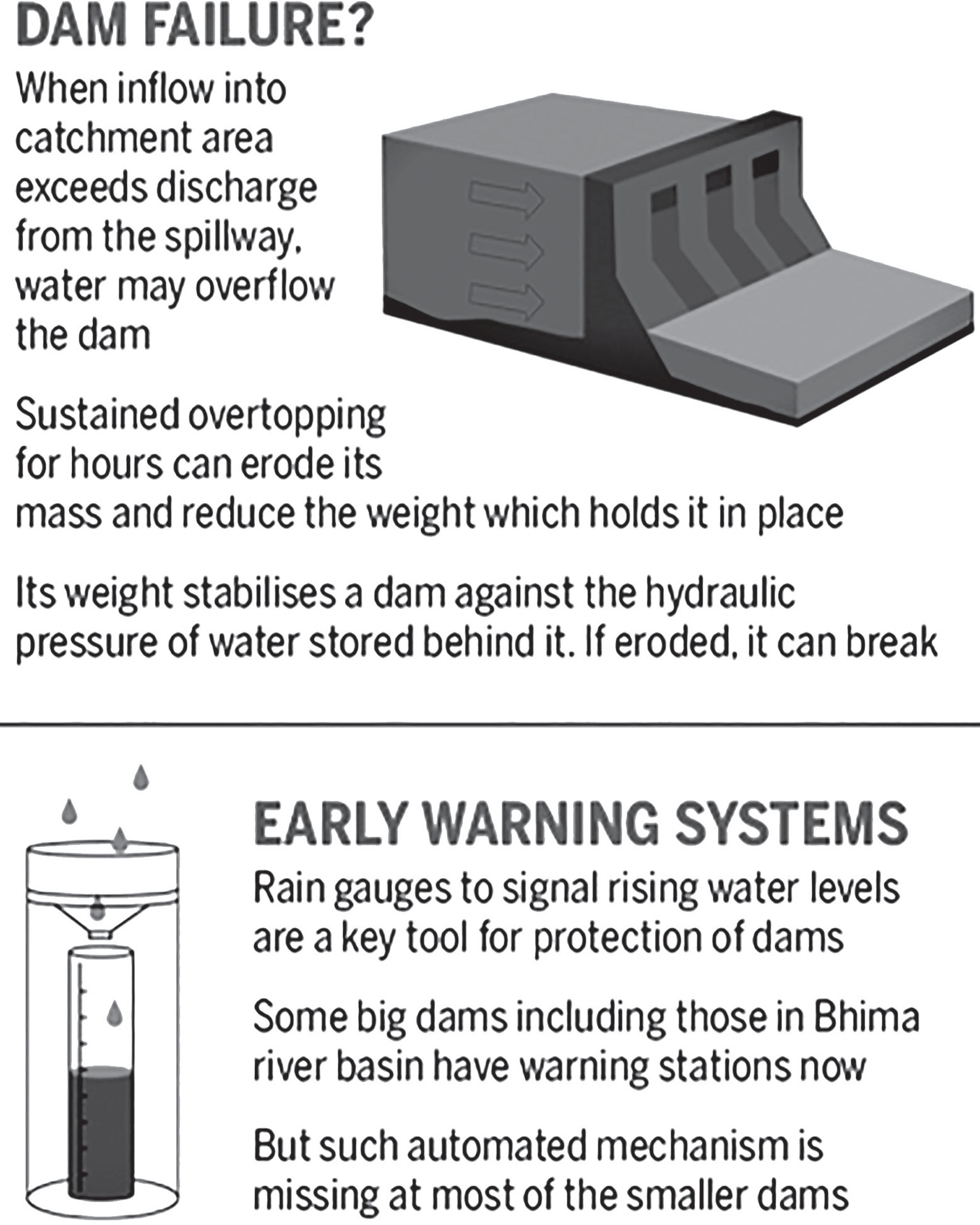
Figure: Dam Failure and Early Warning
Dam Safety Legal and Institutional Framework in India
• The safety of the dams in India is the principal concern of the State agencies and other organisations that own the dams and are involved in various aspects of their investigations, planning, design, construction operation and maintenance.
• Dam Safety Organization (DSO) was established in Central Water Commission (CWC), in May 1979 So far, 14 States – namely, Andhra Pradesh, Bihar, Chattisgarh, Gujarat, Jharkhand, Kerala, Tamil Nadu, Maharashtra, Madhya Pradesh, Orissa, Karnataka, Rajasthan, Uttar Pradesh, and West Bengal – having significant number of dams, have created State level DSOs.
• Dam Safety Act 2021: An Act to provide for surveillance, inspection, operation and maintenance of the specified dam for prevention of dam failure related disasters and to provide for institutional mechanism to ensure their safe functioning. The Act comprehensively addresses the critical dam safety concerns under prevailing as well as new issues such as climate change, etc. Its key provisions include:
• Regular inspection of dams;
• Hazard Classification of Dams;
• Emergency Action Plan;
• ComprehensiveDam Safety Review byan independent panel;
• Funds for timely repair and maintenance;
• Operations and maintenance manual;
• Record of incidents and failure;
• Risk Assessment Study;
• Dam instrumentation including Hydro-Meteorological and Seismological Network;
• Accreditation of agencies;
• Emergency Flood Warning System; and
• Offences and penalty.
• National Committee on Dam Safety: It has been set up under the Chairmanship of the Chairman, Central Water Commission (CWC) to help evolve uniform dam safety policies, protocols and procedures.
• Review of national scenario concerning safety of dams
• Preparation of Emergency Action Plan (EAP) and Reservoir Operation
• Instrumentation of Dams
• Dam Safety Review Panel (DSRP)
• National Register of Large Dams – Updating as per
new formats
• Dam rehabilitation and improvement schemes
• Records of Dam Failures and Major Dam Incidents and their Technical Reports
• Implementation of National Hydrology Project
• Setting up Hydrology units and Design Floods Review and Monitoring of safety aspects of inter- state dams by Sub-Committees etc.
• National Dam Safety Authority as a regulatory body to implement the policy, guidelines and standards for proper surveillance, inspection and maintenance of specified dams and resolve disputes of issues between the State Dam Safety Organisation of two States, or between the State DSO of a State and the owner of a dam in that State, and in certain cases, such as dams extending in two or more States or dams of one State falling under the territories of another State
Biological Disasters
• Biological disasters refer to the severe consequences resulting from the widespread proliferation of specific living organisms that can trigger diseases, viral infections, or large-scale infestations affecting plants, animals, or insects. These events can escalate to epidemic or pandemic levels, posing significant threats to public health and ecosystems.
• Notable examples of biological disasters include outbreaks of cholera, H1N1 influenza (swine flu), and COVID-19.

Figure: Classification of Biological Disasters
• Epidemic-level biological disasters impact a significant number of people within a specific community or area, while pandemic-level biological disasters affect a much larger region, often extending across entire continents or globally.
• For example, cholera is considered an epidemic, while COVID-19 is classified as a pandemic.
• Biological hazards, or biohazards, are biological substances or organic materials produced by parasites, viruses, bacteria, fungi, and proteins that pose a risk to the health of living organisms, especially humans.
• The harmful effects of these biohazards on human health typically fall into three categories: infections, allergies, and poisoning.
• The Ministry of Health and Family Welfare serves as the primary body responsible for managing epidemics, making decisions, providing advisory services, and offering emergency medical relief.
• According to the Indian Constitution, health is a state responsibility, meaning that the state governments hold the primary duty for addressing biological disasters.
• The National Institute of Communicable Diseases (NICD) is the central agency tasked with investigating outbreaks, while the NICD and the Indian Council of Medical Research (ICMR) offer support in terms of research, training, teaching, and laboratory services.
Biological Warfare
Biological Warfare (BW), also referred to as Germ Warfare, involves the use of biological toxins or infectious agents like bacteria, viruses, and fungi with the purpose of killing or incapacitating humans, animals, or plants as a form of warfare.
• Biological weapons, often called "bio-weapons," "biological threat agents," or "bio-agents," are living organisms or replicating entities (such as viruses, which are not universally regarded as "alive") that reproduce or replicate inside their host victims.
• Entomological (insect) warfare is also categorized as a type of biological weapon.
• NBC is the military acronym for nuclear, biological, and chemical warfare, referring to the use of weapons of mass destruction.
• There is a connection between biological warfare and chemical warfare, as the use of toxins produced by living organisms may also be classified as bioterrorism.
• The Ministry of Home Affairs (MHA) is the primary ministry responsible for BW and collaborates with the Ministry of Health and Family Welfare in managing it. MHA handles threat assessment, establishes deterrent mechanisms, and provides intelligence inputs.
Legislation
There are a number of legislations that control and govern the nation’s health policies. The government can enforce these legislations to contain the spread of diseases.
•
The Water (Prevention and Control of Pollution) Act, 1974
• The Air (Prevention and Control of Pollution) Act, 1981
• The Environmental (Protection) Act, 1986, and the Rules (1986). This Act also provides for the Biomedical Waste (Management) Rules with a view to controlling the indiscriminate disposal of hospital/ biomedical wastes.
• The Disaster Management Act (DM Act), 2005, provides for the effective management of disasters and for all matters connected therewith or incidental.
• The Epidemic Diseases Act 1897
The Epidemic Diseases Act 1897
• This Act does not grant the central government the authority to intervene in biological emergencies.
• It needs to be replaced by an Act that addresses the current and anticipated public health needs, including emergencies like biological terrorism (BT) attacks, the use of biological weapons by adversaries, cross-border issues, and the global spread of diseases.
• The new Act should empower both central and state governments, as well as local authorities, to take necessary actions, such as notifying affected areas, restricting movement, or quarantining impacted zones. It should also grant authority to enter premises to collect samples of suspected materials and seal them.
• Additionally, the Act should establish regulations for the transfer of biological samples, as well as enforce biosecurity and biosafety protocols for materials and laboratories.
Infrastructure
• At the operational level, Command and Control (C&C) are clearly defined at the district level, where the district collector holds specific powers, such as requisitioning resources, declaring a disease, inspecting premises, requesting assistance from the Army or state/central authorities, and enforcing quarantine. However, there is no established concept of an incident command system, where the entire response is managed by an incident commander with support from logistics, finance, and technical teams. There is an urgent need to implement an incident command system in every district.
• There is a significant shortage of medical and paramedical staff at the district and sub-district levels. Additionally, there is a severe lack of public health specialists, epidemiologists, clinical microbiologists,
and virologists.
• Biosafety laboratories are required for the prompt diagnosis of the agents for the effective management of biological disasters. There is no BSL-4 laboratory in the human health sector. BSL- 3 laboratories are also limited. Major issues remain regarding biosecurity, the indigenous capability of preparing diagnostic reagents, and quality assurance.
• The US Centre for Disease Control classifies biohazards into four biosafety levels as follows:
• BSL-1: Bacteria and Viruses including Bacillus subtilis, some cell cultures, canine hepatitis, and non-infectious bacteria. Protection is only facial protection and gloves.
• BSL-2: Bacteria and viruses that cause only mild disease to humans, or are difficult to contract via aerosol in a lab setting such as hepatitis A, B, C, mumps, measles, HIV, etc. Protection – use of autoclaves for sterilizing and biological safety
cabinets.
• BSL-3: Bacteria and viruses causing severe to fatal disease in humans. Example: West Nile virus, anthrax, MERS coronavirus. Protection – Stringent safety protocols such as the use of respirators to prevent airborne infection.
• BSL-4: Potentially fatal (to human beings) viruses like Ebola virus, Marburg virus, Lassa fever virus, etc. Protection – use of a positive pressure personnel suit, with a segregated air supply.
• Absence of an Integrated Ambulance Network (IAN): There is no ambulance service equipped with advanced life-support facilities capable of handling biological disasters.
• State-operated hospitals have limited medical resources. Even under normal circumstances, patients are required to purchase their own medicines. There is a lack of essential supplies such as drugs, key vaccines like
the anthrax vaccine, personal protective equipment (PPE), and diagnostics to manage increased demand. During a crisis, the situation worsens due to complicated procurement processes.
National Disaster Response Force (NDRF): The leadership and oversight of the NDRF fall under the Director-General of Civil Defence and the NDRF, appointed by the Central Government. Currently, the NDRF consists of eight battalions, which are deployed at various locations based on the requirements.
Prevention of Biological Disasters
• Prevention and preparedness efforts should concentrate on evaluating biothreats, understanding the medical and public health impacts, developing medical
countermeasures, and implementing long-term strategies that reduce vulnerability and help mitigate post-disaster consequences.
• Key elements of prevention and preparedness include pre-exposure immunization (as a preventive measure), establishing an epidemiological intelligence gathering system, creating a strong surveillance network
capable of detecting early warning signals, interpreting
epidemiological data to assess whether an attack is intentional, and enhancing capacity for surveillance, laboratory operations, and hospital systems that support outbreak detection, investigation, and management.
•
Vulnerability Analysis and Risk Assessment
• Environmental Management
• Ensuring a safe water supply and proper maintenance of sewage systems is essential in preventing biological disasters and waterborne epidemics like cholera, hepatitis, diarrhea, and dysentery.
• Promoting personal hygiene by raising awareness in the community about its importance, along with providing washing, cleaning, and bathing facilities, and preventing overcrowding in sleeping areas.
• Vector Control – Key components of vector control
programs include:
• Environmental engineering efforts and general integrated measures for vector control.
• Removal of breeding sites through water management, draining stagnant pools, and preventing water accumulation.
• Outdoorfogging and regular insecticide spraying to control vectors.
• Monitoring and managing rodent populations.
• Proper burial or disposal of dead bodies.
Prevention of Post-disaster Epidemics
The risk of epidemics increases after any disaster, whether natural or manmade. Preventive measures will be implemented to address such situations.
• Integrated Disease Surveillance Systems: A surveillance team will track potential sources, modes of transmission, and investigate outbreaks.
• Detection and Containment of an outbreak involves four key steps:
• Recognition and diagnosis by primary healthcare providers
• Reporting of surveillance data to public health authorities
• Epidemiological analysis of the gathered data
• Provision of appropriate medical treatment and public health interventions
• Pharmaceutical Interventions: This includes chemoprophylaxis, vaccination, and other preventive methods.
• Biosafety and Biosecurity: A system for inventory management should be in place in laboratories handling bacteria, viruses, or toxins that could be potential agents for biological disasters.
• Protection of important buildings and offices from biological agents, where necessary, can be achieved by limiting access to authorized personnel only through proper screening. Installing High Efficiency Particulate Air (HEPA) filters in the ventilation systems of air conditioning units will prevent infectious microbes from circulating within critical buildings. The post-exposure
approach will involve effective decontamination and safety protocols.
• Training of personnel and public health education.
Nuclear and Radiological Disaster
• A nuclear disaster occurs due to the extraordinary release of radioactive material or radiation, either during the operation of nuclear reactors or other nuclear events, such as the explosion of a Radiological Dispersal Device (RDD), Improvised Nuclear Device (IND), or a nuclear weapon.
• A Nuclear and/or Radiological Emergency (NRE) refers to an incident that results, or has the potential to result, in exposure to or contamination of workers or the public beyond permissible limits. These emergencies are categorized into five main types:
• An accident occurring at any nuclear facility within the nuclear fuel cycle, including nuclear reactors, or at a facility using radioactive sources, leading to a large- scale release of radioactivity into the environment.
• A ‘criticality’ accident at a nuclear fuel cycle facility, where an uncontrolled nuclear chain reaction occurs, causing bursts of neutrons and gamma radiation.
• An accident during the transportation of radioactive materials.
• The malicious use of an RDD or IND by terrorists.
• A large-scale nuclear disaster from a nuclear weapon
Nuclear and Radiological Emergencies Risk Mitigation
attack, resulting in mass casualties and widespread destruction of areas and properties.
• Accidents can occur due to various uncontrollable factors, including human error, system malfunctions, sabotage, extreme natural events such as earthquakes, cyclones, floods, and tsunamis, or a combination of
these causes.
• Unlike a nuclear emergency, the consequences of a nuclear disaster surpass the capabilities of local authorities and require national-level intervention.
• In this context, the International Atomic Energy Agency (IAEA) categorizes these emergency scenarios into two broad categories: nuclear and radiological:
• A nuclear emergency is defined as a situation where there is, or is presumed to be, a risk due to the release of energy and radiation from a nuclear chain reaction or the decay of its products. This includes accidents at nuclear reactors, 'criticality' incidents in fuel cycle facilities, nuclear explosions, and similar events. Notable nuclear accidents include the Fukushima disaster (2011), Chernobyl disaster (1986), Three Mile
Island accident (1979), and the SL-1 accident (1961).
• Radiological emergencies refer to all other situations where there is a potential risk of radiation exposure due to the decay of radioisotopes. Examples of such incidents include accidents in Goiania, Brazil, San Salvador, Istanbul, Turkey, and Panama.

Figure: Nuclear/Radiological Management Framework
Understanding Risk
• Establish monitoring and warning system networks.
• Strengthen radiation monitoring and detection systems
accessible to the public.
• Install radiation detectors at key locations such as border posts and ports.
• Set up a reliable communication network at the national level to ensure last-mile connectivity.
Inter-Agency Coordination
• Effective inter-agency coordination is vital for improving disaster risk governance. This includes cooperation between central and state agencies in overall disaster management, response efforts, issuing warnings, sharing information and data, and implementing non-structural measures.
Investing in DRR – Structural Measures
• Identify safe buildings and locations to serve as temporary shelters near nuclear facilities.
• Construct multi-purpose shelters in proximity to nuclear installations.
• Ensure compliance with relevant building codes.
• Strengthen physical protection systems, along with proper inventory and control of radiation sources.
Investing in DRR – Non-Structural Measures**
• Develop safety and regulatory documents for all nuclear/ radiological applications, transport, waste management, personal safety, and medical aspects.
• Establish regional regulatory centers to improve coverage of safety and regulatory requirements.
• Encourage private sector participation in disaster management initiatives.
Capacity Development
• Raise public awareness regarding nuclear/radiological safety. Train first responders and staff.
• Provide training for medical and paramedical personnel on the medical management of radiological incidents.
• Conduct mass media campaigns and promote community radio for awareness.
• Support the planning and execution of emergency drills across ministries and in all States/UTs.
• Enhance response capabilities:
• Develop nuclear/radiological emergency management plans for major cities and metropolitan areas.
• Monitor vulnerable locations and establish early detection systems.
Preparedness
• Maintain adequate stockpiles of radiation detection instruments, safety kits, and first aid supplies.
• Identify community buildings, schools, and hospitals as potential emergency shelters.
• Ensure food, water, medicines, and other relief materials
are available at these shelters for affected populations.
• Set up at least one mobile radiological laboratory in each district and two units in major cities.
• Appoint and maintain detailed records of radiological safety officers, trained medical staff, first responders, and volunteers for each area.
Steps Taken by the Government
• India has been implementing IAEA safeguards on its civilian nuclear facilities for more than four decades.
• Civil Liability for Nuclear Damages Act has been passed in 2010. The CLNDA provides for strict and no-fault liability on the operator of the nuclear plant, where it will be held liable for damage regardless of any fault on its part. It specifies the amount the operator will have to pay in case of damage caused by an accident at ₹1,500 crore.
• Action Plan for Nuclear and Radiological Disaster has been formulated and implemented by various states on the basis of the NDMA guidelines.
Risk Zoning
• Areas around nuclear plants are divided into zones:
• Exclusion Zone (1.5 km)
• Sterilized Zone (5 km)
• Emergency Planning Zone (16 km)
• India’s national emergency response system architecture is a combination of the Indian Environmental Radiation Monitoring Network (IERMON) network,ERC network, emergency communication rooms,Crises Management Group (CMG), etc.