MONETARY POLICY
One tool for achieving the goals of macroeconomic policy is monetary policy. The central bank, such as the Reserve Bank of India in India, is in charge of implementing monetary policy. As the policy can be implemented without the consent of Parliament, it is entirely discretionary.
The market is informed about interest rates and credit availability by the central bank. The money supply and credit availability, interest rate levels and structures, and currency rates are the main instruments that the central bank monitors.
The main goal is to guarantee price stability while taking
a nation’s total economic development into consideration. It contributes to sustained economic development by fostering favorable conditions for businesses and households. Other goals can include preserving financial stability, protecting the balance of foreign payments and maintaining exchange rate stability.
• The following are the primary goals of monetary policy that appropriately considers short or medium-term economic development:
• To maintain full employment and economic stability.
• To achieve price stability
• To promote economic growth
Types of Monetary Policy
• Depending on the degree of economic growth or stagnation, monetary policies are classified as either contractionary or expansionary.
• Contractionary: Acontractionary policy increases interest rates and limits the amount of money in circulation to prevent inflation, which is the rising costs of goods and services in an economy that reduce the purchasing power of money and obstruct economic growth.
• Expansionary: Economic activity increases when there is a slowdown or recession thanks to an expansionary policy. Interest rates are lowered, which makes borrowing and spending by consumers more appealing while making saving less appealing.
Instruments of Monetary Policy
• The two categories into which it can be separated are qualitative and quantitative.
Quantitative Methods
• The Reserve Bank of India (RBI) uses what are known as general tools, which are also quantitative instruments. These instruments are associated with the amount and volume of money, as their name implies. These tools are intended to regulate the total amount of bank credit available to the economy. These are indirect tools that are used to affect the amount of credit available to the economy.
• Bank Rate Policy: The Bank Rate is the interest rate charged by the RBI on its long-term loans. Clients who borrow through this channel include the Government of India, state governments, banks, financial institutions, cooperative banks and NBFCs, among others. This rate directly influences the long-term lending activities of financial entities within the Indian financial system. In February 2012, the RBI adjusted this rate to align it with the Marginal Standing Facility (MSF). In order to prevent commercial banks from borrowing as much money and to keep inflation under control, the RBI raises bank interest rates when it detects signs of growing inflation. In order to discourage people from borrowing
money and eventually aid in the management of inflation, commercial banks also raise the interest rates they charge to the general public and commercial businesses.
• Conversely, when the RBI lowers bank rates, commercial banks will be able to borrow money more easily and at a lower cost. This will further encourage borrowers and business owners by enabling commercial banks to lend money to them at a reduced interest rate.
• Liquidity Adjustment Facility: An instrument employed in monetary policy, mainly by the Reserve Bank of India (RBI), is the liquidity adjustment facility (LAF), which permits banks to lend money to the RBI through reverse repo agreements or to borrow money through repurchase agreements (Repos). In response to the Narasimham Committee on Banking Sector Reforms (1998), the RBI implemented the LAF. This structure effectively manages the needs for liquidity while maintaining the basic market stability.
• Repo Rate: In order to ensure liquidity, commercial banks sell their securities to the RBI at a rate known as the repo rate. When there is a funding shortfall or when there are legal requirements, commercial banks sell their securities. It’s one of the RBI’s primary tools for controlling inflation.
• Reverse Repo Rate: When there is excess liquidity in the market, the RBI may borrow money from commercial banks. In that scenario, the interest that commercial banks receive on their assets held by the RBI helps them. The RBI raises the reverse repo rate in response to increased national inflation to entice banks to deposit more money with it and enhance the RBI’s earnings on excess reserves.
• The Marginal Standing Facility (MSF) is a tool used by central banks, such as the Reserve Bank of India (RBI), to facilitate overnight borrowing by scheduled commercial banks against government securities that have been approved. When banks experience a lack of liquidity, this method enables them to borrow more money typically over the minimum amounts required by law. The repo rate, which banks obtain by selling their government securities to the central bank, is marginally lower than the MSF rate. The term “spread” refers to the variation between the MSF rate and the repo rate. When banks are unable to obtain the emergency cash they require from other sources to address their short-term liquidity needs, the MSF acts as a safety valve. Banks can borrow money through the MSF window, but they have to pay back the central bank the following working day after posting appropriate government securities as collateral.
• Reserve Requirements: A minimum quantity of reserve assets, such as reserve cash, must be maintained by commercial banks. Their overall cash assets make up a percentage of these cash reserves. The RBI also maintains a fixed level of cash reserves in order to preserve liquidity and regulate credit in the economy. The terms SLR (Statutory Liquidity Ratio) and CRR (Cash Reserve Ratio) refer to these reserve ratios.
CRR
• The Reserve Bank of India requires the maintenance of the Cash Reserve Ratio (CRR), a mandatory reserve.
• All banks are obliged to keep a certain amount of cash balance with the RBI, representing their net demand and time liabilities.
• The CRR is the proportion of total deposits that a commercial bank has to maintain with the RBI as cash reserves.
• The money held by the RBI is not permitted to be used by the banks for economic and commercial purpose.
• It is a mechanism that the central bank uses to manage the nation’s money supply and liquidity levels.
• Thus, the RBI would raise the CRR rate if it aims to lower the money supply in the market, while it will drop the CRR rate if it intends to enhance the money supply in the economy.
Open Market Operations (OMO): Open market operations are the long and short-term sales and purchases of securities by the RBI in the money market. In the money market, securities sold by the RBI are purchased by private, commercial and even individual banks. As a result, as money moves from commercial banks to the RBI, the amount of money in circulation decreases. Conversely, commercial banks that sell their securities to RBI get paid the same amount they originally placed in RBI. This is because RBI purchases securities from commercial banks.
• The Incremental Cash Reserve Ratio (Incremental CRR) allows central banks to control bank cash reserve requirements in situations where new deposits provide surplus liquidity.
• When the system was overflowing with more liquidity as a result of demonetisation in 2016, the RBI used this approach. That was the initial introduction of the Rs 2,000 banknotes that are currently being removed from circulation.
• Banks are encouraged to hold some of these cash in reserves by enforcing higher ICRRs on incremental deposits.
• For instance, after 2,000 banknotes were recently taken out of circulation, Rs 3.14 lakh crore were refunded to the banking system. In this instance, banks will only have about Rs 2.70 lakh crore from the additional deposits for lending purposes if 10% ICRR is applied to Rs 3 lakh crore. They will also need to reserve about Rs 30,000 crore with the RBI.
• To put it briefly, ICRR helps to keep financial stability, avoid inflationary pressures, and stabilize the money supply.
Note: The Reserve Bank of India (RBI) announced the discontinuation of the Incremental Cash Reserve Ratio (I-CRR) on September 8, 2023. Following an assessment, the decision was made to phase out the I-CRR
Operation Twist
The goal of the central banks’ Operation Twist monetary strategy is to lower interest rates and regulate investment in a country. In India, the RBI implemented this strategy in 2019 and 2020. In order to inject liquidity into the markets, the RBI manipulated the yield on government securities under this operation. This is accomplished by using Open Market Operations (OMOs) to simultaneously buy and sell government assets on both a short and long term basis. The US Federal Reserve implemented Operation Twist for the first time in 1961 in an effort to boost the country’s economy. Through higher short-term rates, the mechanism revived the US economy. Operation Twist was once more employed by the US Federal Reserve in 2011 to boost the nation’s economic growth following the global financial crisis
• The Statutory Liquidity Ratio (SLR), which is based on a specific proportion of net demand and time obligations, is another required reserve that banks must maintain as regulated securities.
• SLR represents the portion of Net Time and Demand Liabilities that the bank retains as liquid assets.
• It is employed to keep banks stable by restricting the amount of credit available to their clients.
• The banks store more money than is necessary for the SLR, which is maintained in order to have a specific level of liquid assets on hand to meet depositor demands as they come up.
SLR or Statutory Liquidity Ratio
In the case of SLR, banks are asked to have reserves of liquid assets which include cash, gold and securities
CRR or Cash Reserve Ratio
Banks are required by the CRR to maintain only cash reserves with the RBI.
Qualitative Methods
• Selective instruments of the RBI’s monetary policy are another term for qualitative instruments. These tools are used to distinguish between different credit purposes; for instance, they can be used to favor imports over exports or critical credit supply over non-essential credit supply. Both borrowers and lenders are impacted by this approach.
• Some specific credit control instruments that the RBI uses are as follows:
• Rationing of Credit: For commercial banks, the RBI sets a credit limit. Each commercial bank’s available
credit is restricted in order to provide credit. There are situations in which banks are required to adhere to a specified upper credit limit. The bank’s loan exposure to undesirable sectors is reduced as a result. Moreover, the bill rediscounting is managed by this device.
• Regulation of Consumer Credit: Through the installment of sales and hire purchase of consumer products, this tool regulates the supply of credit available to consumers. Here, terms like as loan length, down payment, installment amount, and so on are predetermined, which aids in monitoring the nation’s credit and inflation.
• Change in Marginal Requirement: Margin is the term used to describe the fraction of the loan amount that the bank does not offer or fund. The loan size may vary in response to changes in the marginal. With the help of this tool, the supply of credit is encouraged for the sectors that are required and prevented for the ones that are not. Reducing the marginal of other needy sectors and raising the marginal of superfluous sectors are two ways to achieve it.
• Moral Suasion: The RBI’s recommendations to commercial banks that aid in limiting lending during an inflationary time are referred to as moral suasion. The RBI suggests that the Indian banking system is under pressure, yet it is not taking strong measures to enforce rule compliance.
Monetary Policy Committee
• The Finance Act of 2016 made amendments to the Reserve Bank of India Act, 1934 (RBI Act) to provide a formalized and statutory framework for a Monetary Policy Committee. This committee’s role is to preserve price stability while taking growth into consideration.
•
The responsibility of setting the benchmark policy rate, or repo rate, needed to keep inflation within the designated target range would fall to the Monetary Policy Committee. Monetary policy decisions will be far more valuable and transparent if they are made via a committee-based method.
• The Monetary Policy Committee will convene at least four times a year and will publish its decisions following each session.
Members of MPC
• According to Section 45ZB, the Monetary Policy Committee (MPC) will have six members, with the RBI Governor serving as its cash, gold and securities chairperson and the Deputy Governor overseeing monetary policy. The RBI Act of 1934 specifies that three of the MPC’s six members must be nominees of the Central Government, and three must be members of the RBI.

• A minimum of three individuals who meet the qualifications of “persons of ability, integrity and standing, having knowledge and experience in the field of economics or banking or finance or monetary policy” are required to be nominated by the central government.
• Four members make up the quorum for the MPC meeting.
• The Governor has casting vote in the event that there is a tie in the number of votes cast by the MPC members.
• The Monetary Policy Report, which explains the causes of inflation and projections for the next six to eighteen months, must be published by the Reserve Bank once every six months.
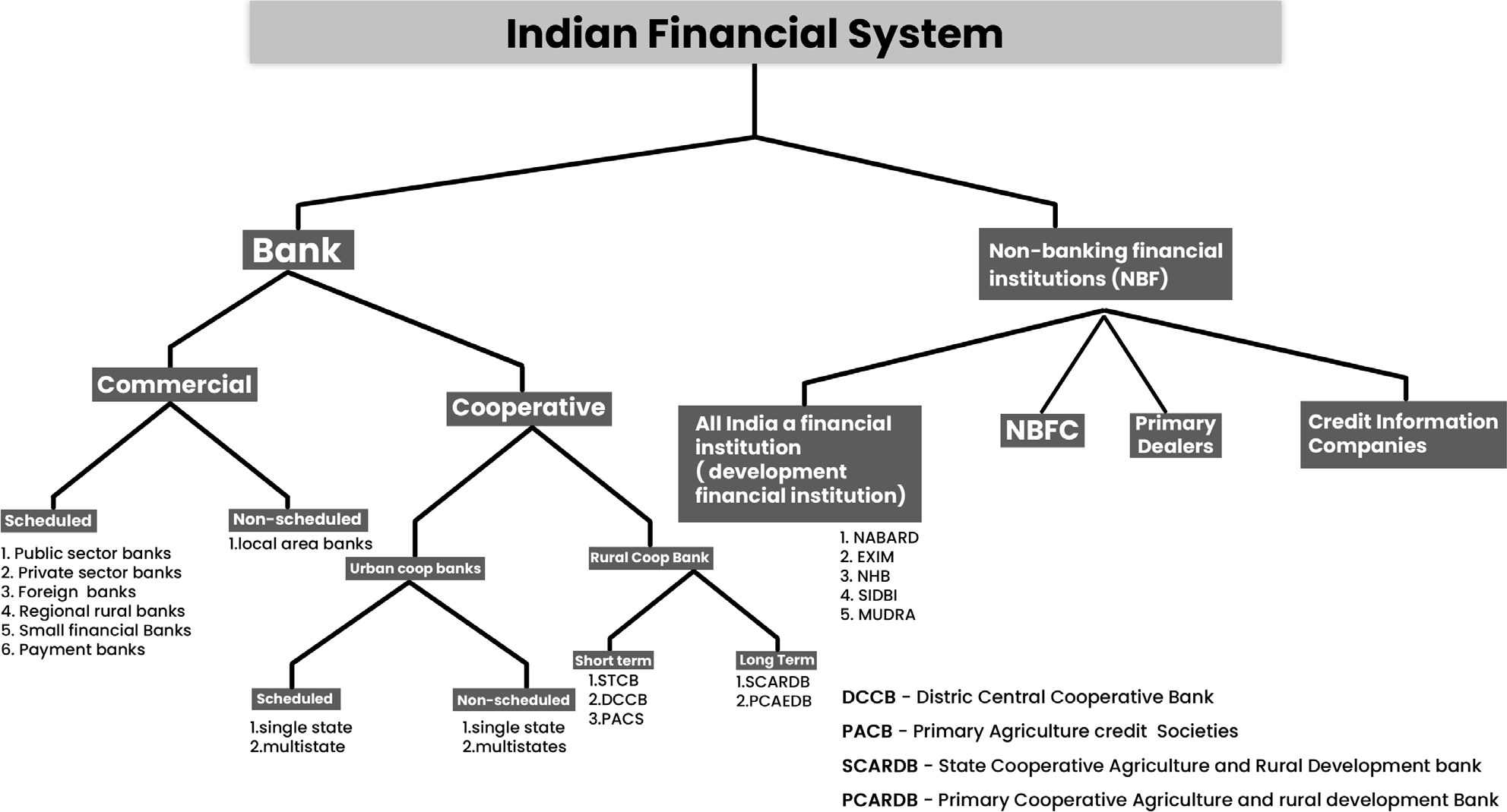
STRUCTURE OF BANKING SYSTEM IN INDIA
Commercial banks
• A commercial bank is a type of financial organization that offers its client’s services like overdraft protection, savings accounts, certificates of deposit, loans and so on. Lending money to individuals and collecting interest on such loans is how these institutions generate revenue.
• Acommercial bank offers a variety of loans, including loans for businesses, vehicles, homes, people, and education. These loans are provided by them using the funds that their clients put in various kinds of accounts. They use the deposits as their loan capital.
• A nation’s commercial banks are vital to its economy because they generate capital, credit, and market liquidity. These banks are often found in cities, although more and more of them are opening online these days.
• The Banking Regulation Act 1949 governs commercial banks. The categories for commercial banks are as follows:
Scheduled Commercial Banks
• The Reserve Bank of India Act, 1934’s Second Schedule lists the commercial banks that are considered scheduled.
• A bank must have raised funds and paid-up capital of at least Rs. 5 lakhs in order to be classified as a scheduled bank. With the RBI, they uphold a Cash Reserve Ratio (CRR). The RBI should be satisfied that their operations are not being carried out in a way that jeopardizes the interests of their depositors.
• In India, scheduled commercial banks are divided into five types based on who owns them and how they operate. The following bank groups are:
• State Bank of India
• Nationalised Banks
• Private Banks
• Foreign Banks
• Regional Rural Banks
State Bank of India
• The Bank of Calcutta was founded in 1806, and that is when the State Bank of India first emerged. It was the first British Indian joint-stock bank, supported by the Bengali government. Following in their footsteps, the Bank of Bombay and the Bank of Madras advanced
modern banking in India until joining forces to become the Imperial Bank of India in 1921. The Imperial Bank had a network of 172 branches and more than 200 sub- offices, with a capital base of INR 11.85 crores, deposits and advances of INR 275.14 crores and INR 72.94 crores, respectively.
• The All-India Rural Credit Survey Committee suggested in 1955 that the Imperial Bank of India be taken over in order to establish a state-sponsored and partnered bank. July 1, 1955, saw the founding of the State Bank of India. Subsequently, the State Bank of India was able to acquire eight previous State-associated banks as subsidiaries (later termed Associates) after the State Bank of India (Subsidiary Banks) Act of 1959 was approved.
Nationalised Banks
• The Reserve Bank of India (RBI) Act, which was passed in 1949, marked the start of bank nationalisation in India. As a result, the largest public sector bank, the State Bank of India was eventually nationalized in 1955, after the Imperial Bank of India. Fourteen significant commercial banks were nationalized in 1969, and six more were added in 1980, bringing the total to twenty. Wars with China and Pakistan, acute food shortages brought on by drought, decreased public investment, and sluggish economic growth in the 1960s and 1970s all contributed to the necessity for nationalization. Between 1951 and 1968, the proportion of credit that commercial banks disbursed to the industrial sector nearly doubled, while less than 2% of all credit went to farmers.
• On August 30, 2019, the Indian government made the merger announcement. Strengthening the banking industry and boosting shareholder value was the main goal of mergers. Due to their shared use of a CBS platform that would allow for quick gain realization, these banks were amalgamated.
• At present, there are 12 nationalized banks in India: Punjab National Bank (PNB), Bank of Baroda (BOB), Bank of India (BOI), and Central Bank of India, Canara Bank, Union Bank of India, Indian Overseas Bank (IOB), Punjab, and Sindh bank Indian Bank, UCO Bank, Bank of Maharashtra, State Bank of India (SBI).
Private Sector Banks
• In India, private individuals own and claim a larger percentage of the shares in private sector banks. In the beginning, the Indian financial system was controlled by public sector banks. But since 1990, technological advancements and modern technologies have made private sector banks the dominant force. Both Old Private Sector banks (established prior to 1968) and New Private Sector banks (established subsequent to the 1990s) can be used to describe these banks. Their sustained expansion and inventiveness serve as evidence of the significance of private sector banks within the Indian banking infrastructure.
Foreign Banks
• Private foreign banks are international banks that have branches and headquarters located in many nations. These banks must abide by the laws and guidelines set forth by their home and host nations.
• As of July 14, 2020, the Reserve Bank of India reports that there are 46 foreign banks operating in India. To meet the demands and specifications of its clients who are multinational corporations, these banks open a variety of bank branches. London-based Standard Chartered Bank is the biggest private foreign bank. There are 100 of its branches nationwide.
Regional Rural Banks
The Regional Rural Banks (RRBs) were established in 1975 under the provisions of an ordinance issued on September 26, 1975, and the Regional Rural Banks Act of 1976. RRBs are financial institutions that provide essential credit to agriculture and other rural sectors.
These banks blend the cooperative model, which is well- attuned to local rural challenges, with the professionalism and resource-mobilizing capabilities of commercial banks.
The equity of the Regional Rural Banks is held by the stakeholders in a fixed proportion. Regional rural banks are:
• 1. 50% owned by the federal government;
• 2. 35% by sponsor or scheduled banks; and
• 3. 15% by state governments.
• The Government of India’s notification area, which includes one or more State districts, is the only area in which Regional Rural Banks may operate. In the following heads, RRBs carry out a variety of tasks.
• Providing Banking services for rural and semi-urban areas;
• Performing government functions, such as paying MGNREGA employees’ salaries and distributing pensions, among other things.
• Providing para-banking services such as Internet and mobile banking, UPI, debit and credit cards, and lockers.
• After commercial and cooperative banks, the Regional Rural Banks, or RRBs, make up the third tier of the commercial banking system.
• In order to meet the demands of agricultural communities and other rural communities for rural credit, the Regional Rural Banks
• The RRBs’ primary goal is to support small and marginal farmers, agricultural laborers, and small artisans who play a crucial role in the growth of the rural economy by offering credit and other banking services.
• RRBs are a brand-new type of commercial bank that can only operate locally and are supported by banks with strong commercial positions.
Non-Scheduled Commercial Banks Local Area Banks
• Banks that are specifically designed to serve a limited area and conduct business there are known as local area banks.
• In India, Local Area Banks were established in 1996 as a union budget initiative to create small private banks for residents in underserved areas without access to banks.
• The Reserve Bank of India issues and oversees the regulations governing the licenses of these banks.
• A minimum paid-up capital of Rs.5 crores is needed for Local Area Banks, of which 25% is provided by the promoter group and the remaining amount by the general public.
Objectives of Local Area Banks
Financial Inclusion: For the people of that region where traditional banks are not established, LABs provide a formal financial structure. The aim of the organization is to provide individuals with the benefit of having their money preserved in a secure location for future usage. They facilitate financial inclusion by doing this.
Economic Development: LABs encourages the regional economy by lending to local small enterprises and making loans to them. They help established firms grow and offer financial support to aspiring business owners.
Savings Mobilisation: By encouraging people to save money for better times in the future, LAB fosters financial security.
Credit Disbursement: They make it easier for financing to flow to industries like agriculture, small businesses, and rural infrastructure that are essential to local growth.
Community Development: Community development projects are a common activity for LABs. Various initiatives have been implemented to assist the impoverished in accessing health care services, education, and other necessities.
Functions and Requirements of Local Area Banks
• They have the status of scheduled banks because they are qualified for financial inclusion in the RBI Act, 1934’s Second Schedule. Additionally, they can help their clients with financial transactions.
• They have to maintain their statutory liquidity ratio at 25%, their cash reserve ratio at 3%, and their minimum capital adequacy ratio at 15%.
• They have to provide the RBI with regular returns and reports, and they are accountable to the RBI for oversight and inspection.
• In order to give people a secure place to save their money, LABs mobilize deposits from the local community. Within their operational boundaries, they are permitted
to engage in all forms of banking activity, including receiving deposits, making loans, printing checks and drafts, and offering remittance services, among others.
• They provide credit to people, companies, and organizations in their business domain. This covers loans for homes, small companies, and agricultural endeavors. They must lend at least 40% of their net bank credit to the priority sector, with the weaker segments receiving at least 25% or 10% of this amount.
• Financial education seminars are a common activity for LABs in an effort to raise consumer financial literacy and encourage prudent financial practices.
• By addressing their financial needs and building trust, LABs actively participate in the local community through a variety of outreach projects.
Cooperative Banks
• Membership: Co-operative Societies or Individuals.
• Cooperative banks are owned and run by their members and function on the cooperative model. A village or other community’s financial needs are met by people banding together to pool resources and offer banking services including savings accounts, loans, and other financial services.
• Small financial institutions known as cooperative banks provide lending services to small businesses in both urban and non-urban areas.
• These are subject to both the Banking Laws Act of 1965
and the Banking Regulations Act of 1949, and are overseen and controlled by the Reserve Bank of India (RBI).
• The Co-Operative Banks have a huge significance for the small businesses as these have around 67% penetration in villages and account for 46% of the net funding for the rural businesses through support for processing, housing, warehousing, transport, dairy, etc.
• Businesses that meet specific eligibility criteria can become members by purchasing shares or making an initial deposit.
Features of Cooperative Banks
• The primary objective of the cooperative banking model is social benefit, which sets it apart from standard banking models.
• ‘One person, One Vote’: This is what Cooperative Banks follow. The organization’s management is within the purview of a selected Board of Directors.
• Profit Distribution: The main goal of cooperative banks, which are non-profit organizations, is to meet the financial needs of their members. Any excess the bank makes is either reinvested to increase the bank’s capital base or given as dividends to the members.
• Community Development: By encouraging financial literacy, helping out small businesses in the area, and funding community initiatives, they also significantly contribute to community development. They encourage their members to support one another and feel united.

State Cooperative Banks
• Definition: As the name implies, a state cooperative bank operates at the state level.
• Regulatory body: The Reserve Bank of India (RBI) and the corresponding state governments both regulate them.
• Segment served: Across the nation, they offer financial services to low-income and rural communities.
• Services offered:
• They frequently serve as the main source of financing for small enterprises, small-scale industries, and agriculture and related industries.
• These banks also offer banking services to agricultural, dairy, and credit union cooperatives, among other cooperatives.
• Source of capital: The state governments, deposits, funds, and borrowings from the RBI are the sources of SCB’s working capital.
Central Cooperative Banks (CCBs)
• Definition: Central Cooperative Banks (CCBs) are cooperative institutions founded and operated in accordance with the Cooperative Societies Act.
• Regulatory body: They are subject to Reserve Bank of India regulations and are overseen by the State Cooperative Department.
• Segment served: They offer financial services to those living in rural and semi-urban areas all around the nation.
• Services offered:
• They offer their members financial services like loans, deposits, and other services.
• They also support and provide funding for agricultural initiatives including input supply services and crop insurance.
• Source of capital: Most of the working capital collected by central cooperative banks comes from individual contributions, deposits, borrowings, and other sources.
Urban Cooperative Banks
• The urban cooperatives are growing into significant organizations due to the size of their operations and customers.
• The government revised the Banking Regulation Act in February 2020, granting the RBI additional authority to oversee UCBs.
• To make sure that UCBs are financially stable enough to carry out their duties, the Reserve Bank of India oversees and regulates them.
• There are regulations pertaining to UCBs that cover licensing, minimum net owned fund requirements, SLR, CRAR, and CRR maintenance, among other things.
What is an Urban Cooperative Bank?
• According to Section 56 of the Banking Regulation Act of 1949, a co-operative society that is not a primary agricultural credit society is referred to as a primary co- operative bank (also known as an Urban Co-operative Bank, or UCB).
• The transaction of banking business is the primary or principal business.
• Paid-up share capital with reserves that total at least one lakh rupees.
• The Banking Regulation (Amendment) Act, 2020: As was mentioned in the previous section, the RBI was only
able to impose prudential standards on UCBs. But the main problems that contributed to UCBs’ demise were poor governance and poor management. The amendment gave RBI significant administrative authority over UCBs. in order to address the problem of bad governance:
• The RBI may take precedence over the Cooperative Bank Board in light of state government consultations.
• RBI to rebuild the cooperative bank or combine it with another bank without putting a stop to it.
• Payments cannot be made to someone in exchange for giving up shares that a cooperative bank has issued.
• Cooperative banks cannot raise stock or issue unsecured debentures without first receiving RBI clearance.
The Banking Regulation (Amendment) Act, 2020
• In order to expand on certain of the provisions of the Banking Regulation Act, 1949 (the “BR Act”), the Banking Regulation (Amendment) Act, 2020 (the “BR Amendment Act”) was passed.
• Cooperative banks were exempt from some BR Act regulations, but thanks to the BR Amendment Act, those laws are now applied to them, bringing their regulation into compliance with that of commercial banks.
• Presently, the RBI has the authority to replace a co- operative bank’s board of directors and to use the “fit and proper” standard for appointing or dismissing a chairperson.
• Moreover, cooperative banks are allowed to raise share capital and other unsecured securities from the general public with previous RBI approval.
Highlights of Act
• The Banking Regulation Act of 1949 exempts cooperative banks from a number of its restrictions. Some of these regulations are applicable to them under the Act, therefore their regulation is comparable to that of commercial banks.
•
Subject to RBI approval in advance, cooperative banks may raise capital from the public in the form of equity or unsecured loans.
• The RBI has the authority to set requirements and standards for co-operative bank chairman employment. If a chairman does not meet the “fit and proper” requirements, RBI may dismiss them and appoint a replacement. In order to guarantee there are enough qualified members on the Board of Directors, it may give instructions to rebuild the group.
• A cooperative bank’s board of directors may be replaced by the RBI following discussions with the state government.
• Without imposing a moratorium, the Act permits RBI to restructure or combine a bank.
Key Issues and Analysis
• People with little resources can access financial services through cooperative banks. The poor performance of cooperative banks has been attributed, nevertheless, to the RBI’s lack of regulatory control comparable to that of commercial banks.
• The purpose of the Act is to expand RBI regulation of cooperatives banks with relation to capital, auditing, winding up, and management.
• Constitutionally, “incorporation, regulation and winding up” of co-operative organizations is in the State List, but “banking” is a Union List issue.
• The question is whether the Act falls under Parliament’s legislative purview because it regulates co-operative bank administration, audits, capital, and winding up, all of which are crucial to controlling banking activities.
• The Act gives cooperative banks the ability to issue equity shares to residents living in their service area as well as to members.
Development Banks SIDBI
• In 1988, the Indian Parliament passed a special Act to create SIDBI, or the Small Industries Development Bank of India, which became operational on April 2, 1990. The headquarter of SIDBI is located in Lucknow, Uttar Pradesh. It is one of the four key All-India Institutions, along with NABARD, EXIM, and NHB.
• The primary goal of SIDB is to build over 55% of MSMEs in the nation’s rural areas. To support the MSME sector, the Indian government established the R.S. Gujaral’s committee of financial exports in 2013. The Department of Industrial Policy and Promotion (DIPP) of the Government of India has deployed a module named “E-biz” under the National E-governance strategy in order to reduce human interaction in the MOU process.
Functions of SIDBI
SIDBI emerged as a single window operation to meet its financial and improvement needs as well as to make the MSME sector strong, vibrant, and globally competitive.
SIDBI helps financial institutions in lending to small-scale industries so that they have a healthy financial position and also provides non-financial assistance to business owners by helping them procure raw materials.
SIDBI engages commercial banks and other financial institutions to grant credit to small-scale industries and encourage credit by small independent company business units and also provide resource assistance to them.
SIDBI also provides venture capital assistance through Venture Capital Fund, and it also co-promotes state-level venture funds.
SIDBI helps in expanding business areas for small-scale industry sector products in domestic and international markets in partnership with commercial banks.
SIDBI also aims to enhance shareholder wealth through modern technologies and innovative ideas by providing a digital platform. It also provides services like factoring and leasing to domestic independent company business units in the small-scale sector.
SIDBI also provides an additionally timely flow of credit for working capital as well as term loans to small-scale enterprises in collaboration with commercial banks.
SIDBI takes initiatives for modernization and technological upgradation of existing industrial units to become future units that generate more wealth and employment.
SIDBI also acts as a nodal agency for various ministries of the Government of India:
• Ministry of MSME.
• Ministry of commerce and industry.
• Ministry of Textiles.
• Ministry of food processing industry.
Schemes offered by SIDBI in MSME Sector
• Direct Financing: which provides term loans in foreign currencies and working capital help.
• Indirect Finance: support by offering refinancing that includes banks.
• Micro Finance: which offers small-scale credit loans on immediate bases.
• STFS (SIDBI Trader Finance Scheme): The scheme provides wholesale retailers with at least three years of company management experience.
• SEF (SMILE equipment Finance): assists MSMEs in the purchase of new equipment.
• TULIP (Top-Up Loan for Immediate Purpose): This loan will provide within 7 days.
•
SPEED: Financing for Equipment Purchase for Business Development
• Loans under a partnership with OEM (Original Equipment Manufacturer).
• Working Capital Cash Credit Scheme: which provides instant loans.
National Bank for Agriculture and Rural Development [NABARD]
• NABARD, India’s leading development bank, was established in 1982 through an Act of Parliament with the goal of fostering sustainable and inclusive agriculture and rural development. Over its more than four-decade journey, this premier financial institution has significantly improved lives in rural India by providing agri-finance, supporting infrastructure development, advancing banking technology, and promoting microfinance and rural entrepreneurship through Self-Help Groups (SHGs) and Joint Liability Groups (JLGs). NABARD continues to contribute to nation-building by driving financial and non-financial initiatives, fostering innovation, and supporting institutional development in rural areas.
Functions of NABARD
• It essentially carries out three different types of tasks, such as body, credit, and improvement capacities. In order to fulfill its primary objective, the National Agricultural and Rural Development Bank fulfills four key roles. Credit, money, checking, and growth are these four essential functions. To determine the status of each of the four NABARD components, but in doing so, we prefer to look at them individually.
• Credit Function: The National Agricultural and Rural Development Bank (NABARD) handles credit work because it is the primary provider of credit lines in rural areas. Among those responsibilities include the creation, management, and screening of credit streams in the rural areas of the nation.
• Monetary Functions: A few consumer banks and charities that promote near improvement initiatives are part of NABARD. The National Agricultural and Rural Development Bank, or NABARD, can establish plants, food parks, handling units, craftsmen, and other unique organizations, as well as lend money to consumer banks, provided it meets its financial standards.
• Oversight operates: As mentioned above, NABARD is the primary organization in charge of overseeing gardening and provincial exchange programs. It is therefore the responsibility of this organization to monitor and oversee all tasks and activities related to improvement.
EXIM Bank
• The Government of India founded the Export- Import Bank of India, or EXIM Bank, as a specialized
financial organization in 1982. Its main goal is to help Indian exporters and importers by offering financial support and other support services, hence facilitating international commerce and investment. Via its array of financial and promotional initiatives, EXIM Bank is instrumental in driving India’s economic expansion and exports.
Schemes of Financial Assistance by EXIM Bank
To support Indian companies involved in foreign investment and trade, the Export-Import Bank of India (EXIM Bank) provides a range of financial assistance programmes. These programs are intended to stimulate foreign investment, streamline imports, and boost exports. The following are some of the main financial aid programs offered by EXIM Bank:
Export Credit: Indian enterprises can finance their export activity with export credit provided by EXIM Bank. Pre-shipment credit, which finances the production of export goods, and post-shipment credit, which finances working capital requirements following shipment, are two examples of the several forms that export credit is provided. In addition to helping exporters manage cash flow, these credit facilities enable them to fulfill export orders.
Buyer’s Credit: Purchasers of Indian goods and services from abroad can apply for buyer’s credit from EXIM Bank. Foreign importers are granted credit, which allows them to buy Indian goods and services on installment plans. In order to source from Indian exporters, it encourages purchasers from other countries.
Lines of Credit (LOCs): To assist with initiatives involving the import of Indian goods and services, EXIM Bank extends credit lines to foreign governments, financial institutions, and other organizations. LOCs facilitate economic cooperation and bilateral trade between India and other nations. Usually, they are employed in transportation, power generating and building projects that include the development of infrastructure.
• Export Finance: To accommodate exporters’ unique demands, EXIM Bank provides a range of export credit programs. Export production finance, export credit insurance, and export bill discounting are a few examples of these programs. Export financing aids in the management of exporters’ cash flow and the reduction of trade-related risks.
• Overseas Investment Finance: Through its programs for financing foreign investments, EXIM Bank assists Indian businesses wishing to invest abroad. It offers financial support for establishing overseas joint ventures, subsidiaries, or acquisitions. This facilitates the expansion of Indian companies’ worldwide reach and opens up new markets.
• Export Marketing Services: Exporters in India can
get help from EXIM Bank with market research, market entrance tactics, and export possibilities identification. Exporters can flourish in foreign markets and make well-informed judgments with the aid of these services.
• Technology and Innovation Promotion: For the purpose of innovation, R&D and technology advancement, EXIM Bank offers financial support to Indian businesses. This aids companies in becoming more competitive in international marketplaces.
• Export Development Fund: A program for financial assistance that promotes exports, trade-related research, and capacity-building is the Export Development Fund (EDF). The EDF wants to make India’s export ecosystem stronger.
IFCI
• IFCI is a non-banking financial company operating in the public sector, presently listed on the NSE and BSE. It offers financial support for the growth of India’s industry. These activities are aligned to projects in the airport, road, power, telecom, real estate, and manufacturing sectors.
• In addition, IFCI is a nodal organization that promotes entrepreneurship among the less advantaged groups in society.
• In this sense, banks are protected by IFCI against loans made to young entrepreneurs who are members of Scheduled Castes.
• The main goal of IFCI is to fund public limited firms and cooperative organizations over the medium and long terms. The IFCI’s authorized share capital has been increased to Rs. 20 crores.
• The only businesses that the IFCI is permitted to provide long and medium-term financing to those, involved in manufacturing, mining, shipping and the production and distribution of electricity.
National Housing Bank
Background of National Housing Bank
In its 7th Five-Year Plan (1985–1990), the Indian government noted that individual households have limited access to long- term financing. Therefore, it was suggested that national institutions be established in order to close any gaps in the long-term funding of the housing sector. The National Housing Bank, or NHB, was then established based on the suggestions made by the Committee of Secretaries, which was presided over by Dr. C. Rangarajan.
About the National Housing Bank
• The National Housing Policy of 1988 proposed the creation of NHB as the top institution for housing. As a result, NHB was set up on July 9, 1988, under the National Housing Bank Act of 1987. The RBI provided all of the bank's paid-up capital.
Neo Banks
• Neo Banks Meaning: These are digitally operated financial institutions that strictly operate online.
• They do not have any physical branches; instead, they provide all standard bank services through a smartphone app or digital setup.
• These digital banks provide instantaneous money transfers, loans, payments, and other financial services to meet the needs of the tech-savvy generation.
• The important thing to keep in mind is that these neo banks depend on their banking partners who provide financial services and products, and they could not even have a banking license.
• These banks are all digital. They also are unable to seek for a banking license because the RBI does not permit 100 percent digital banking operations. These so-called “neo banks” are skilled at using artificial intelligence and technology to provide clients with tailored financial services. For a low price, it is provided.
How are Neo Banks Different from Digital Banks?
• Digital banks are frequently found operating as online divisions of well-known financial and banking organizations. They might have a few physical branches and be supported by bigger financial organizations. They might possess several physical branches and be supported by more established financial institutions.
• Conversely, no physical branches exist for neo banks; they only conduct business online.
How are Neo Banks Different from Payments Banks?
• Payments banks are governed by the RBI and offer all banking services to clients with the exception of lending and credit card issuance. Because of this, banks accepting payments are essentially free from credit risk.
• However, because they provide lending services in addition to credit cards, neo banks are more vulnerable to credit-related risk.
MUDRA Bank
• The government-owned Micro Units Growth and Refinance Agency Ltd. (MUDRA) is a financial organization devoted to the growth and refinancing of microenterprises.
• MUDRA Ltd. is a non-banking finance company that was established as a subsidiary of SIDBI in anticipation of the enactment of an act establishing MUDRA Bank.
• MUDRA’s aims to finance small businesses in both rural and urban areas that are not corporate (informal sector) and have financing needs up to Rs 10 lakhs. Examples of these businesses include small manufacturing units and shopkeepers.
The responsibility for refinancing all last mile financiers, which include Micro Financial Institutions, Non-Banking Finance Companies, Societies, Trusts, Companies, Co- operative Societies, Small Banks, Scheduled Commercial Banks, and Regional Rural Banks, would fall under MUDRA’s purview. These lenders provide loans to micro and small businesses involved in trading, manufacturing, and services.
Pradhan Mantri Mudra Yojana (PMMY)
• The flagship program of the Indian government is the Pradhan Mantri Mudra Yojana (PMMY). The program enables income-generating micro firms operating in the non-farm manufacturing, processing, trading, or service sectors to get microcredit or loans up to Rs. 10 lakhs.
• MUDRA assists financial intermediaries in providing loans to micro and small businesses that generate income but are not part of the corporate or agricultural sectors.
• Micro and small entities include millions of sole proprietorships and partnerships that run small businesses in both rural and urban areas. These businesses include small manufacturers, retailers, fruit and vegetable vendors, truck drivers, food service operators, repair shops, machine operators, small industries, artisans, and food processors.
• Only banks and lending institutions, such as the following, are eligible to offer loans under the MUDRA system.
• Public Sector Banks
• Private Sector Banks
• State operated cooperative banks
• Rural banks from regional sector
• Institutions offering micro finance
• Financial companies other than banks
Non-Banking Financial Company (NBFC)
• A Non-Banking Financial Company (NBFC) is a company that is registered under the Companies Act, 1956 and is involved in the following business activities: lending and advances; purchasing shares, stocks, bonds, debentures, securities issued by the government or local authority; leasing; hire-purchase; insurance; and chit business. However, an NBFC does not include any institution whose primary business is engaged in industrial activity, agriculture, the purchase or sale of any goods (other than securities); selling, buying, or building of real estate; or the rendering of any services.
• The Reserve Bank of India and the Ministry of Corporate Affairs both oversee the NBFCs’ operations.
• A non-banking financial company (also known as a residuary non-banking company) is a company whose primary business is to receive deposits under any scheme or arrangement, either all at once as a single amount, gradually through contributions, or in any other manner.
What is difference between banks & NBFCs?
• NBFCs operate similarly to banks in that they lend and invest, but there are a few key distinctions, which are listed below:
• NBFCs are not able to accept demand deposits.
• Because they are not a member of the payment and settlement system, NBFCs can’t issue cheques payable to themselves.
• Furthermore, depositors of NBFCs are not qualified for the Deposit Insurance and Credit Guarantee Corporation’s deposit insurance program, in contrast to bank depositors.
• Under minimum capitalization standards, 100% FDI is allowed in NBFCs through the automatic method, specifically in 18 activities.
Different Types of NBFCs
• The following are the many kinds of Non-Banking Financial Corporations, or NBFCs:
• On the nature of their activity
• Asset Finance Company (AFC): Financing of tangible goods, such as cars, tractors, and generators that support economic or productive activities.
• Investment Company (IC): Acquiring securities with the purpose of re-selling.
• Loan Company (LC): Provides finance by extending loans or for any activity than its own. But an asset finance company is not included in this.
• Infrastructure Finance Company (NBFC-IFC): Provides loans for projects linked to infrastructure.
• Infrastructure Debt Fund (NBFC-IDF): Facilitates the flow of long-term debt into projects that deal with infrastructure.
• Systemically Important Core Investment Company (CIC-ND-SI): Obtains securities and shares principally for the purchase of equity shares.
• Micro Finance Institution (NBFC-MFI): Extends credit to the economically disadvantaged groups. Furthermore, they extend assistance to MSMEs, or micro, small, and medium-sized enterprises.
• NBFC Non-Operative Financial Holding Company (NOFHC): enables promoters or organizations to establish a new bank.
•
Factor (NBFC-Factor): Specializes in the acquisition of assignor receivables or the repurchase of debts secured by receivables at a discount.
• Mortgage Guarantee Company (MGC): Engages in mortgage-related activities.
• Account Aggregator (NBFC-AA): Collects and offers information on a customer’s financial assets in a consolidated, organised and retrievable method to the customer or others as required by the customer.
• NBFC Peer to Peer Lending Platform (NBFC-P2P): Provides an online platform in order to bring lenders and borrowers together onto a single space to help mobilise unsecured finance.
• On the basis of deposits:
• Deposit accepting Non-Banking Financial Corporations
• Non-deposit accepting Non-Banking Financial Corporations
Liquidity Trap
• A liquidity trap is an adverse economic scenario that can happen even when interest rates are low, as investors and consumers store cash instead of using it for investments or spending, impeding the ability of policymakers to promote economic growth.
• The phrase “liquidity trap” was coined by economist John Maynard Keynes, who described it as a situation in which interest rates drop to the point where most individuals would rather hold onto their cash than invest it in bonds and other debt instruments. As a result, Keynes claimed, monetary officials are unable to further reduce interest rates or expand the money supply in order to promote growth.
• Banks struggle to find qualified borrowers for loans, which is a prominent issue in a liquidity trap. This is exacerbated by the fact that there isn’t much space for extra incentives to draw in well-qualified applicants given that interest rates are already so close to zero.
Signs of a Liquidity Trap
• Low interest rates are one indicator of a liquidity trap. Low interest rates have an impact on bondholder behavior, particularly when combined with worries about the country’s present financial situation. The sale of bonds at a price that is detrimental to the economy is the ultimate outcome.
• A liquidity trap is not defined by low interest rates alone. In addition, there must be a dearth of bondholders who want to hold onto their bonds and a restricted number of buyers in order for the scenario to be considered. Rather, investors are giving strict cash savings a higher priority than buying bonds.
• A situation does not qualify as a liquidity trap if investors are still interested in holding or buying bonds during periods when interest rates are low, even close to zero percent.
Characteristics of a Liquidity Trap
• A liquidity trap arises when businesses, investors, and consumers decide to hoard cash, which makes the economy as a whole resistant to measures taken by policymakers to promote economic activity.
• The essential features of a liquidity trap are as follows:
• Very low interest rates (at or close to 0%)
• Economic recession
• High personal savings levels
• Low inflation or deflation
• Ineffective expansionary monetary policy
Why liquidity traps occur on deflation
When prices decline and money’s purchasing power rises, this is known as deflation. When individuals decide to save their money rather than use it for investments or purchases because they think prices will keep dropping, deflation may begin. In severe circumstances, a deflationary spiral may occur in which falling prices prompt reductions in demand, production, and wages, all of which further lower prices. In this kind of feedback.
Balance Sheet Recession
• An economic downturn known as a “balance sheet recession” is mostly the result of businesses and individuals opting to settle their debts rather than increase their spending or borrowing. This happens when the amount of outstanding debt increases to the point where lenders and borrowers are worried that the loan might not be repaid in full. Debt repayment takes precedence over new loans and investment, even as interest rates decline.
Low Demand from Investors
• Companies issue stock and bonds to raise money. Lower interest rates won’t make a difference if there isn’t much demand from investors to invest in them. Furthermore, because they see the investment as dangerous during a recessionary period of generally low demand, both the companies and investors may decide to delay taking any action.
Reluctance to Lend
• If banks consider much of the credit market to be high- risk, they may become unwilling to lend. Many people and businesses found it challenging to get loans, even at extremely low interest rates, because banks tightened their underwriting standards and turned away all but the best candidates.
Curing the Liquidity Trap
• There are several methods for escaping a liquidity trap. While none of these might be completely effective on their own, they might push people to start investing and spending money rather than saving it.
• A rate increases: The Banks can raise interest rates, which may lead people to invest more of their money, rather than hoard it. Yet, this is a highly risky course of action when there is low inflation and a recession.
• A (big) drop in prices: When there are genuine deals available, individuals find it impossible to resist spending money. The allure of reduced costs grows too strong, and the savings are utilized to benefit from those reduced costs.
• An increase in government spending: Government initiatives can stimulate expenditure and employment creation when businesses pull back.
• Quantitative easing (QE): The central bank can start purchasing longer-dated government bonds along with other securities like mortgage bonds in order to artificially decrease interest rates below zero and promote expenditure in the economy.
• Negative interest rate policy (NIRP): Following the global financial crisis of 2008, Europe and Japan employed this remarkable weapon of monetary policy. Negative interest rates, which credit interest to borrowers and subtract interest from them, are imposed when nominal interest rates fall below zero.
Steps which is taken by the Reserve Bank of India are the followings
• The RBI introduced Partial Credit Enhancement (PEC) for bonds on November 2, 2018, with a minimum three-year occupancy duration. During the liquidity crisis, these were issued by NBFCs with systemically important non- deposit takings.
• RBI reduced regulations on selling or securitizing the loan books in order to lessen the burden on NBFCs. Consequently, after holding loans for six months, NBFCs are able to securitize loans with maturities longer than five years.
• For more operational flexibility, several NBFC types were consolidated into a smaller number of them. AFC- Investment and Credit Company (NBFC-ICC) was the new category created by the merger of AFC, LCs, and ICs.
Why did IL&FS default?
• The issue facing IL (Infrastructure Leasing) and FS (Financial Services) stemmed from its practice of obtaining short-term loans via commercial papers (CP) and certificates of deposits (CDs) for funding infrastructure projects, which can have protracted and unpredictable gestation periods.
• It made these lenders more susceptible to asset-liability mismatches (ALMs; these lenders have both long- and short-term assets).
• Following the demonetization in 2016, a shortage of cash caused liquidity to deteriorate for a few months, which delayed loan recoveries. When IL&FS failed, the system was just beginning to recover from the consequences of demonetization.
Measures by RBI
• After the IL&FS crisis, RBI monitored NBFCs more closely. In order to reduce industry stress, it loosened lending standards and exposure limitations and increased oversight based on NBFC size and payment patterns.
• The RBI suggested a liquidity coverage ratio for large NBFCs, however it is only currently in effect for banks.
Recent Steps
• Re-Classification of Non-Banking Financial Companies Sustaining the various categories of NBFC such as NBFC- Infrastructure Investment Company, Core Investment Company, Microfinance Institution, Systemically Important/ Non-Systemically Important, Deposit taking/ non-deposit taking etc. the re-classification of NBFCs in to three levels is done to make certain provisions universal.
• Layer Based Classification into four layers – Base Layer, Middle Layer, Upper Layer, and Top Layer
• Classification based on Asset Dimensions and Perceived Risk Factor
• Various activities carried out by NBFCs are taken into account while classifying.
• Enhanced Governance –The RBI has adjusted and standardized the governance framework, which will be applied layer by layer, to address the demand for time.
• The governance across several layers will differ and rely on NBFCs satisfying thresholds.
• Added Disclosure Specifications are provided for the Middle and Upper Layer NBFCs.
• Constitution of Internal Committees and Assessments
• Internal Capital Adequacy Assessment Process – Under the Master Circular - Basel III Capital Regulations, NBFCs must evaluate their capital in proportion to business risk, just as commercial banks do.
•
Similar to Commercial Banks
• Sufficient capital to sustain all business risks for NBFC
• Develop and use better Internal Risk Management Techniques
• Core Financial Service Solution
• Akin to Core Banking Solution adopted by Banks
• With ten or more Fixed Point Service Delivery Units, the Solution is required to be adopted by the NBFC Middle Layer and Upper Layer.
• Quarterly reports to RBI regarding the Solution’s implementation are required.
• For Seamless customer interface in digital offerings and transactions.
Shadow Banking
• In the financial system, “credit intermediation involving entities and activities remains outside the regular banking system” is referred to as “shadow banking.”
• The term “shadow banking” refers to bank-like operations (mostly lending) that happen outside of the established banking industry. These days, market- based finance or non-bank financial intermediation are the terms that are frequently used to describe it globally.
• The purpose of shadow bank financing is comparable to that of regular bank lending. It is not, however, subject to the same regulations as conventional bank lending.
A significant contributing factor to the rise in housing lending in the period leading up to the 2008 financial crisis was the shadow banking system.
Primary Dealers (PDs)
The Reserve Bank of India established the Primary Dealers (PDs) system in the Government Securities Market in 1995 with the goal of fortifying the Government Securities market infrastructure and establishing a more effective secondary market trading mechanism. This was done to promote large- scale government securities holding and increase market vigor and liquidity. The RBI offered banks the opportunity to handle Primary Dealership business departmentally in 2006–07. Subsequently only Primary Dealers, not the RBI, are permitted to underwrite primary issues of government securities the RBI has subsequently relinquished this role the Government of India refers to Primary Dealers as Merchant Bankers.
Differentiated Banking
• Differentiated banks are licensed by the Reserve Bank of India (RBI) to provide specific banking services and
products, distinct from universal banks. The primary objective of these banks is to promote financial inclusion and payments. In 2014, the Nachiket Mor Committee proposed the concept of differentiated banks to further inclusion. The RBI introduced this approach in 2014 with the introduction of small finance and payments banks.
• India offers diverse opportunities in the banking sector, which can be utilized by niche banking to facilitate specialization and optimize resource use. Each niche can be individually large, sustaining significant balance sheets, and specialized entities can play a major role in all. As the banking sector evolves, some banks and non-bank financial companies may choose to operate as specialized niche banks to derive advantages such as lower capital requirements, lower fund costs, and specialization.
Small Finance Banks (SFBs)
• The RBI has granted licenses to Small Finance Banks (SFBs), which are specialized banks that offer low-income people and underprivileged communities financial services and products. These include microfinance and micro-enterprise services, along with other fundamental banking services.
• SFBs are governed by the RBI Act of 1934, the Banking Regulations Act of 1949, and other pertinent statutes and directives from time to time. They are registered as public limited companies under the Companies Act of 2013.
• The establishment of small finance banks aims to increase financial inclusion by
• To give financial inclusion to certain population segments who are frequently left out of the standard banking system. This is one of the goals of the establishment of small finance banks.
• Small loans, savings accounts, insurance and other fundamental banking services are among the financial goods that SFBs assist individuals in obtaining.
• Scope of SFBs: The primary focus of small finance banks is required to be on fundamental banking operations, such as deposit acceptance and lending to underserved and unserved sectors, such as small businesses, marginal farmers, micro and small industries, and unorganized sector organizations, without any limitations.
• The Nachiket Mor Committee on Financial Inclusion recommended SFBs.
• The RBI released the SFBS guidelines in 2014. RBI’s recommendations for SFBs in India are:
• SFBs are granted the scheduled bank status after being operational and are deemed suitable under section 42 of the RBI Act,1934.
• SFBs are required to primarily focus on providing access to financial services to the unbanked and underbanked segments of the population.
•
They are required to maintain a minimum Capital to Risk-Weighted Assets Ratio (CRAR) of 15%.
• They are required to extend 75% of their Adjusted Net Bank Credit to Priority Sector Lending.
• SFBs are required to open at least 25% of their total branches in unbanked rural areas.
• For small finance banks, the minimum paid-up voting equity capital is Rs. 200 crore.
• SFBs are required to maintain at least 50% of their loan portfolio as microfinance and advances of up to Rs. 25,00,000.
• SFBs are required to comply with various prudential norms and regulations related to income recognition, asset classification and provisioning.
• SFBs are encouraged to adopt technology to improve their operational efficiency and reach the target segments.
Payment Banks
• Payment Bank was established to conduct business on a smaller scale with less credit risk, in accordance with the recommendations made by the Nachiket Mor Committee. A payments bank functions similarly to any other bank, however without the credit risk and on a smaller scale. Put simply, it can do the majority of banking functions but not credit card or loan issuance. The main objective is to promote financial inclusion through providing banking and financial services to underbanked and unbanked populations, including low-income households, small businesses and migrant workers among others.
• They are regulated by numerous laws, including the Payment and Settlement Systems Act of 2007, the RBI Act of 1934, the Foreign Exchange Management Act of 1999, and the Banking Regulation Act of 1949, but they are registered under the Companies Act of 2013.
• Paytm Payment Bank, Fino, India Post Payment Bank, Jio Payment Bank, Airtel Payment Bank and NSDL Payment Bank are the six payment banks that exist in India at this time.
Features of Payment Banks
• For the first five years after the Payment Bank’s founding, the promoter shall initially contribute a minimum of 40% of the paid-up equity capital.
• A minimum paid-up capital of Rs. 100 crore, is required.
• Payment banks are able to receive deposits of up to Rs. 20 lakh. Current and savings accounts are acceptable forms of demand deposits.
• Deposit funds are limited to investments in safe government securities only in the form of Statutory Liquidity Ratio (SLR). The balance of the demand
deposit must be 75% of this. A time deposit should be made with another scheduled commercial bank for the remaining 25%.
• Payments banks will be permitted to make personal payments and receive cross border remittances on the current accounts.
• It can issue debit cards.
Payment Banks Are not allowed to perform certain activities:
• Payment banks receive a ‘differentiated’ bank license from the RBI and hence cannot lend.
• Payment banks cannot issue credit cards.
• It cannot accept time deposits or NRI deposits.
• It cannot issue loans.
• It’s not allowed to establish subsidiaries for non-banking financial activities.
Difference Between Payments Bank and Small Finance Bank
The following are some significant differences between India’s Payments Banks and Small Financing Banks:
FinTech
• Fintech, a combination of the terms “financial” and “technology,” is the application of new technological advancements to products and services in the financial industry.
• The phrase refers to a rapidly growing industry that offers numerous services to meet the needs of both businesses and consumers. Fintech offers a seemingly limitless range of uses, from cryptocurrencies and investment apps to mobile banking and insurance.
• FinTech, an inventive invention of the 21st century, facilitates financial transactions for businesses and individuals by delivering financial products and services digitally.
• FinTech now assists financial companies in reaching a wide number of customers digitally and offers them quick, simple and safe transactions.
Evolution of FinTech
• 1887- 1950 is an era when we started with technologies such as telegraph, railroads and steamships that permitted for the first-time rapid transmission of financial information across borders.
• The 1950s introduced credit cards, the 1960s introduced ATMs, the 1970s brought computerized stock trading, and the 1980s saw the emergence of bank mainframe computers along with increasingly advanced data and record-keeping systems. The Internet and the e-commerce industry flourished in the 1990s.
•
In the twenty-first century, we use a plethora of financial technology services, such as cryptocurrency, Robo- advisors, mobile wallets, payment applications, equity crowdfunding, and much more, which entirely replaces banking services rather than improving them.
Bali Fintech Agenda
• The World Bank Group and the International Monetary Fund introduced the Bali Fintech Agenda, a collection of 12 policy components designed to assist member of nations in managing the risks associated with the fast advancements in financial technology while simultaneously assisting in capitalizing on the opportunities and advantages that these advancements offer in the banking services sector.
• The Agenda proposes a framework of high-level issues that countries should consider in their own domestic policy discussions and aims to guide staff from the two institutions in their own work and dialogue with national authorities.
• The Agenda will help guide the attention of IMF and World Bank staff members on fintech issues within the purview of their expertise and mandate, inform their discussions with national authorities, and help shape their contributions to the work of relevant international organizations and standard-setting bodies on fintech issues.
FinTech Categories Ranked by Adoption Rate

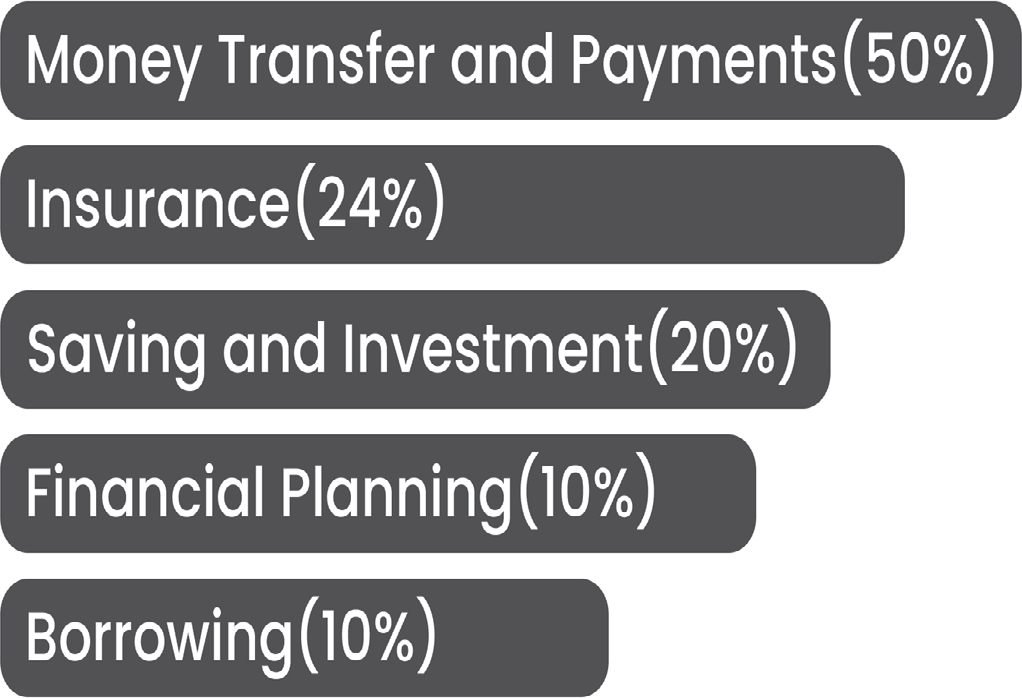
Current Scenario of the FinTech Industry
• Over the previous five years, more than $9 billion has been invested in digital lending, and an EY estimate predicts that the market will be worth $515 billion by 2030.
• Aside from that, 2022 witnessed an increase in cross border trade, which aided local payment systems in gaining popularity and general recognition outside of the country.

• According to the National Investment Promotion and Facilitation Agency (NIPFA), India has the highest finTech adoption rate globally at 87 percent, which is significantly higher than the global average rate of 64 percent.
• It’s not surprise, considering the circumstances, that a number of international finTech companies are looking to establish themselves in India as a result of the boom, and as a result, it’s expected that these companies will only get bigger in the future.
Factors of Growth of FinTech in India
Regulatory support: With initiatives like the Digital India project and the Unified Payment Interface (UPI) fostering digital payments and financial inclusion, the Indian government has been encouraging fintech innovation. With programs like the regulatory sandbox, which enables fintech to test their products in a controlled setting, the Reserve Bank of India (RBI) has also taken the initiative to create a favorable regulatory climate for the fintech industry.
Innovation and technology: Artificial intelligence (AI), machine learning (ML), blockchain, and other cutting- edge technologies are being used by fintech companies in India to disrupt established financial services and develop new business models. In order to provide loans to individuals and SMEs that might not have access to traditional banking services, digital lending platforms, for example, use AI and ML to evaluate creditworthiness.
Partnerships and collaborations: To increase their market share and provide fresh goods and services, fintech companies in India are collaborating with established financial institutions. Paytm and ICICI Bank have teamed to provide digital credit to their consumers, whereas PhonePe and Bajaj Finserv have joined to offer instant personal loans.
Financial inclusion: In India, fintech is essential to the advancement of financial inclusion, especially in rural areas where traditional banking services are scarce. Fintechs are assisting in closing the gap between the
unbanked and the established financial system by providing underprivileged populations with digital payment options, microlending, and other financial services.
E-commerce growth: The expansion of online shopping in India has given fintech a big chance to provide payment options and other financial services to consumers. E-commerce platforms like Amazon, Flipkart, and Myntra offer a seamless payment experience for customers buying through companies like Paytm, PhonePe, and Razorpay.
Wealth management: There’s an increasing need for wealth management services in India as the middle class grows. Fintech companies are addressing the needs of this growing industry by providing robo-advisory services, digital investing platforms, and other wealth management solutions.
Cybersecurity: Cybersecurity has emerged as a major problem as India’s financial industry witnessed the rapid growth. To safeguard the confidentiality of the information that belongs to their clients, fintech companies are investing in cutting-edge security solutions like biometric authentication, encryption, and fraud detection.
Government Initiatives Driving Fintech
• Jan Dhan Yojna
• On August 15, 2014, Prime Minister Narendra Modi unveiled the Pradhan Mantri Jan Dhan Yojana (PMJDY), a financial inclusion program for Indian nationals. Its goal is to increase the number of people who can afford financial services like bank accounts, remittances, credit, insurance, and pensions.
• Many people have benefited from the project; as of January 27, 2021, 41.75 crore accounts had been opened under PMJDY, of which 35.96 crore were active.
• Digital India
• The goal of the Digital India program was to provide all Indian residents with electronic access to government services.
• The initiative’s goals were to introduce several online services to enable greater reach and accessibility, such as the Accessible India Campaign, BHIM (Bharat Interface For Money), E-Panchayat, E-Hospital, etc., and to develop a stable and secure digital infrastructure through AADHAR, Digital Sakasharta Abhiyaan, DigiLocker, etc.
• Unified Payments Interface (UPI)
• One of the greatest achievements of the Indian payment system is UPI, which is becoming more and more popular. In under five years, UPI was able to secure a 73% market share of the total volume of digital transactions.
• The expansion of UPI has prompted a number of private companies to offer digital payment options that are radically changing the Indian economy. In June 2021 alone, Indians transacted 2.8 billion, or 280 crore, valued Rs 5,47,373 crore. This represents an increase in volume of 10.6% and an increase in value of 11.56% over May.
• Trade Receivable Discounting System (TReDS)
• In 2017, the Reserve Bank of India (RBI) launched The Trade Receivable Discounting System (TReDS), an online bill-discounting platform, in an effort to increase liquidity for small firms. Cash-strapped MSMEs can raise money using TReDS by selling corporate trade receivables.
• Corporates and MSMEs adopted TReDS at an increased rate during the COVID-19 pendemic.
• Regulatory and Policy Support
• Through innovative distribution models and regulatory sandboxes, Indian regulators have encouraged fintech innovation, and it is anticipated that they will persist in supporting the digital agenda. Innovation will be further stimulated by recently announced projects including the Open Credit Enablement Network, Public Credit Registry, GeM- SAHAY, and Regulatory Sandbox framework.
• The government’s core infrastructures, including
online identity verification, online payments, and safe online sharing of financial data through account aggregator systems, along with the introduction of new finance products that prioritize digitalization, have made the Fintech industry exceptionally effective.
• Banking Laws (Amendment) Act, 2025
• It includes multiple banking reforms to improve the audit quality and transparency of the Banks. Now depositor can manage the designate nominees as per his wish. Unclaimed funds of the depositors will now be managed under Investor Education and Protection Fund. Threshold limit now increased upto 2 crore.
Challenges in the Indian Fintech Industry
• Regulatory and Compliance Laws
• The government has imposed stringent regulatory
and compliance requirements to control the services provided by fintech companies in an effort to ensure the safety of the fintech ecosystem.
• Even if some of these rules are necessary, they unavoidably cause the fintech companies in the Indian financial markets to slow pace.
• No Bank Account
• India is a large country with a wide range of educational and socioeconomic backgrounds, therefore a sizable portion of the populace is still unbanked. Even yet, a lot of consumers choose in- person transactions over those conducted online.
• Cash-Driven Economy
• Since India has always been a cash-based economy, people have a cautious attitude regarding digital payments. Furthermore, because so many individuals lack access to banking and education, they frequently associate digital transactions with online fraud.
• Furthermore, a number of people are unable to recognize the convenience that fintechs provide through their inventive goods and services because they lack financial literacy.
• Cyberfrauds
• Due to its rapid growth, the fintech industry is vulnerable to numerous cyberfrauds and thefts. These cybersecurity problems can cause fintech companies to lose a significant amount of money while conducting online transactions since they handle sensitive client data.
Digital Banking
• According to the Reserve Bank of India (RBI), digital banking refers to the electronic banking services that a licensed bank offers now and in the future for the execution of financial, banking, and other transactions.
• It also includes the use of electronic devices or equipment for the execution of financial transactions through websites, mobile apps, and other digital channels that involve a high degree of process automation and cross-institutional service capabilities under improved technical architecture and unique business strategies.
Growth of Digital Banking in India
• In India, Covid-19 has effectively created a new angle for digital banking in the future. During that time, digital adoption in India took off like a rocket. The micro-level shift was facilitated by the introduction of new digital participation from other financial firms. Indians are the most open to adopting new digital payment methods in Asia Pacific, according to a global Mastercard survey.
• The research paper by Boston Consulting Group (BCG) also notes that favorable underlying customer demographics, mature infrastructure and a “surplus of
capital” are responsible for India’s digital growth. Indian banking is leading the way as a “model banking of the future,” laying the groundwork for QR codes and smooth UPI payments. This strategy should be applied to data management and lending as well.
• These important drivers of growth serve as the foundation for the digital transformation of Indian banking.
Digital Lending
• The process of obtaining a loan through online platforms and applying for one without needing to physically visit a bank or other financial institution is known as digital lending. Borrowers can apply for loans online, get approved, and manage loan repayments all with this method.
Digital Currency
• Digital currency is any form of money that is solely accessible online. Most countries have already switched to using electronic currency. What distinguishes digital currency from the electronic money already seen in bank accounts is that it never takes on a physical form.
e-banking
• The internet and e-commerce lead to the e-banking. A service offered by banks that allows a consumer to use the internet to complete transactions is called e-Banking. Account statements, fund transfers, account opening, financial product information and other services are all included in online banking.
• An operator who is human is not required to respond to customers. All of the banks’ operations are automated, and they have a single database. By enhancing the service, it reduces banking costs and improves the financial relationship.
• Because it is end-to-end encrypted and offers online banking services, it is totally safe and secure. Moreover, it encourages cashless and paperless financial transactions.
The RBI and banks have implemented a number of initiatives to raise awareness of and encourage the use of digital banking services.
The Digital Finance for Rural India – The creation of the Creating Awareness and Access (DFIAA) Scheme, which aims to aware rural citizens about the alternatives for digital money;
The Ministry of Electronics & Information Technology implements the Pradhan Mantri Gramin Digital Sakasharta Abhiyaan Scheme as a Central Sector Scheme through Common Service Centers (CSC) e-governance services India Ltd. with the active participation of all State governments and Union Territories (UTs);
RBI offers training courses and electronic banking awareness campaigns through its regional offices to raise public awareness of digital payments;
RBI has been carrying out multi-channel public awareness media campaigns to sensitise public about how to be vigilant while using digital banking. Additionally, RBI has carried out multilingual media campaigns with themes like “Safety of Digital Banking,” “Convenience of Digital Banking,” etc.
RBI conducts Financial Literacy week every year since 2016 to propagate financial education;
Banks conduct special camps through their Financial Literacy Centres (FLCs) on “Going Digital” through Unified Payments Interface (UPI) and *99# (USSD);
Banks’ rural branches hold camps that cover all of the topics in the Financial Awareness Messages Booklet and on UPI and *99# USSD, two digital platforms; and
Banking Correspondents also create awareness while facilitating transactions in the rural areas because of their familiarity with local population.
Different Payment System in India Unified Payments Interface (UPI)
• UPI stands for Unified Payments Interface. The adoption of the Unified Payment Interface (UPI) was India’s first significant move toward a cashless economy. This new function allows you to use your smartphone as a virtual debit card. Furthermore, UPI lets you send and receive money. By enabling several bank accounts into a single mobile application (of any participating bank), the Unified Payments Interface (UPI) technology brings together diverse banking operations, seamless fund routing, and merchant payments under one roof. It also facilitates “Peer to Peer” collection requests, which are flexible enough to be scheduled and funded based on need and convenience.
What is UPI Transaction?
• Through the use of a single smartphone app and the Unified Payments Interface (UPI) payment system, customers can link several bank accounts and transfer money without needing to supply an IFSC code or account number. Funds are credited instantaneously and in real time through this real-time payment system.
• As per the NPCI, UPI payment crossed more than 20 billion transactions worth over ₹24.85 Lakh Crore by August 2025.
• From 15th September 2025, users can make merchant transactions of up to ₹10 lakh per day for selected categories.
Features of Unified Payments Interface (UPI)
• The following characteristics of the Unified Payments Interface (UPI) make it a revolution in the digital market:
• Easy and safe money transfers between bank accounts are supported by this user-friendly system.
• Interbank transactions are made easier by this rapid payment method.
• It makes it possible for the nation to have extensive digital payment options.
• The National Payments Corporation of India created and introduced it in 2016.
• Every month, it claims more than one billion transactions.
• As of July 2022, there are 338 banks on UPI, up from 235 banks in July 2021, and 3.25 transactions have generated a volume of 6.28 billion.
• Within the next three to five years, the National Payments Corporation of India hopes to reach 1 billion daily transactions on the UPI network.
• Karthik Raghupathy, head of the strategy and investor relations, PhonePe, recently said to a magazine that the volume of UPI transactions has gone up to about 46 billion in the FY22 from 5 billion in Financial Year 2019, which accounts for more than 60% of all non- cash transaction volumes in FY22.
IMPS
• The payments can be made instantly to the beneficiary, payee, or account via the Immediate Payment Service (IMPS) electronic money transfer technique. IMPS is
available 24 hours a day, 7 days a week (including Sundays and holidays) and can be completed anytime. The RBI (Reserve Bank of India) and NPCI (National Payments Corporation of India) are responsible for managing IMPS.
• To carry out IMPS transfer via net banking, the remitter will have to register the recipient by providing all relevant information including bank account number and IFSC code, bank name, bank branch and so on. Each bank charges a different transaction fee for IMPS transfer. The fee varies from bank to bank depending on the amount of money being transferred. Generally, the fee ranges from one rupee to seven rupees.
RTGS - Real Time Gross Settlement
• The term real-time gross settlement (RTGS) refers to a funds transfer system through which you can send money and/or securities instantly. RTGS payments are final and irreversible once finished. The systems are administered and run by central banks in a majority of countries. RTGS facilitates quick and secure transactions, thereby reducing fraudulent transactions.
• With the Real-Time Gross Settlement (RTGS) cash transfer technique, funds are sent instantly and without any delays. The minimum amount that may be sent with RTGS is Rs. 2 lakh, and it is usually reserved for higher value transactions.
NEFT - National Electronics Fund Transfer
• The National Electronics Fund Transfer (NEFT) system allows for the safe transfer of funds throughout the nation from one bank account to another. Every NEFT settlement follows a batch-wise procedure. This mechanism allows money transfers on an individual basis to all Indian banks that support NEFT.
• In addition to other information like the account holder’s name, bank account number, and branch, the bank’s IFSC code is required in order to start a NEFT transfer. The National Electronic Fund Transfer (NEFT) is a payment platform which is used nationwide by many banks. This allows the easy and hassle-free transfer of money from one bank account to another bank account. With the world slowly shifting to online banking, the concept of NEFT has become very popular in the country and is an easy way of transferring funds. It eliminates the need to visit the bank to transfer funds, as you can transfer funds while at home.
Difference between RTGS and NEFT
| Category | NEFT | RTGS |
| Settlements | Transactions settled in batches | Transactions settled individually |
| RTGS Timings | Settled on an hourly basis during the bank working hours | Processed immediately in real-time |
| Transaction Amount | No minimum limit but has a maximum limit | The minimum limit is Rs.2 lakh. No upper ceiling |
| Value | Meant for lower or medium range transactions | Meant for higher value transactions |
Digital Wallets
• All that a digital wallet is is an electronic wallet that functions similarly to a physical wallet and allows for payment processing. A mobile wallet is what’s utilized when a digital wallet is used on a smartphone. E-wallets, often known as digital wallets, have revolutionized how customers pay for a range of goods and services.
• Numerous economists and academics believe that digital payments are quickly becoming the norm and will likely be the most in-demand kind of payment method in the future. India is moving toward a cashless economy and a digital future, thus the government has been implementing a number of initiatives to support and encourage the usage of this technology.
• The several government-backed digital payment apps, such the BHIM app and the Unified Payments Interface (UPI) payments app, have made this feasible.
BHIM UPI Payments App
• The BHIM, or Bharat Interface for Money, app is a feature- rich payment solution that utilizes Unified Payments Interface (UPI) technology.
• Users of BHIM can perform a range of real-time financial transactions, such as sending and receiving money, with the assistance of a Virtual Payment Address (VPA). 13 languages including Hindi, Tamil, Telugu, Malayalam, Bengali, Odia, and Marathi are supported by the app. In addition, 12 regional languages are offered.
Non-Fungible Tokens
• NFT stands for non-fungible tokens, which are typically made with the same kind of programming as cryptocurrencies. These cryptographic assets are, to put it simply, built on blockchain technology. Unlike other cryptographic assets, they cannot be traded or swapped in the same way.
• Digital Asset With a valid certificate generated by the blockchain technology that powers cryptocurrency, NFT is a digital asset that symbolizes items found on the Internet, such as art, music, and games.
• NFTs are not fungible and cannot be traded for another. Cryptocurrency
• A cryptocurrency, often known as digital currency, is a different kind of payment made feasible by encryption techniques. Cryptocurrencies can be utilized as a virtual accounting system in addition to a means of commerce because they use encryption technology.
•
Cryptocurrency is a type of digital payment that does not rely on banks to verify transactions. Money can be sent at any time and from any location via peer- to-peer technology. Unlike real money that is carried and transferred in the physical world, cryptocurrency payments are done only with digital inputs to an online database tracking individual transactions.
• Since cryptocurrencies are decentralized, no single entity is in charge of regulating them. Their foundation is the blockchain network technology, which guarantees transparency and facilitates the tracking of each transaction. Theoretically, these currencies are unaffected by manipulation or intervention by the government. Cryptocurrencies are immune to inflation as they lack an underlying economic foundation.
Difference between Cryptocurrency and NFTs
• Convertible cryptocurrencies are similar to tangible money. They can therefore be exchanged or traded with one another. For instance, the value of one Bitcoin will always be equal to that of all other Bitcoins. In the same way, one ether unit is always equivalent to another.
• Because of their fungibility, cryptocurrencies can be used in the digital economy as safe means of exchange. NFTs are not interchangeable, though. To put it another way, one NFT’s value is not the same as another’s. Every work of art is distinct, one-of-a-kind, and irreplaceable. Because NFTs make each token distinct and irreplaceable, they alter the cryptographic paradigm by preventing non- fungible tokens from looking alike.
• NFTs are digital representations of assets that are distinguished from one another by a unique, non- transferable ID. For this reason, they have been likened to digital passports.
• Moreover, NFTs can be extended. Thus, it is possible to “grow” a third NFT on its own by combining two NFTs. She is able to purchase her NFTs with any cryptocurrency wallet. The only prerequisite for acquiring an NFT is that. To purchase art, no KYC documentation is needed. A cryptocurrency wallet that runs on Meta-Mask and an NFT marketplace where NFTs can be purchased and sold are all you need.
Blockchain
• Blockchain describes a data-documentation technique that guarantees the confidentiality and integrity of the data. This makes trying to alter, falsify, or hack the system difficult or impossible. Fundamentally, a blockchain is a
digital record of transactions that is shared and duplicated throughout a network of computer systems that employ blockchain technology.
• The computers that are a part of the blockchain network copy and distribute transactions through a distributed ledger called a blockchain.
Benefits of Blockchain
• Time-saving: Settlements can be completed more quickly and affordably because no central authority verification is required.
• Cost-saving: A blockchain network reduces costs in a number of ways. No requirement for independent confirmation. Direct asset sharing is possible between participants. There are fewer middlemen. With copies of the shared ledger available to all participants, transaction efforts are minimized.
• Tighter security: Blockchain data is shared among millions of participants, making it impenetrable to tampering. Fraud and cybercrimes are unlikely to occur on this system.
• Collaboration: It eliminates the need for third-party negotiation and enables all parties to communicate directly with one another.
• Reliability: Blockchain authenticates and confirms each interested party’s identity. By doing so, duplicate records are eliminated, lowering rates and speeding up transactions.
Types of Blockchain
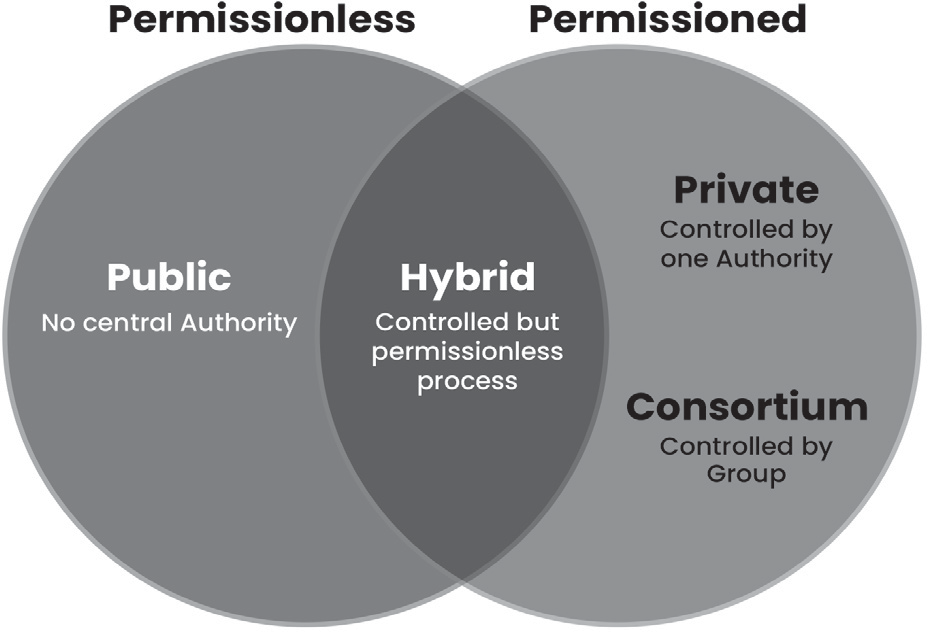
Blockchain technology
• Blockchain technology is a framework for storing public transactional records, or blocks, across multiple databases, or the “chain,” within a peer-to-peer network. People often refer to this kind of storage as a “digital ledger”.
• Each and every transaction in this ledger is validated and protected against manipulation by the owner’s digital signature. Because of this, the data in the digital ledger is extremely safe.
Advantages of Blockchain Technology

• Decentralization: Blockchain technology’s decentralized structure reduces costs and increases transparency by doing away with the need for intermediaries.
• Security: Transactions on a blockchain are secured through cryptography, making them virtually immune to hacking and fraud.
• Transparency: Blockchain technology increases transparency and lowers the possibility of conflicts by enabling all participants to a transaction to have access to the same information.
• Efficiency: Compared to traditional transactions, transactions on a blockchain can be completed more quickly and efficiently.
• Trust: Trust can be developed between participants to a transaction by using blockchain technology, which is transparent and safe.
Disadvantages of Blockchain Technology
• Scalability: Blockchain technology can be challenging to scale for large-scale applications because to its decentralized nature.
• Energy Consumption: Mining blockchain transactions takes a lot of processing power, which might have an adverse effect on the environment and energy usage.
• Adoption: Blockchain technology has many potential uses, but because of its technical complexity and lack of awareness, adoption has been slow.
• Regulation: Businesses and investors may experience uncertainty since the regulatory framework surrounding blockchain technology is still developing.
• Lack of Standards: Integrating blockchain technology into current systems can be challenging for organizations due to the absence of established protocols and technologies.
Central Bank Digital Currency (CBDC)
• Central bank Digital currencies or tokens are digital currency. It is a cryptocurrency that is a bit similar and is released by a central bank. The fiat currency of that nation is equal to the value of CBDCs.
• CBDCs, commonly referred to as “programmable money,” allow digital fiat or payment tokens to be created with particular attributes and functions.
• The Reserve Bank of India issues legal tender known as Central Bank Digital Currency, or CBDC. Additionally referred to as the “digital rupee” or e₹, it will provide atomicity the instantaneous settlement of transactions as well as the trust, security, and settlement finality of physical cash in a digital format.
• An explicit claim on the central bank is represented by e₹. Currency notes can be utilized in the same way as physical currency; they can be used for digital transactions or value storage.
Two types of CBDCs
• Wholesale central bank digital currencies: It would allow for more effective clearing activities between the member banks and the central bank.
• Retail central bank digital currencies: It would be equivalent to a banknote in function but would be in digital form and accessible to the general population.
e-RUPI
• National Payments Corporation of India (NPCI) has introduced an innovative digital solution called e-RUPI in collaboration with partner banks, the Department of Financial Services (DFS), the National Health Authority (NHA), and the Ministry of Health and Family Welfare (MoHFW).
• It will be possible for customers of this easy one-time payment method to redeem the voucher at participating businesses without the need for a card, digital payments app, or online banking access. Organizations or the government would send SMS or QR codes to the beneficiaries with e-RUPI for a particular purpose or activity.
• The contactless e-RUPI ensures complete confidentiality of beneficiary details, making it simple, safe, and secure. Because the necessary amount is pre-stored in the voucher, the entire transaction process using this voucher is comparatively speedier and more dependable.
75 Digital Banking Units
• According to the RBI, a DBU is “a specialised fixed point business unit/hub housing certain minimum digital infrastructure for delivering digital banking products and services as well as providing both self-service and guided digital maintenance for already-existing financial products and services.”
• DBUs will offer account users a variety of digital banking services.
• The increased digital experience and cost-effective access to products and services will be made possible for customers in an efficient, paperless, secure, and connected environment. The majority of services will be available in self-service mode at all times, year-round.
RBI- Reports
• RBI publishes two statutory reports, the Annual Report of the Bank and the Report on Trend and Progress of Banking in India. In addition to pertaining to the Bank’s operations during a specific year, these reports, along with the Report on Currency and Finance, also take into account economic developments, banking-related issues, financial sector policy and the prevailing social climate. They thus represent a significant body of material for the history of India’s economy and finance.
Financial Stability Report (FSR)
• Every two years, the Reserve Bank of India (RBI) releases the Financial Stability Report (FSR). The Financial Stability Report (FSR) is a compilation of the Sub- Committee of the Financial Stability and Development Council’s (FSDC) evaluations of the risks to financial stability and the resilience of the financial system.
RBI – Digital Payments Index
• In 2018, the RBI developed a collective Digital Payment Index (RBI-DPI) to project the growth of digital payments in the future. When compared to 217.59 in the same month, the Digital Payment Index (DPI), which was reported in September 2021, shows a 39.64% rise to 304.06 DPI. According to the index, the DPI is at 349.30 in March 2022 compared to 304.06 in September 2021.
Essential Points of the Digital Payment Index
• RBI made the decision to start publishing the Digital Payments Index (DPI) semi-annually in March 2021, with a four-month delay. As a result, the RBI began publishing the DPI for March and September in the months of January and July, respectively, starting in 2021.
• The Base period of the RBI-DPI has been set as March 2018, at a score of 100.
• The DPI index comprises five broad parameters to evaluate the penetration of digital payments in the country.
The following are the parameters and inside each of them are Sub Parameters made up of measurable indicators:
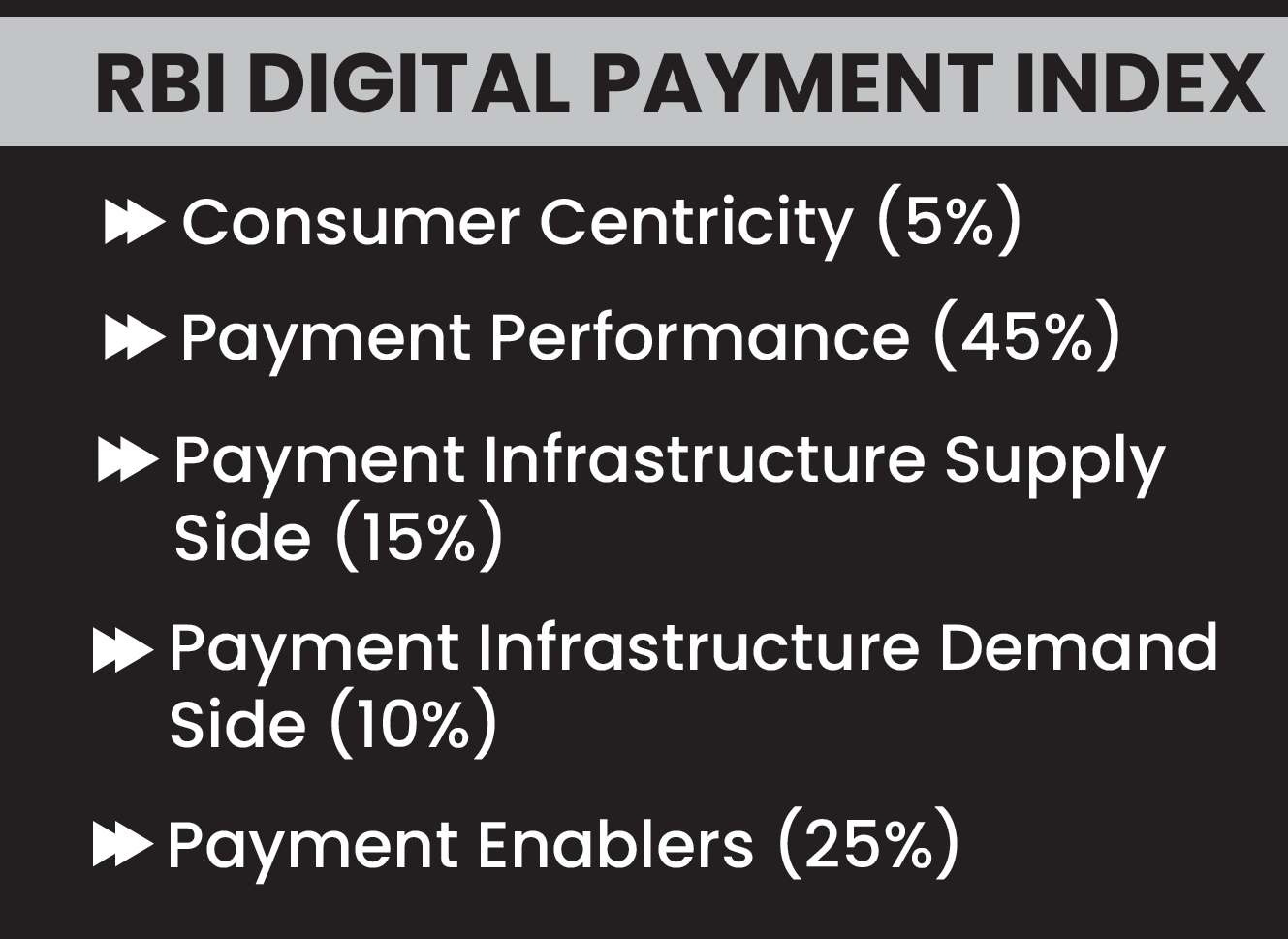
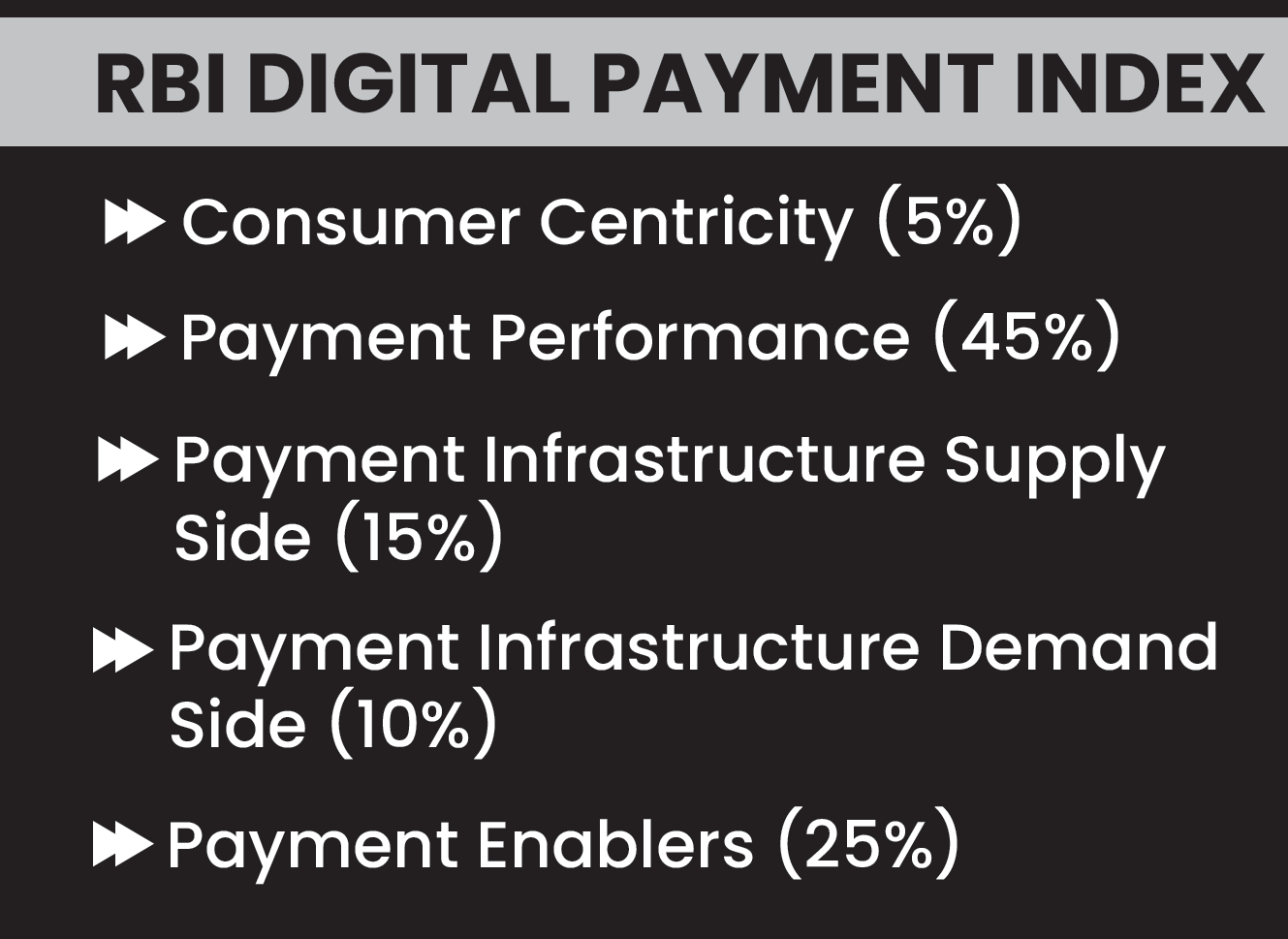
Storage of Payment System Data
• The Reserve Bank of India in its directive on ‹Storage of Payment System Data› has made it clear that entire payment data shall be stored in systems located only in India.
• All system providers need to ensure that within a period of six months, the entire data relating to payment systems operated by them is stored in a system only in India.
• Data stored in India should include end-to-end transaction details and info about payment transactions.
Depending on the nature and origin of a transaction, the RBI may give prior approval for the data to be shared with the foreign regulator