MONEY
Money is defined as any item that is widely used as a medium of trade, a gauge and reserve of value and a standard for installment payments. Money is an acknowledged, centralized, widely used means of trade that makes it easier to transact for goods and services.
Characteristics of Money
Legal tender: Any officially recognized payment method that can be used to satisfy financial obligations or pay off debts, whether private or public, is known as legal tender. Legal tender must be accepted by a creditor in order to satisfy a debt. Only the national entity with the necessary authority may issue legal tender.
Fungible currency: To be considered fungible, a currency must have equivalent quality and interchangeability among its units. It is deemed untrustworthy to conduct transactions with a non-fungible money.
Durable: Reusable money is strong enough to be used repeatedly. It shouldn’t be able to spoil quickly. Perishable goods and articles cannot be saved for use in future transactions and should not be utilized as cash. Thus, a currency needs to be strong in order to preserve its future-oriented use-value.
Easily recognizable: It is necessary to verify the money’s legitimacy with the recipients. To put it another way, the money needs to be accepted everywhere. Disagreement over the exchange terms results from unrecognized money or currency. Both the acceptance of the money system and public confidence are guaranteed by a recognized currency.
Stability: The value of a currency needs to be stable. To put it simply, the value of money should be rising or staying the same. A currency whose value is constantly fluctuating cannot be unstable. The acceptance and legitimacy of the monetary system may be harmed by an abrupt decline in value, which is a risk associated with unstable currencies.
Portable: The ability to easily move money from one location to another is a requirement for currency. To improve its utilization, the money needs to be divided into different amounts. If money is not transportable, its transportation costs may surpass its value. To ensure smooth transactions of different quantities of goods, money should therefore be able to be further divided
into smaller pieces. So, that it can be easily portable and transportable.
Functions of Money
Three categories apply to the functions of money:
Primary Functions
Secondary Functions
Contingent Functions
Primary Functions
• Money as a medium of exchange: Apart from near-money assets, this is the most significant and distinctive function of money. The purchasing and selling of products and services has been made much easier by the widespread use of money as a means of exchange. Time and energy are not lost when using money, even though it divides transaction into two parts: selling and buying.
• Money as a measure of value: Money serves as a yardstick to measure values of all other goods and services in terms of their money price. In the absence of money, the value of one commodity could be expressed only in terms of the other goods and services.
Secondary Functions
• Store of Value or Wealth: Functioning as a store of value, money offers an optimal and efficient means to accumulate wealth and transmit purchasing power across time horizons.
• Compared to the cumbersome and impractical nature of storing wealth in perishable or high-cost goods, money presents a superior solution.
• Its durability allows for indefinite storage. Additionally, money's universal acceptance guarantees its convertibility into goods and services at any given time.
• Finally, its portability simplifies and secures the act of saving for future use, unlike the challenges associated with storing physical goods.
• Standard of Deferred Payments: The principle of deferred payments establishes money as a universally accepted measure of debt, enabling the exchange of goods and services now with settlement at a future date. Daily commerce involves countless transactions where immediate payment doesn't occur. Money fosters such activity, facilitating capital formation and driving a nation's economic development. The significance of this monetary function lies in two key aspects:
• It catalyzes the emergence of financial institutions.
• It streamlines the processes of borrowing and lending.
• Transfer of Value: The money’s ability to store value is the source of this function. Value is transferred through money from one location or person to another. When you are a traveler, carrying cash with you makes it simple to make the essential purchases both at your destination and while traveling. The bank is another option for money transfers.
Contingent Functions
Distribution of national income: Distributing the nation’s produce to those who have contributed to its production is made easier with the use of money. People collaborate to generate things in modern society in roles such as laborers, capital owners, landlords, etc. Thus, the output that is produced has to be divided among all of them in the form of income (wages and salaries, interest, rent, etc.).
Basis of credit system: Promise to pay, or credit, is the foundation of the modern economy. All that exists as modern money coins, bills, bank drafts, etc. is really an assurance that something will be paid. Still, when banks use cash deposits to support the expansion of secondary deposits, this money also helps the banks generate more credit.
Maximisation of utility and profits: Money helps consumers in maximising their satisfaction. When money is allocated between different goods and services, the consumer maximizes his utility. Likewise, producers can calculate money cost of production and then decide the price that can result in maximum profits.
Money imparts liquidity and uniformity to assets: Being the most liquid asset, money makes it convenient to hold wealth in that form. Any asset can be purchased with money and money can also be obtained from any item.
Types of Money
Fiat Money: Unlike actual goods, fiat money is solely supported by directives from the government. The government’s declaration that it is an accepted form of payment, grants it the status of a medium of exchange.
Commodity Money: This money is not only a means of commerce; it is a real commodity with intrinsic value. Precious metals, diamonds, spices and even coffee can be used as commodities.
Fiduciary Money: This is non-government backed money that is based more on faith than on the inherent worth of the currency itself. This payment method is predicated on the belief or assurance that it would be acknowledged as payment.
Bank Money: This money is present in the economy as debt that commercial banks have produced. In order
to generate interest, banks lend out money to other customers based on the fiat money that those customers have deposited.
Crypto currency: A crypto currency, often known as digital currency, is a different kind of payment made feasible by encryption methods. Crypto currencies can be utilized as a virtual accounting system in addition to a means of commerce because they use encryption technology.
Money Supply in India
What is ‘Money Supply’
The total amount of money in circulation within an economy is known as the money supply. The money that is in circulation includes cash, banknotes, money in deposit accounts and other liquid assets. The evaluation and examination of the money supply aid economists and decision-makers in formulating new policies or changing current ones that involve raising or decreasing the money supply.
Since the value eventually influences the business cycle, which in turn affects the economy, it is significant. Every nation’s central bank releases data on the money supply on a regular basis, using the monetary aggregates that are determined by them. In India, RBI uses the monetary aggregates M0, M1, M2, M3, and M4.
Demand and Supply of Money
Demand for Money
What motivates people to want a particular amount of money is revealed by the demand for money. Since people need money to perform transactions, the value of those transactions will decide how much money they want to keep: the more transactions that must be completed, the more money will be wanted.
It should be obvious that an increase in income would result in a rise in the demand for money because the amount of transactions that can be made depends on income. Furthermore, the amount of money that people save in cash as opposed to depositing it in a bank where they would earn interest is also influenced by the interest rate.
Supply of Money
Money in a modern economy is made up of bank deposits and cash. There are numerous money measurements, depending on the kinds of bank deposits that are being taken into account. The mechanism that creates these consists of the commercial banking system and the central bank of the economy.
Measures of Money Supply in India
The Indian economy’s money supply is typically expressed as Reserve Money (M0): High-Powered Money,
Financial Base, Base Money, and so on. The following formula is used to determine M0:
M0 = Money in circulation + Bankers’ deposits + other
deposits with RBI
It is the economic foundation’s currency.
Narrow Money (M1) = Money in Circulation + Demand Deposits in the Banking System (Current and Savings Accounts) + Additional deposits with the Reserve Bank of India (RBI)
Narrow Money (M2) = Post Office Savings + Bank Savings Deposits + M1
Broad Money (M3) = M1 + Time Deposits made with
banks.
Broad Money (M4) = M3 + any deposits made at post
office savings banks.
Note: ‘Other’ deposits with RBI comprise mainly: deposits made by quasi-governmental organizations and other financial institutions, such as primary dealers; balances in the accounts of foreign governments and central banks; and accounts held by international organizations like the International Monetary Fund, among others. Apart from the aforementioned, M0 is an additional metric for gauging the money supply. Other names for the M0 include “monetary base,” “central bank money,” “high- powered money,” and “reserve money.”
Reserve Money (MO) ═ Currency in circulation+ Bankers’ deposits with the RBI+ ‘Other’ deposits with the RBI ═ Net RBI credit to the Government+ RBI credit to the commercial sector+ RBI’s claims on banks+ RBI’s net foreign assets+ Government’s currency liabilities to the public- RBI’s net non-monetary liabilities.
All money in circulation, whether it is through the banking system or the general public, is included in M0. MI, on the other hand, comprises publicly held cash. The public’s money holdings are far smaller than the amount held by the banking sector. Because of this, MO is much bigger than MI.
Components of Money Stock in India
The assets that function as a medium of trade would not fall under any strict definition of money. This ought to comprise currency C, which can be used straight to pay for goods and services, as well as bank-issued chequable deposits, which are used to pay for goods and services with checks.
M = C+DD+OD
C denotes currency in terms of coin and paper note
DD denotes Demand Deposits in Commercial Banks
OD denotes Deposits in public financial institutions, International financial institutions
CURRENCY (C)
Coins and paper money notes both are used as form of payment in India. Reserve Bank of India currency notes with a denomination of two rupees or more are considered paper money.
The Reserve Bank of India is responsible for them. Together with metallic coins of lower denomination, there are also little quantities of Government of India rupee one notes and coins. They directly represent a financial obligation of the Indian government. But the RBI, acting as a representative of the federal government, distributes them. The RBI accomplishes this by keeping government currency in stock and allowing it to be fully convertible into other national currencies and vice versa. They cannot, however, be exchanged for valuables like gold or silver, nor can they be combined with cash notes.
DEPOSITS (D)
The institutions supplying these deposits can be Banks, or Post offices, or Non-Bank Financial Intermediaries.
Current account deposits: The majority of current account deposits are utilized by businesspeople for their daily transactions; that are payable on demand, transferable by cheque, and do not collect interest.
Fixed Deposits and Recurring Deposits: When you make a fixed deposit with a bank, you might earn interest at a specific rate based on how long you keep the deposit there. Their status as near money restricts their use to a narrower meaning of money; they cannot be used as a form of payment or transferred. It is also not possible to check recurring deposits that accrue compound interest on the amount deposited into the account on a regular basis.
Saving Account Deposits: Individuals keep these deposits for transactional purposes; a portion or whole of the deposit is not chequable, and a specific amount cannot be withdrawn. On the amount that is not withdrawn, they receive interest at a rate.
Post Office Deposits: Post Office Deposits include fixed and recurring deposits as well as savings components. Bank savings accounts and Post Office savings accounts are comparable, except withdrawals are made via withdrawal slips, and there are limits on the quantity and frequency of withdrawals. They are less liquid than deposits at commercial banks, although they are more liquid than bank fixed deposits.
Classification of Bank Deposits by RBI
The RBI reclassifies current saving and fixed deposits of the banks into Demand and Time deposits.
Demand deposits
Deposits that can be transferred by check and withdrawn at any time. In other words, these are deposits in
commercial banks that can be withdrawn on demand, without prior notice. According to this criterion, deposits made into current accounts are classified as demand deposits, as is the part of deposits made into savings accounts that are taken out or utilized for transactions.
Time deposits
Deposits that accrue interest but are not taken out. Because of this, time deposits can be used to categorize both fixed and recurring deposits. When it comes to savings account deposits, the amount that is really taken out is categorized as a demand deposit; the amount that is left in the account and earns interest is categorized as a time deposit.
Net Demand Deposits
In a bank, demand deposits are the combination of interbank and public deposits. Still, we deduct interbank deposits from total deposits to obtain net demand deposits with banks, since we are only concerned with deposits made by the general public.
Liabilities of a Bank
The term “net demand and time liabilities” (NDTL) describes the entire amount of public deposits held by banks with other banks. All liabilities included in demand deposits are those that the bank must pay when called upon. They consist of demand drafts, current deposits, amounts owed on past-due fixed deposits and the demand liabilities section of savings bank accounts. Time deposits are made up of deposits that are not immediately withdrawable by the depositor but are instead returned upon maturity. Rather, in order to access the cash, he or she will need to wait until the lock-in term is ended. Examples include staff security deposits fixed deposits, and the time liabilities part of savings bank deposits. A bank’s call money market borrowings, certificate of deposit and investment deposits in other banks are examples of its obligations.
Money Multiplier
A money multiplier is a phenomena where money is created in the economy through the development of credit. Put another way, a money multiplier is the power a central bank has to control the money supply by changing the minimum reserve rates that must be maintained.
The Money Multiplier, also known as the Deposit Multiplier, calculates how much money banks may make in deposits for each unit of money they have in reserve. The Money Multiplier has a significant impact on the financial system of the economy since it assists the government in determining the appropriate level and mode of economic stimulation each time it is necessary.
There is an inverse link between the Legal Reserve Ratio (LRR) and the money multiplier. The term “LRR” describes the quantity of deposits that banks must always
hold on hand as reserves in order to cover unforeseen costs and uphold public confidence. The banks are needed to have two different kinds of reserves:
The reserves that banks are required to hold with the central bank are known as the cash reserves ratio, or CRR.
The Statutory Liquidity Ratio (SLR) indicates the quantity of liquid assets that banks must have on hand as reserves.
In the monetary economy, the Central Bank can effectively regulate the creation of money through the use of the basic money multiplier formula, which serves as a comprehensive instrument for money supply calculations.
Money Multiplier Formula
Money multiplier = 1 LRR Where, LRR = Legal Reserve Ratio
Money Multiplier Equation
Money Multiplier = in Total Money Supply in the
Monetary Base
The credit multiplier formula is another name for it. A lower money multiplier results from a greater loan-to- ratio (LRR) because commercial banks must maintain larger reserves, which reduces the amount of money they can lend to the general public.
Money Creation by Banking System
Banks are able to lend because they do not anticipate that every depositor will take their entire balance out at once. Every time a bank makes a loan to an individual, a new account is created in that individual’s name. Consequently, the money supply rises to include both new and old deposits (plus currency.)
Let’s use an illustration. Let us assume that the nation is home to a single bank. For this bank, let’s create a fictitious balance sheet. Any company’s assets and liabilities are listed on its balance sheet. Traditionally, the firm’s liabilities are listed on the right side while its assets are listed on the left.
What a company has or is entitled to collect from third parties are its assets. A bank’s assets consist of loans made to the general public, in addition to buildings, furniture, etc. This is the person’s right to recoup the Rs 100 that the bank claims when it extends a loan to them. Reserves constitute yet another asset owned by a bank. The Reserve Bank of India (RBI), the nation’s central bank, accepts deposits from commercial banks in exchange for cash. The RBI issues bonds and treasury bills, among other financial instruments, to supplement cash in these reserves. The deposits we hold with banks are comparable to reserves.
We maintain deposits, which are our assets that we are free to take out. Similar to this, commercial banks like State Bank of India (SBI) maintain what are known as Reserves deposits with the RBI.
Assets = Reserves + Loans
Any company’s debts or what it owes other people are its liabilities. A bank’s primary source of liabilities are the deposits that customers make with it.
Liabilities = Deposits
According to the accounting rule, the account’s two sides must balance. Therefore, assets are listed as net worth on the right-hand side if they exceed obligations.
Net Worth = Assets – Liabilities
Balance Sheet of a Fictional Bank
Assume that our fictitious bank has liabilities (deposits) of Rs 100 at the beginning. This can be as a result of Ms. Fernandes making a Rs. 100 bank deposit. Permit this bank to deposit the same amount as reserves with the RBI.
Balance Sheet of a Bank
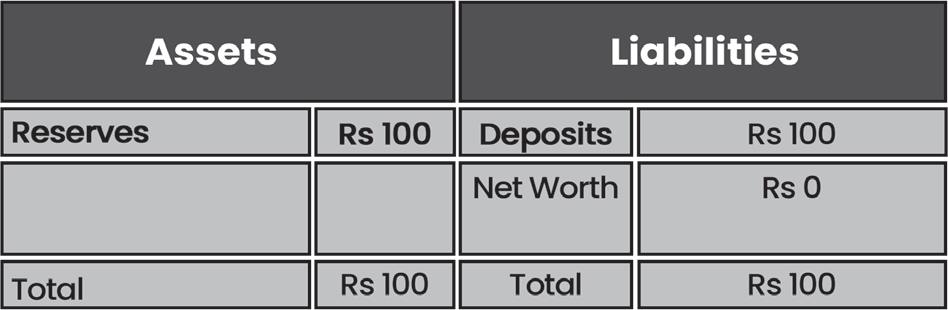
The entire money supply in the economy will be equal to Rs 100 if we assume that there is no money in circulation.
M1= Currency + Deposits = 0 +100 =100
Limits to Credit Creation
Let’s say Mr. Mathew visits this bank to apply for a Rs. 500 loan. The total quantity of bank deposits and, thus, the money supply will increase if the loan is approved and Mr. Mathew deposits the loan amount in the bank. It appears that the banks are able to continue printing as much money as they choose. However, the amount of money or credit that banks may create is limited. The Central Bank makes this determination (RBI). Every bank is required to maintain a specific percentage of deposits as reserves, as determined by the RBI. In order to prevent any bank from “over lending,” this is done. The banks are required by law to comply with this requirement. This is referred to as the “Reserve Ratio,” “Cash Reserve Ratio (CRR),” or “Required Reserve Ratio”.
Cash Reserve Ratio (CRR) = Percentage of deposits that a bank is required to retain on hand as cash reserves.
Banks are required to keep a portion of their reserves in liquid assets Commercial banks can maintain their SLR in the forms of gold, liquid cash or any type of securities for the foreseeable future in addition to the CRR. This ratio is known as the Statutory Liquidity Ratio (SLR).
One term for such a system is the Fractional Reserve Banking System. That is to say, just a tiny percentage of bank deposits are backed by actual cash on hand and are therefore withdrawable. The fractional reserve banking system serves as the basis for expanding credit and the money supply in the economy. Since most depositors do not take their entire balance out at once and since outflows of funds are compensated by inflows of funds, banks only need to keep a fraction of their deposits as cash. It makes credit possible for expansion.