Muhammad Bin Tughluq (1324-1351)
Muhammad bin Tughlaq emerged as a remarkable ruler in his era, deeply knowledgeable in religion and philosophy, displaying an open and critical mindset. He engaged not just with Muslim mystics but also with Hindu yogis and Jain
saints like Jinaprabha Suri. However, this diverse interaction wasn’t favoured by many orthodox theologians, who labelled him a ‘rationalist’ for his reluctance to blindly accept religious beliefs. He was also willing to appoint individuals to high positions based on merit rather than noble lineage. However, his tendency towards impatience and hastiness proved to be a downside.He was a compelling figure in medieval Indian history due to his ambitious pursuits and ground-breaking experiments, although their advanced nature led to significant failures. Demonstrating remarkable religious tolerance, he nurtured diplomatic relations with distant nations like Egypt, China, and Iran. Despite introducing progressive reforms, none succeeded. Isami, Badauni, and Ibn Battuta, contemporaneous chroniclers, failed to capture his full essence accurately. Nonetheless, Muhammad bin Tughlaq distinguished himself as the only Delhi Sultan to receive an extensive education covering literature, religion, and philosophy.
• This decision to transfer the capital was controversial. Devagiri had served as a vital base for the expansion of Turkish rule in South India, and Muhammad Tughlaq had spent considerable time there during his princely days.
• The motive behind this relocation was to exert better control over South India by establishing a secondary capital.
• To facilitate this shift, Tughlaq pressured officers, influential figures, and Sufi saints to move to Daulatabad, providing incentives and accommodations.
• However, this initiative led to discontent and a sense of longing among those who had generations-long ties to Delhi.
Despite efforts to create infrastructure and ease travel, including constructing a road and rest houses between Delhi and Daulatabad, the relocation caused significant casualties due to the strenuous journey and scorching heat of the summer.
Ultimately, Muhammad bin Tughlaq abandoned Daulatabad after realizing that controlling North India from there was as futile as controlling the South from Delhi, acknowledging the failure of this ambitious endeavour.
The endeavour to establish Devagiri as a second capital may have faltered, yet it had lasting positive effects. It facilitated improved communication between North and South India, fostering cultural and religious exchange. Those who settled in Daulatabad contributed to disseminating Turkic cultural and social concepts in the Deccan, initiating a fresh phase of cultural interaction within and between the regions.
TOKEN CURRENCY
There was a shortage of silver in the world at the time and the sultan attempted to solve this problem by introducing a token currency. Money, after all, is a medium of exchange and all countries today use token currencies- so they do not have to depend on the supply of arbitrary fixation of state shares without consideration for actual yields.
A prolonged famine exacerbated the situation, with relief efforts arriving too late, leading to numerous deaths in Delhi and the sultan left the capital for a period.
The measures he initiated to revamp agriculture had long-term implications but catastrophically failed during his rule, perhaps due to flawed planning or inexperienced implementation by officials
AGRICULTURAL REFORMS
Upon returning to Delhi, Muhammad Tughlaq aimed to enhance cultivation in the doab. He had recognized that effective relief and agricultural development were crucial.
He initiated a scheme offering takkavi loans to farmers for purchasing seeds and expanding cultivation.
The diwan-i-amir-i-kohi department was established, dividing the area into development blocs led by officials tasked with extending cultivation through loans and encouraging the cultivation of better crops like wheat instead of barley, sugarcane instead of wheat, grapes, and dates instead of sugarcane.
However, the scheme faltered due to the incompetence and dishonesty of those chosen, who misused funds for personal gain. The significant sums invested couldn’t be recovered. Fortunately, Muhammad Tughlaq passed
away, and Firoz pardoned the loans.
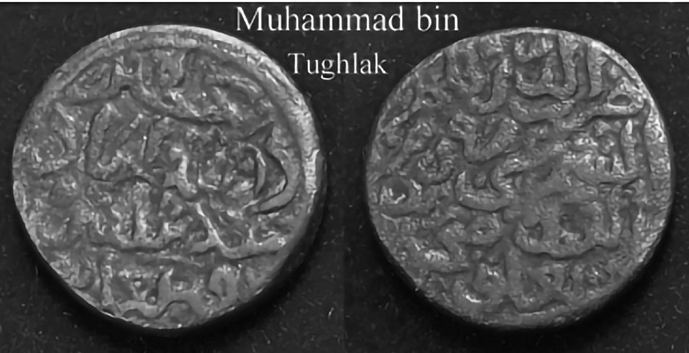
Muhammad Tughlaq decided to introduce a bronze coin which was to have the same value as the silver tanka.
However, this idea at the time was very advanced for its time. It was completely novel in India and it was difficult to get the traders and the common man to accept it.
It would have been successful if the government found a way to prevent the people from forging the coins. The government failed and as a result, the new coins were devalued greatly.
Muhammad Tughlaq decided to recall the token currency and offered to exchange silver coins for the bronze ones. As a result, many people swapped their new coins. However, counterfeit coins, which could be identified through specific tests, were not accepted in the exchange.
TAXATION IN THE DOAB
The failure of these experiments led to a loss of the Sultan’s standing and a significant waste of resources.
To offset financial woes, Muhammad bin Tughlaq increased land revenue in the Doab region, burdening the farmers excessively amid a severe famine, resulting in significant peasant revolts.
This uprising stemmed from over-assessment and
Nonetheless, the cultivation extension policy persisted
and gained momentum under Firoz and later, Akbar.
Beginning of the end: Dissatisfied nobles and rebellions
Muhammad Tughlaq grappled with the issue of the nobility, expanding its composition beyond old noble families to include individuals from various backgrounds like barbers, cooks, and weavers, including converts, which fueled resentment among the traditional aristocracy.
This diverse nobility lacked cohesion or loyalty to the sultan, while the vast empire created opportunities for rebellions and the pursuit of independent authority.
The reign also witnessed a surge in rebellions by nobles and provincial governors.
Hasan Shah’s rebellion led to the Madurai Sultanate, and the establishment of the Vijayanagar and Bahmani kingdoms followed in 1336 and 1347, respectively.
Governors in Oudh, Multan, and Sind revolted, while Taghi rebelled in Gujarat, leading to a three-year pursuit by the Sultan.
As Muhammad Tughlaq’s health deteriorated, he passed away in 1351, leading to varying opinions about his
reign– according to Baduani, the Sultan was freed from his people and the people from the Sultan. According to Barani, Muhammad bin Tughlaq was a mixture of opposites
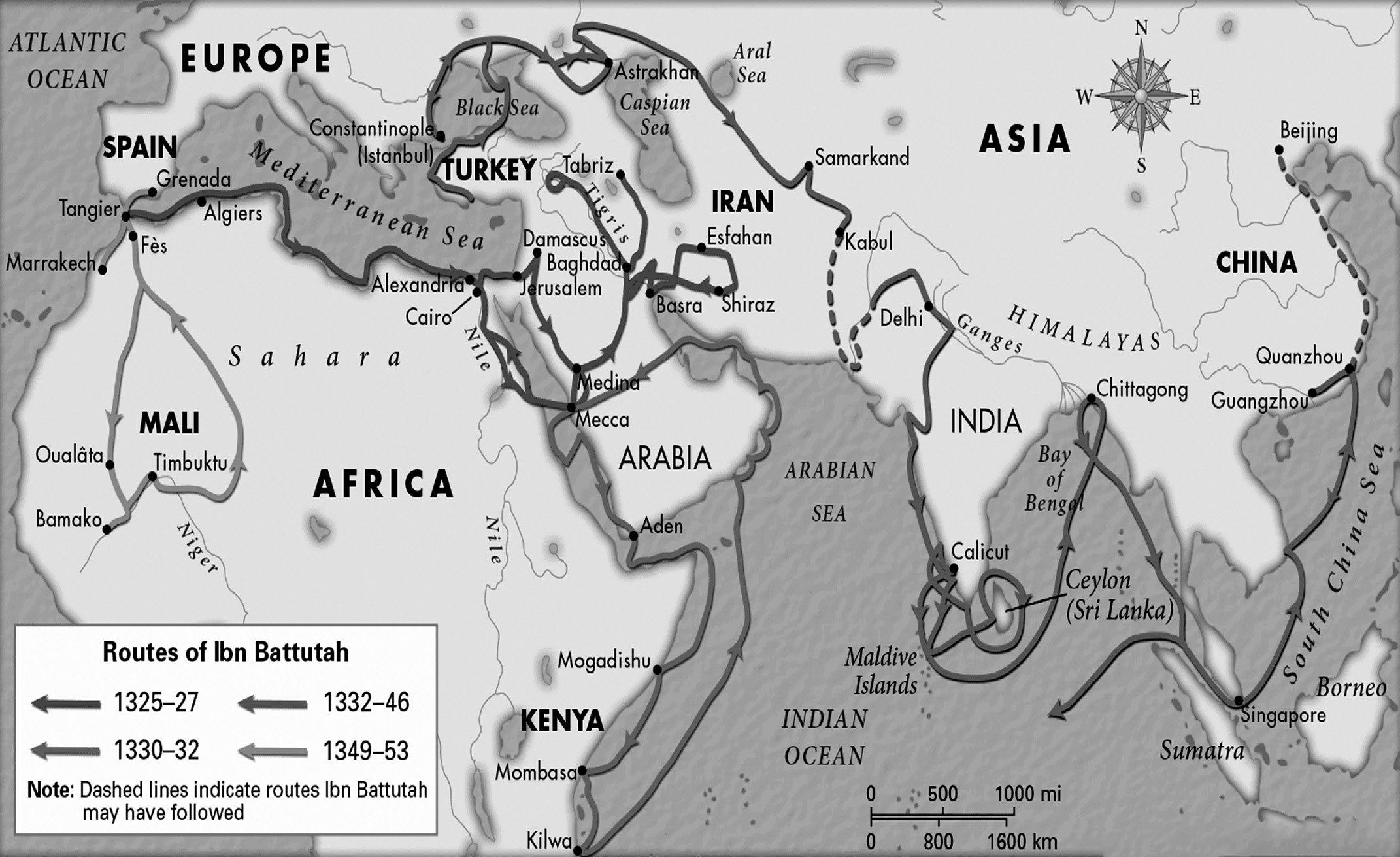
Ibn Battuta’s Rihla, written in Arabic, serves as a treasure trove of detailed insights into the social and cultural tapestry of the fourteenth-century subcontinent. Hailing from Tangier, Ibn Battuta belonged to a revered and erudite family renowned for their expertise in Islamic religious law, or sharia. His innate love for exploration and an insatiable curiosity for distant lands led him on remarkable journeys that opened up new worlds and introduced him to diverse peoples.
Before embarking on his Indian venture in 1332-33, Ibn Battuta had already undertaken pilgrimage trips to Mecca and had traversed vast regions, exploring the landscapes of Syria, Iraq, Persia, Yemen, Oman, and certain trading ports along East Africa’s coast. His travels were not merely geographical; they were windows into the rich cultural and societal panoramas of each region.
Fascinated by the fame of Sultan Muhammad bin Tughlaq, the ruler of Delhi renowned for his patronage of arts and scholarship, Ibn Battuta set his sights on Delhi. His journey took him through Multan and Uch before arriving in Delhi, where the Sultan, impressed by his erudition, appointed him as the qazi, or judge, of Delhi. His tenure in this prestigious position lasted for several years until a falling-out led to his imprisonment. However, upon clarification of the misunderstanding with the Sultan, Ibn Battuta was reinstated in imperial service. His remarkable journey continued, as he was tasked in 1342 to embark on an envoy mission to China, representing the Sultan to the Mongol ruler.
Ibn Battuta’s travelogue often draws comparisons with the accounts of Marco Polo, the Venetian explorer who traversed China and India in the late thirteenth century. However, Ibn Battuta’s travels were marked by significant dangers; he encountered numerous instances of bandit attacks, facing perilous situations that threatened his life. Despite his preference for traveling in caravans with companions, even this did not guarantee safety, as he and his fellow travelers were brutally attacked while journeying from Multan to Delhi, resulting in severe injuries and fatalities among his companions