NET NEUTRALITY
• Net neutrality refers to the fact that governments and internet service providers treat all data on the internet equally and do not charge users more for higher-quality delivery or give some websites preferential treatment.
• The Telecom Regulatory Authority of India (TRAI) recently proposed the formation of a multi-stakeholder body (MSB) to guarantee that internet service providers in the nation follow net neutrality principles.
• All Internet service providers (ISPs) must provide the same amount of data access and speed to all traffic under network neutrality and traffic to one service or website cannot be banned or downgraded.
• NET is not neutral in India in case of special services like Internet of Things, Remote Surgery etc.
Key principles of NET Neutrality include

• The following internet space stakeholders are affected
by net neutrality:
• Users of any kind of online service
• Internet service providers (ISPs), also known as telecom service providers (TSPs),
• Over-the-top (OTT) service providers, who offer internet access products including apps and webpages
• The government, which has the authority to control and define these players’ relationships
• TRAI is an independent regulator in the telecom sector, which mainly regulates TSPs and their licensing conditions, etc.
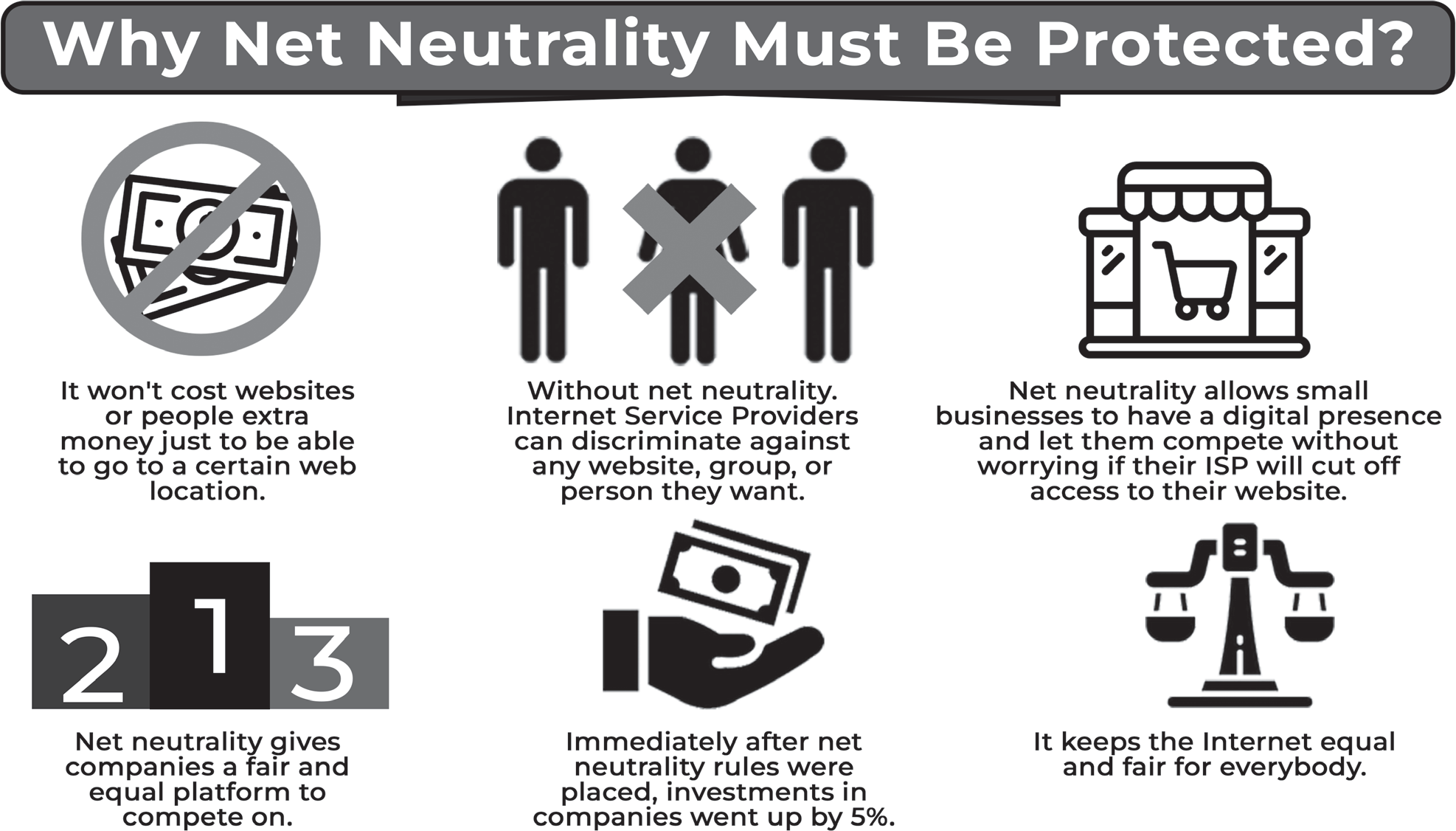
Why does Net Neutrality Matter?
• Preserves an Open Internet: Net neutrality guarantees
information, ideas, and services can be accessed freely and without limitations.
• In the absence of net neutrality, particular ISPs may restrict access to some websites or offer faster connections to others. At worst, an ISP might completely prevent users from accessing a particular piece of content.
• Promotes Consumer Choice: Customers are free to select the services, apps, and content they wish to use without any limitations thanks to net neutrality. They are not restricted to an ISP-selected pre-selected list of offerings.
Protects Freedom of Expression: Net neutrality is an essential tool for democratic engagement because it protects freedom of expression by enabling unhindered organization, communication, and mobilization of supporters.
CELLULAR OPERATORS ASSOCIATION OF INDIA
• The Cellular Operators Association of India (COAI) is an Indian non-governmental advocacy and trade association with a primary focus on the telecom sector.
• COAI was established in 1995 as a non-governmental organization .
• As of 2017, the Department of Telecommunications, Government of India, and COAI were organizing the India Mobile Congress together.
• Over a period of time COAI has become the recognized voice of the Indian telecom sector, communicating with Ministries, decision-makers, regulators, financial institutions and technical bodies directly.
• It offers a platform for dialogue and idea sharing between these organizations and the service providers, who are all interested in seeing the growth of mobile phone technology in the whole country.
• In order to give an industry consensus position to the government on important matters relevant to the growth and development of the Indian telecom industry, COAI works with other industry associations, such as CII, FICCI, ASSOCHAM, ISPAI, VSAT, IAMAI association, etc.
• The 5G India Forum (5GIF) was set up recently by the COAI.
What if there is no net neutrality?
If net neutrality is eliminated, internet service providers will have the power to (and probably will) modify internet traffic in order to increase their profits.
For example, some ISPs believe they should be able to charge businesses for services like YouTube and Netflix because they consume more bandwidth than a normal website.
These ISPs essentially want a share of the profits that Netflix and YouTube bring in.
Without net neutrality, the internet as we know it would not exist. Instead of free access, customers can be presented with package plans.
For example, websites with their headquarters in India can only be accessed by paying 500 rupees. It’s possible that visiting websites hosted overseas will cost you extra money.
Alternatively, depending on the add-on package you chose and the service fee, the rate at which you receive different kinds of content may change.
In the absence of net neutrality, we probably won’t see an open and free internet but rather a web with silos and an ISP-imposed cost to access each one.
Laws related to Net Neutrality in India
In India, net neutrality is governed and upheld in large part by the Telecom Regulatory Authority of India (TRAI). The following developments indicate how net neutrality is regulated in India:
TRAI’s Recommendations in 2017:
TRAI broadened the principles of non- discrimination to the treatment of content.
To avoid content discrimination, license agreements between the government and ISPs should be changed.
• TRAI’s Consultation Paper on 5G Digital Transformation, 2023 :
• Its objective is to pinpoint policy obstacles and create a workable framework for the quick uptake and best use of new technologies in the 5G ecosystem.
Concerns for Consumers
• Additional Costs
• Net neutrality proponents argue that charging OTT platforms more could trickle down to customers in the form of increased fees or worse service.
•
Net neutrality critics contend that maintaining open competition in internet services is essential to protecting customers’ freedom of choice and acces
Way Forward
• Regulation Clarity: The TRAI should continue to provide the regulatory clarity and guidance on net neutrality. This will include defining and enforcing net neutrality principles that prevent discriminatory practices, while also allowing for reasonable network management.
• Multi-Stakeholder Approach: Considering of a methodical strategy that takes into account the needs of both OTT service providers and telecom operators. It is critical to strike a compromise that permits telecom businesses to recover their investments while maintaining fair competition and innovation.
Transparency: Promote openness in the way ISPs run their networks and interact with OTT providers. By being transparent, we can make sure that any network management procedures are fair and inclusive