New Economic Policy 1991
• The evolution of the Indian economy from a public sector- dominated socialist pattern to a liberalized open market economy was a slow process.
• The convergence of peculiar circumstances such as the Gulf War, the collapse of the Soviet Union and unstable governments at the centre and the economic crisis as seen in the balance of payment issue in the early 1990s made it imperative for India to respond to the changed scenario.
• The origin of the economic crisis can be traced to the inefficient management of the Indian economy in the 1980s. In the late 1980s, government expenditure began to exceed its revenue by such large margins that it became unsustainable.
• Inflation was soaring, and imports grew in excess of the export to such a level that foreign exchange reserves declined to a level that it was not adequate to finance imports for more than two weeks. Even there was insufficient foreign exchange to pay the interest to international lenders.
• To ward off this precarious situation of the economy,
India approached the World Bank and IMF and received
$7 billion as loans to manage the crisis. In return, these institutions wanted that India should open up the economy by removing restrictions in several sectors, reducing the role of government in many areas, and removing trade restrictions.
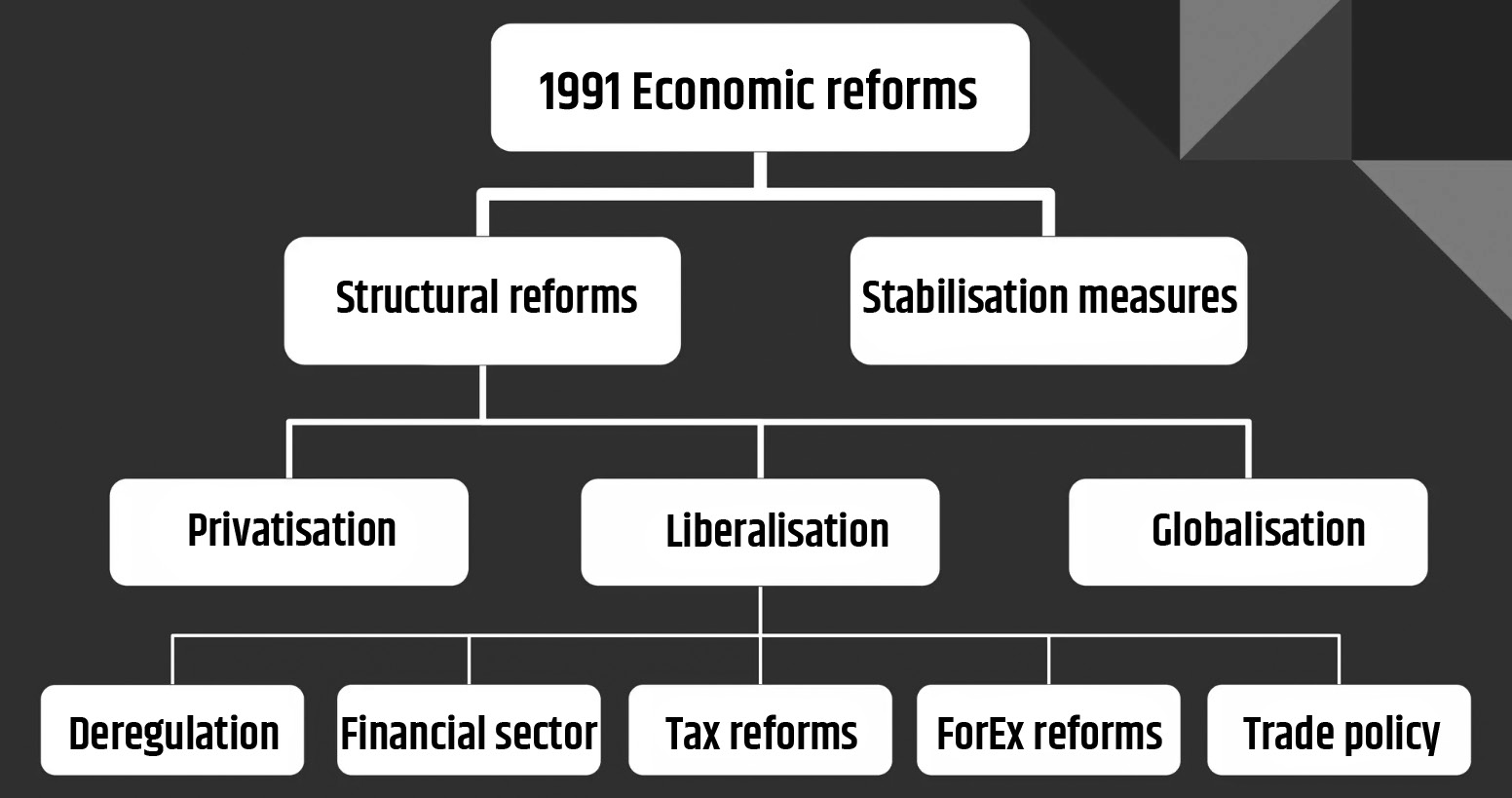
India had no choice but to accept these conditions and announced the New Economic Policy. The crux of the policy was to remove the barrier to the entry of private firms and to create a more competitive environment for the economy. These reforms can be classified into two types
The stabilisation measures (short-term)
The structural reform measures (Long term)
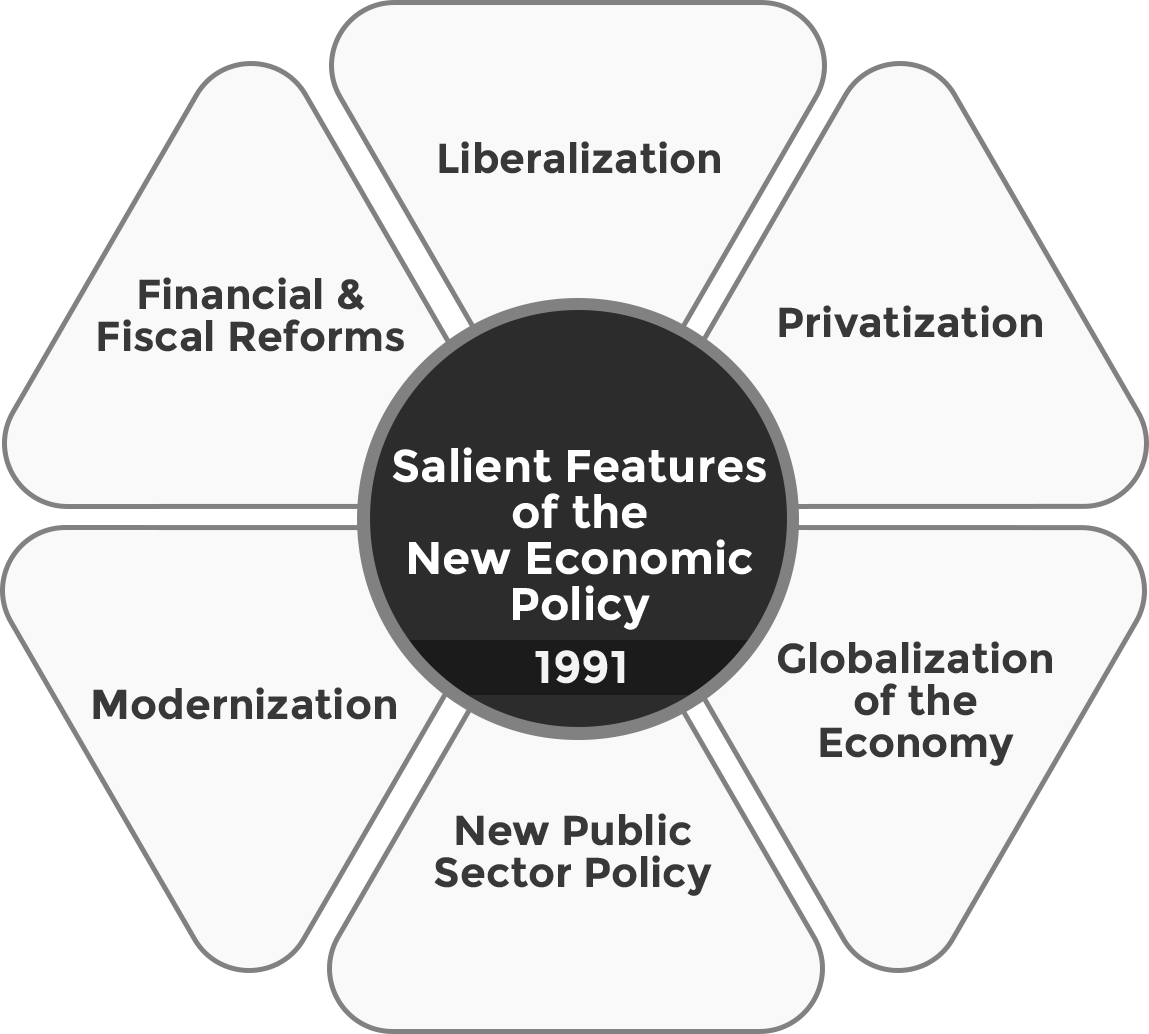
• The government initiated a variety of policies which fall under three heads viz. Liberalization, Privatization and Globalization, “LPG Policy”. The first two are policy strategies & the last one is the outcome of these strategies.
Liberalization
• 1991 reforms were more comprehensive as compared to the reforms of the 1980s. Industrial licensing was abolished for almost all but product categories – alcohol, cigarettes, hazardous chemicals industries, expensive electronics, aerospace drugs and pharmaceuticals.
• The only industries now reserved for the public sector are defence equipment, atomic energy generation and railway transport. In many industries, the market has been allowed to determine the prices.
Financial sector reforms
• The major aim of financial sector reforms was to reduce the role of RBI from regulator to facilitator of the financial sector. In a way, the financial sector may be allowed to take decisions without consulting RBI.
• These reforms led to the establishment of private sector banks, and the entry of foreign banks with certain conditions on FII, such as merchant bankers, mutual funds and pension Funds were not allowed to invest in Indian Financial Markets.
Tax Reforms
• Since 1991, there has been a continuous reduction in the taxes on individual incomes. The rate of corporation tax was reduced; It also initiated simplification of procedures to pay the income tax.
Foreign Exchange Reforms
• Initially, the rupee was devalued against foreign currencies. This led to an increase in the inflow of foreign exchange.
• Now usually, markets determine exchange rates based on the demand and supply of foreign exchange.
Trade and Investment Policy Reforms
• To support the efficiency of the local industries and foster the use of modern technologies, the competitiveness of industrial production was increased and foreign investment and technology were welcomed into the economy.
• Import licensing was abolished except in the case of hazardous and environmentally sensitive industries.
Privatisation
• The government had shed off the ownership and management of various government-owned enterprises. The government started disinvestment by selling off the equity of PSUs. The purpose behind such a move was to improve financial discipline and to facilitate modernisation.
• The government has also made attempts to improve the efficiency of PSUs by giving them autonomy in taking managerial decisions.
Globalization
• Globalization is the outcome of the policies of liberalisation and privatisation.
• Globalization implies greater interdependence and integration. It involves the creation of networks and activities transcending economic social and geographical boundaries. The best example is outsourcing. e.g., BPOs.
• Globalization is a mixed bag of results. On the one hand, it has provided greater access to global markets, imports of high technology, etc. On the other hand, developed countries expand their markets in other countries.
It has also been pointed out that market-driven Globalization has widened the economic disparities between nations and people