Non-Alignment Policy
A nation’s foreign policy is shaped by both domestic and external factors, and India’s foreign policy was deeply influenced by the noble ideals that fuelled its struggle for independence.
However, India’s independence coincided with the onset of the Cold War, a period defined by political, economic, and military rivalry between two superpower-led blocs: the United States and the USSR. Nehru argued that the newly independent nations of Asia and Africa had little to gain by aligning with either of the military blocs. This vision eventually led to the formation of the Non-Aligned Movement (NAM).
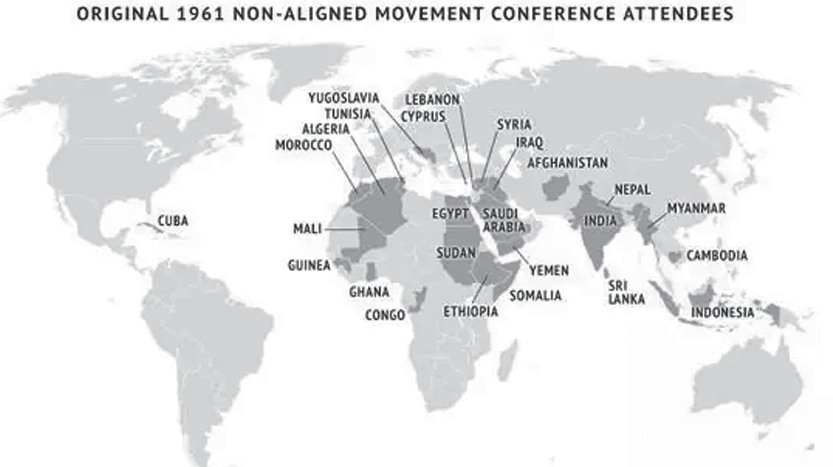
Salient features of the Idea of Non-alignment
The leaders of the Non-Aligned Movement (NAM) were committed to expanding the “area of peace” rather than promoting hostility. As a result, India, along with countries like Egypt and Indonesia, opposed joining military alliances such as the Baghdad Pact, the Manila Treaty, SEATO, and CENTO.
Non-alignment came to represent the struggle of India and other newly independent nations to maintain and strengthen their independence from colonialism and imperialism.
In pursuit of a peaceful world, India championed a non-alignment policy aimed at reducing Cold War tensions and contributing personnel to UN peacekeeping operations.
The adoption of non-alignment gave many nations a
stronger voice at the United Nations. The principle of “one country, one vote” allowed the non-aligned bloc to prevent domination by the Western powers, helping democratize international relations.
John Foster Dulles, the former U.S. Secretary of State, criticized the movement as an “immoral neutrality,” but Nehru countered, asserting that non-alignment meant the freedom to evaluate each issue on its merits, to discern right from wrong, and then take a stand for what was right.
By not aligning with any bloc, non-alignment allowed India to build economic ties with countries on both sides of the Cold War divide. India could obtain capital, technology, machinery, and food from Western nations, while also relying on the Soviet Union, after 1954, to help build heavy industries in the public sector when the United States was unwilling to provide assistance.