Oil Spills
Oil leaks or oil spill is considered among the worst ecological disasters. The most transported commodity in the world is oil and because of its chemical nature, it is transported through the medium of the sea.
This type of spills occurs when there is a collision of vessels carrying oil cargo. Oil spills not only pollute the sea but the whole environment. It is a nation and international concern regarding the marine pollution because when the spill occurs it is not a short-term pollution it is a long- term pollution. The spills last for decades and it cannot be cured until and unless the appropriate measures are taken to prevent, control and remove the risk.
The term Oil Spill is usually applied to marine oil spills, where oil is released into the ocean or coastal waters, but spills may also occur on land.
It is a form of pollution, oil spills may be caused by releases of crude oil from tankers, offshore platforms, drilling rigs or wells.
Causes of oil spills are invariably leakage somewhere in the pipeline. Leakage in the pipeline in turn can be due to a variety of reasons such as sub- standard pipes, corrosion of metal, pipes having outlived their life, poor maintenance etc.
• Example: On 28 January 2017 two ships collided off Kamarajar Port Limited’s (KPL) harbour and resulted in a major oil spill disaster. The Chennai Oil Spill resulted in irreversible environmental damage.
Factors that contribute to oil spills are:
• Sea Collisions: With numerous tankers transporting oil from extraction platforms, the risk of a tanker collision off the coast, leading to a spill and potentially escalating into a major oil spill disaster, remains a concern.
• Oil Extraction Activities: The possibility of defects or malfunctions in oil pipelines or spills near extraction platforms is a constant threat. Additionally, the vulnerability of these oil rigs to enemy attacks during conflicts increases the risk of an oil spill disaster.
• Grounding: There have been several instances where navigational errors have caused ships to run aground.
• Oil Tanker Bilge Discharge: Accidental oil discharges along oil tanker routes are possible. Many ships also discharge bilge water, which often contains oil, into the open ocean.
• Oil Transfer Spillage: The risk of oil spillage is ever- present when transferring oil from ships to shore facilities, especially during operations at offshore terminals or at ports.
Impact of Oil Spills
• An oil slick is the floating of oil over the water after the oil spill and when an oil slick reaches the beach, the oil grasp to every rock and grain of sand present there at the beach. If the oil spill reaches to the forest or other wetlands the grasses, there absorbs the oil which can damage the plant and make the whole place an unsuitable habitat.
• When the oil stops floating on the surface and sinks into the water it has the same effect to the marine ecosystem which leads to the killing of the fishes inside the water and thus resulting in the breaking of the food chain from which the world is connected.
• According to the reports, despite the efforts of cleaning up after the Exxon Valdez oil spill in 1989 a study of 2007 conducted by the National Oceanic and atmospheric administration (NOAA) found that 26000 gallons of oil from the Exxon Valdez oil spill was still found in the sand along the Alaska shoreline that is why it is regarded as
the most dangerous environmental disaster which cannot be removed even after years. The scientists also revealed that the oil was declining less than 4 percent rate annually.
• Oil spills kill birds: These are the kind of birds which swim and dive for their food and are most likely to be damaged by the oil spill. Even the small amount of oil can cause danger to the bird. By the coating of oil over the birds not make them able to fly and thus destroying their natural waterproofing.
• As per the reports, Exxon Valdez oil spill killed approximately between 2,50,000 to 5,00,000 seabirds and also a number of shorebirds.
• Oil spills kill marine mammals: Whenever the oil stops floating and gets started to sink into the marine ecosystem it causes a problem for the dolphins and whales as the oil reaches down there it creates a problem for the animals to breathe.
• Even when the marine mammals sense danger during the time of oil spill and leaves the place makes them safe but it causes a problem of food as their whole habitat is dependent on the marine fishes which are exposed to the oil spills which may be poisoned by the oil.
• Oil spills kill fish: The oil spills cause a big danger to the marine fishes which causes their death as they are exposed to a large quantity of oil spill.
• Wildlife habitat and breeding grounds: It has long-term effects on every kind of environment not only the marine environment. The oil spills destroy the natural habitat of the seaside animals like sea turtles who spend most of their time in the sea but comes ashore to nest.
• Sea turtles can be exposed to the oil spill as they stay ashore for the nest and when the oil floats over to beaches it destroys the eggs which cause a problem in their development.
• The danger the oil spill has varied due to different factors including the amount of oil spilled, the time, the location, the type and weight of oil spill but at the end, every oil spill is a danger to the environment.
Mitigation measures and Steps Taken
• Spill Response: Indian Coast Guard is the Central Coordinating Authority in India for matters related to Oil Spill.
• All the Offshore Installations and Pipelines are need to be designed as per International Standards i.e. API, ISO, IMO etc.
• In addition, regular inspection and maintenance of equipment, pipelines and offshore structures are required as per maintenance protocol.
• All the offshore installations should be equipped with oil & gas detectors and fire suppression systems.
• The National Oil Spill Disaster Contingency Plan (NOSDCP) promulgated by the Indian Coast Guard should be implemented effectively.
• Risk Assessment for predicting the possible and worst- case scenarios
• Environmental Sensitivity Index Mapping for coastal area
• Net Environmental Benefit Analysis (NEBA) studies to evaluate and compare oil spill response options.
• Need to conduct regular internal mock drills and training exercises on bioremediation, booms (i.e. temporary floating barriers), dispersants, in-situ burning etc.
• Tier-1 pollution response equipment’s as per “National Oil Spill Disaster Contingency Plan (NOS-DCP)” for regular inspection of ships and patrolling, and Tankers above 25 years of age are not allowed to enter the ports.
• International Convention on Civil Liability for Oil Pollution 1969,International Convention On The Establishment Of An International Fund For Oil Pollution Damage 1971 and Regional Oil Spill Disaster Contingency Plan (ROS-DCP) also exist.
• In 2015, India ratified the International Convention on Civil Liability for Bunker Oil Pollution Damage, 2001 (Bunker Convention).
• Oil Zapper/Bioremediation: Bacteria can be used to clean up oil spills in the ocean through bioremediation. Specific bacteria can be used to bioremediate specific contaminants, such as hydrocarbons, which are present in oil and gasoline.
•
Here, useful bacteria include Paraperlucidibaca, Cycloclasticus, Oleispira, Thalassolituus Zhongshania etc.
• Containment Booms: Floating barriers, called booms, are used to limit the oil spread and to help in recovery, removal, or dispersal.
• Skimmers: They physically separate the spilt oil from the water’s surface.
• Sorbents: For example, straw, volcanic ash, and shavings of polyester-derived plastic etc. that absorb the oil from the water are used.
• Dispersing agents: These are chemicals that contain surfactants, or compounds that act to break oil into small droplets accelerating its natural dispersion into the sea.
Coastal Erosion
• Shoreline changes induced by erosion and accretion are natural processes that take place over a range of time scales. They may occur in response to smaller- scale (short-term) events, such as storms, regular wave action, tides and winds, or in response to large-scale
(long-term) events such as glaciation or orogenic cycles that may significantly alter sea levels (rise/fall) and tectonic activities that cause coastal land subsidence or emergence.

Figure: Coastal Erosion Process
• Hence, most coastlines are naturally dynamic, and cycles of erosion are often an important feature of their ecological character. Wind, waves and currents are natural forces that easily move the unconsolidated sand and soils in the coastal area, resulting in rapid changes in the position of the shoreline.
• Excluding the impact of human activity, these processes are simply natural evolutionary phenomena. Human
activities along the coast (land reclamation, port development, shrimp farming), within river catchments and watersheds (river damming and diversion) and offshore (dredging, sand mining) in combination with
these natural forces often exacerbate coastal erosion in
many places and jeopardize opportunities for coasts to fulfil their socio-economic and ecological roles in the long term at a reasonable societal cost.

Map: Coastal Erosion of India
State of Coastal Erosion In India
• Recently, the Ministry of Earth Sciences informed the Lok Sabha that of the 6,907.18 km long Indian coastline of the mainland, a significant area is under varying degrees of Coastal erosion.
• About 34% is under varying degrees of erosion, while 26% of the coastline is of an accreting nature, and the remaining 40% is in a stable state.
• West Bengal suffered erosion along about 60.5% of the coast (323.07 km) over the period from 1990 to 2018. This is followed by Kerala (46.4%) and Tamil Nadu (42.7%) respectively.
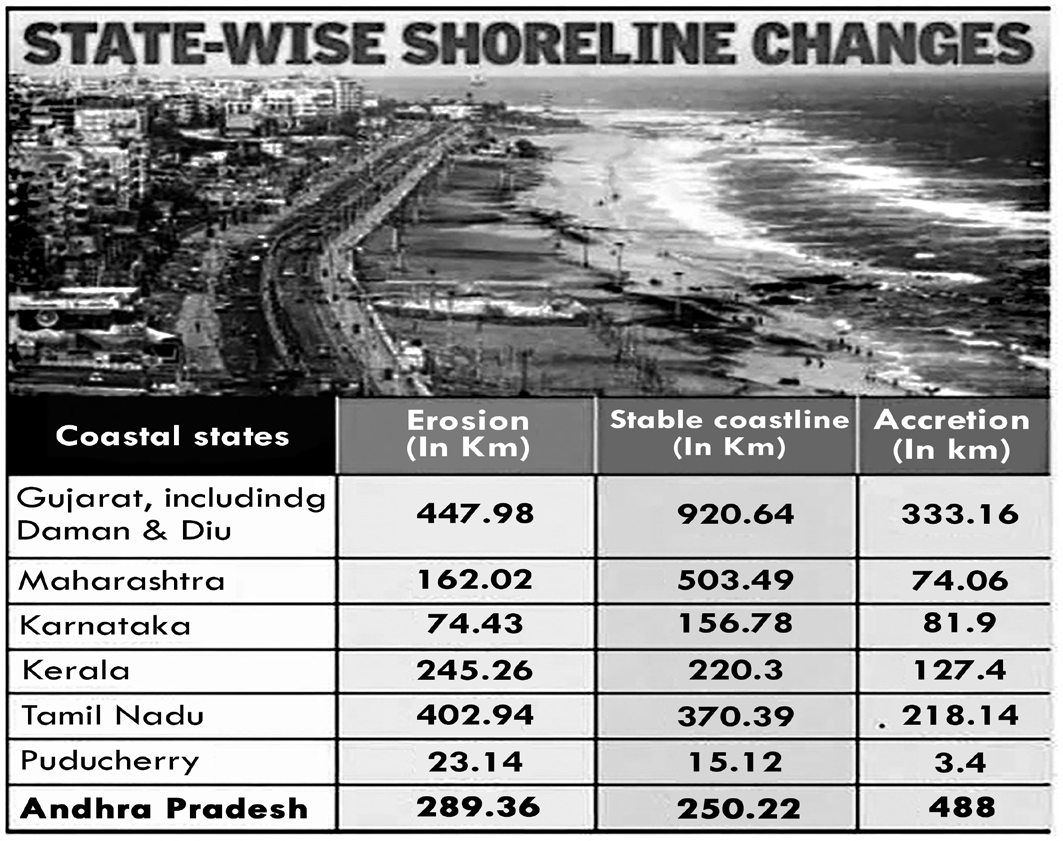
Figure: Coastal Erosion in India
Causes of Coastal Erosion
| NATURAL | ARTIFICIAL |
| a) Action of breaking waves | a) Construction of unplanned structures |
| b) Effect of severe cyclonic storms | b) Reduction of sediment supply due to damming of rivers |
| c) Rise in sea level | c) Removal of sand from beaches |
| d) Deflation | d) Dredging of inlet channels |
| e) Tidal current | e) Unplanned reclamation |
• Nature: Wave energy and Natural hazards like cyclones, thermal expansion of seawater, storm surges, tsunami etc due to the melting of continental glaciers and ice sheets as a result of climate change hamper the natural rhythm and precipitate erosion.
Coastal Erosion Mitigation Measures
•
Sand Movement: Strong littoral drift resulting in sand movement can also be considered as one of the major reasons for coastal erosion. Littoral drift means the natural movement of sediment along marine or lake shorelines by wave action in response to prevailing winds.
• Human Factors: Dredging, sand mining and coral mining have contributed to coastal erosion causing sediment deficit, modification of water depth leading to longshore drift and altered wave refraction. Coastal erosion has been sparked by fishing harbours and dams constructed in the catchment area of rivers and ports reducing the flow of sediments from river estuaries.
Impact of Coastal Erosion
• East coast of India has been impacted by erosion by the sea over the last few years, with some of them being completely engulfed by the sea as well.
• In addition to recurring cyclones, human-made structures such as dams and ports have aggravated coastal erosion.
• Economic impacts - Loss of property, impact on fisheries and tourism sector.
• Environmental impacts - destruction of animal habitats.
• Coastal features like dunes and mangroves provide a natural defence against several hazards, including tsunamis and storm surges, so their loss due to erosion may signal an increase in vulnerability from these hazards.
• Disaster induced erosion will cause rapid erosion equating years of non-disaster linked erosion.
• Resettled population as “climate refugees” where the original inhabitants of a region are made refugees because of climate-induced causes like the example of Satabhaya village in Kendrapara district, Odisha.
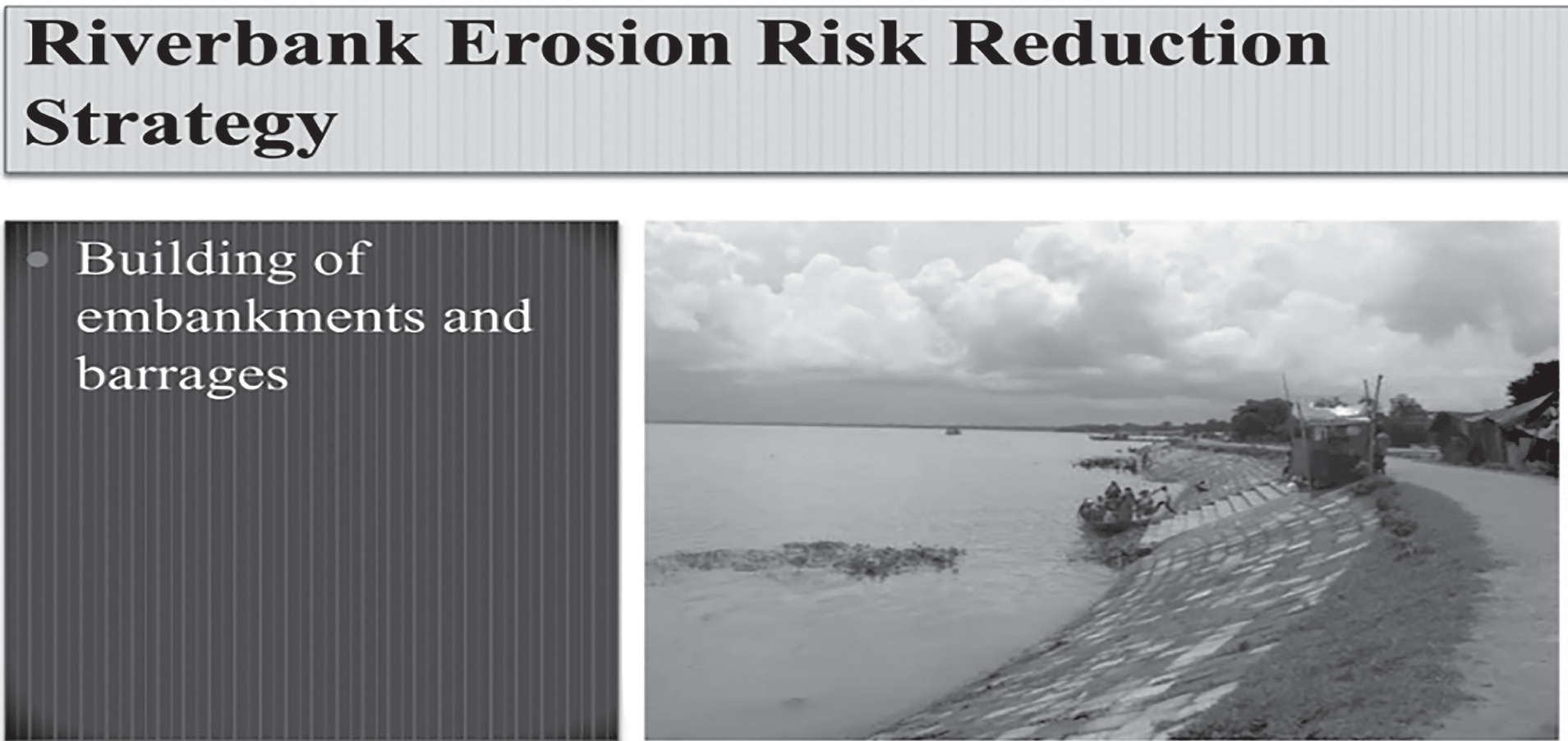
• Hard Engineering Options (such as building sea walls, revetments and groynes)
• Groyens and Breakwaters: These are structures that are built perpendicular to the shore to trap sand and protect against erosion.
• Soft Shore Protection: This involves the use of natural materials such as vegetation or sand-filled bags to protect against erosion.
• Soft Engineering Options (such as beach nourishment and managed retreat).
• Beach Nourishment: This involves the addition of sand to the beach to restore its natural slope and protect against erosion.
• Control of Beach Groundwater Table or Beach Dewatering System.
• Vegetation Planting like Mangroves and creation of Shelter Belts.
• Use of Geo-synthetic Tubes / Bags.
• Coastal Zoning: This involves the careful planning of development along the coast to minimize the impact on natural shoreline process. Coupling GIS and remote sensing techniques be used for coastal zone disaster management.
• Coastal Management through legal mechanisms like Eco Sensitive Zones, Coastal Regulatory Zones and creation of Marine Protected Areas.
Steps Taken to Mitigate Coastal Erosion
• National Disaster Management Authority (NDMA) in 2023 is working on the draft of India’s first National Policy for The Mitigation and Rehabilitation of the people affected by River and Coastal Erosion, based on the 15th Finance Commission’s report for 2021.
• Earlier, the Indian National Centre for Ocean Information Services (INCOIS) had prepared and published an atlas of Coastal Vulnerability Index (CVI) maps for the entire coastline of India using seven input parameters:
shoreline change rate, sea-level change rate, coastal elevation, coastal slope, coastal geomorphology, significant wave height and tidal range.
• Innovative methods including Tetrapod used in Kerala
are very effective to prevent coastal erosion.
• National Centre for Sustainable Coastal Management (NCSCM): It aims to promote integrated and sustainable management of the coastal and marine areas in India for the wellbeing of the traditional coastal and island communities.
• Integrated Island Management Plan (IIMP):
• Conserve and protect of Islands unique environment and its marine areas
• Provide livelihood security to the local communities
• Promote sustainable development based on scientific principles taking into account the dangers of natural hazards, sea level rise due to global warming
• Integrated Coastal Zone Management Plan (ICZMP): Management of the coast using an integrated approach, regarding all aspects of the coastal zone to achieve sustainability.
• Detailed hazard assessments carried out by central agencies such as the National Centre for Coast Research, National Centre for Sustainable Coastal Management, Central Water Commission and, high-resolution LiDAR data available with National Remote Sensing Centre should be made available to the SDMAs. These should be made available in easy-to-access in Geographic Information Systems (GIS) formats by the NDMA.
• Government has identified 98 coastal erosion hotspots in 11 coastal states/UTs.
• The Ministry of Environment Forest & Climate Change has issued the Coastal Regulation Zone (CRZ) 2019 notification with a view to conserve and protect the unique environment of the coastal stretches and marine areas, besides livelihood security to the fisher communities and other local communities in the coastal areas.
Nodal Ministry for Management / Mitigation of Different Disasters
| Disaste | Nodal Ministry/ Department |
| Biological | Ministry of Health and Family Welfare (MoHFW) |
| Chemical and Industrial | Ministry of Environment, Forests and Climate Change (MoEFCC) |
| Civil Aviation Accidents | Ministry of Civil Aviation (MoCA) |
| Cyclone/Tornado | Ministry of Earth Sciences (MoES) |
| Tsunami | Ministry of Earth Sciences (MoES) |
| Disaste | Nodal Ministry/Department |
| Drought/Hailstorm/Cold Wave and Frost/Pest Attack | Ministry of Agriculture and Farmers Welfare (MoAFW) |
| Earthquake | Ministry of Earth Sciences (MoES) |
| Flood | Ministry of Water Resources (MoWR) |
| Forest Fire | Ministry of Environment, Forests, and Climate Change (MoEFCC) |
| Landslides | Ministry of Mines (MoM) |
| Avalanche | Ministry of Defence (MoD) |
| Nuclear and Radiological Emergencies | Department of Atomic Energy (DAE) |
| Rail Accidents | Ministry of Railways (MoR) |
| Road Accidents | Ministry of Road Transport and Highways (MoRTH) |
| Urban Floods | Ministry of Urban Development (MoUD) |