ORBIT
An orbit is the curved path that an object in space (such as a star, planet, moon, asteroid or spacecraft) takes around another object due to gravity. Gravity attracts objects of mass to nearby objects, causing them to orbit each other with enough momentum. In our Solar System, the Moon orbits Earth, and Earth orbits the Sun, but that does not mean the larger object remains completely still. Because of gravity, Earth is pulled slightly from its centre by the Moon (which is why tides form in our oceans) and our Sun is pulled slightly from its centre by Earth and other planets.
During the early creation of our Solar System, dust, gas, and ice travelled through space with speed and momentum, surrounding the Sun in a cloud. The Sun’s gravity attracted these particles into orbit, shaping the cloud into a ring around the Sun. These particles eventually settled and clumped together, growing larger like snowballs, forming planets, moons, and asteroids. This formation of planets, moons, and asteroids is why all planets have orbits around the Sun in the same direction and plane.
Satellites are launched by rockets into space, where gravity keeps them in their desired orbit. This process is similar to throwing a ball out of a window of a tall tower, where the initial speed is given by the throw, but gravity alone keeps the ball moving towards the ground once it is released. Satellites are placed hundreds or thousands of kilometres above Earth’s surface and then given a push by rocket engines to start their orbit. A powerful throw will cause the ground to curve away before the object reaches the ground, causing it to fall towards Earth indefinitely and circle the planet repeatedly.
In space, there is no air friction, so gravity allows the satellite to orbit around Earth with minimal assistance. This allows for technologies such as telecommunication, navigation, weather forecasting, and astronomy observations.
What shape is an orbit?
Orbits come in different shapes. All orbits are elliptical, which means they are an ellipse, similar to an oval. For the planets, the orbits are almost circular. The orbits of comets have a different shape. They look like a “squashed” circle. They look more like thin ellipses than circles.
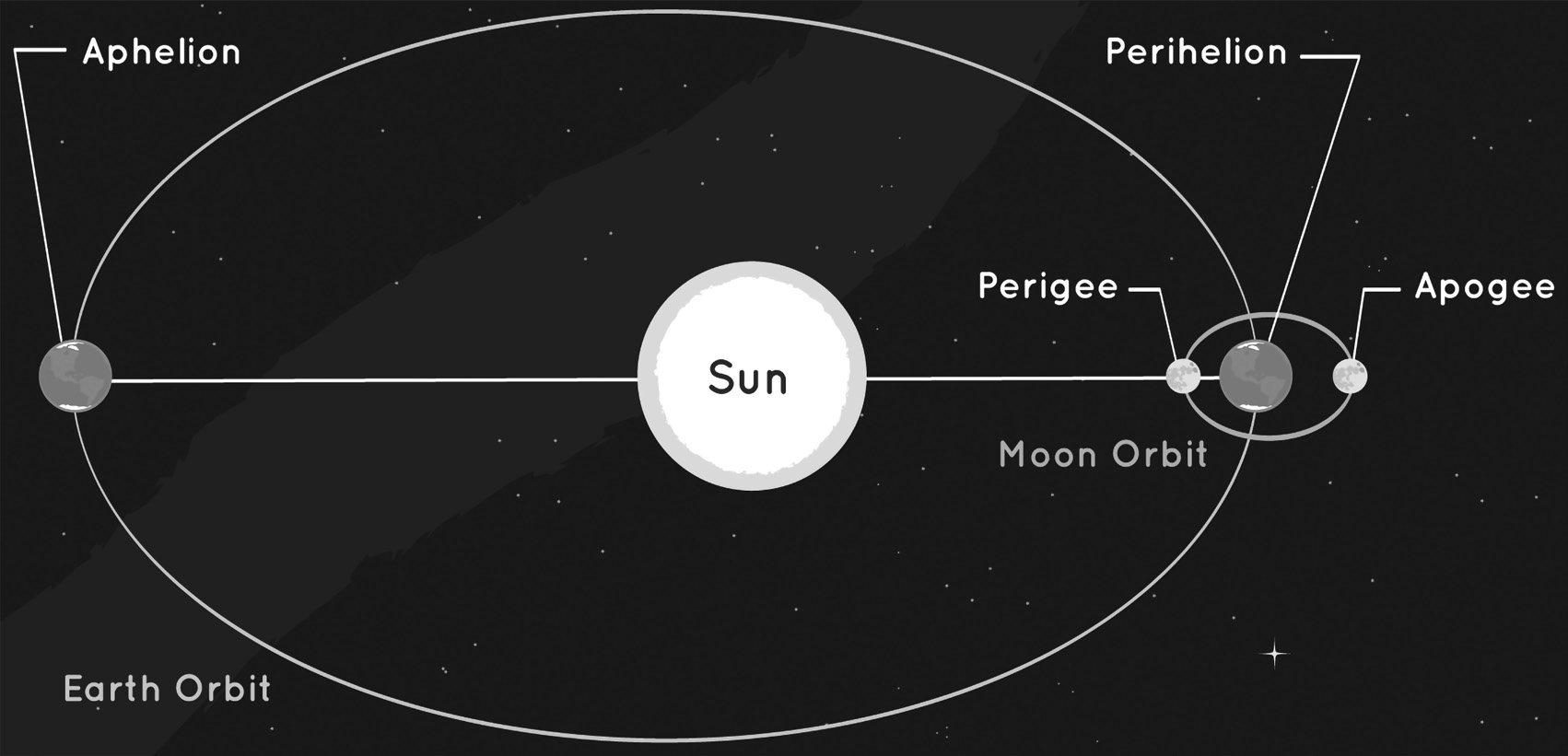
Satellites that orbit Earth, including the Moon, do not always stay the same distance from Earth. Sometimes they are closer, and at other times they are farther away. The closest point a satellite comes to Earth is called its perigee (peri + gee = close + earth). The farthest point is the apogee (apo + gee = far + earth). For planets, the point in their orbit closest to the Sun is perihelion (peri + Helion = close + Sun). The farthest point is called aphelion (ap + Helion = far + Sun). Earth reaches its aphelion during summer in the Northern Hemisphere. The time it takes a satellite to make one full orbit is called its orbital period. For example, Earth has an orbital period of one year
How Do Objects Stay in Orbit?
According to Newton’s first law of motion, unless a force is applied, an object in motion will continue to move. A satellite would travel in a straight path in the absence of gravity, but with the presence of gravity, it is drawn back towards Earth. The pull of gravity and the satellite’s momentum are always at odds with one another. An object’s momentum and gravity need to be balanced for it to enter an orbit. It will zoom by if its momentum is too high, and it will be pushed down and crash if its momentum is too low. The item always falls toward the planet when these forces are balanced.
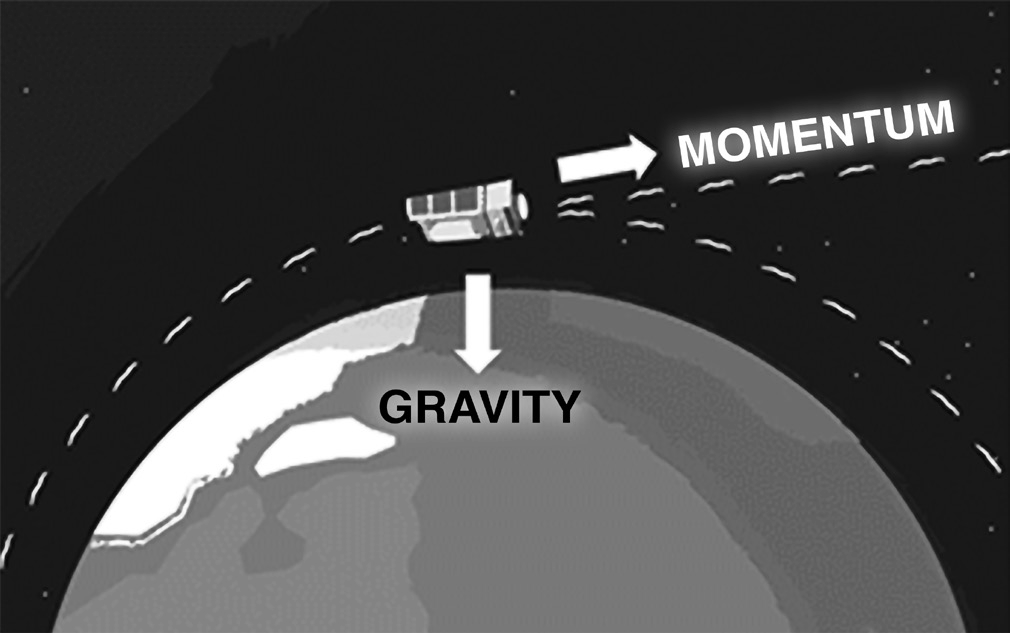
Orbital Velocity
The velocity at which a body orbits another body is known as orbital velocity. An object is said to be in orbit when it revolves around the Earth in an uniform circular motion. The distance between the object and the earth’s center determines the orbit’s velocity. Artificial satellites are typically given this velocity in order to revolve around a specific planet.
The orbital velocity formula is given by, It is given by
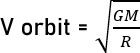
Where,
G = gravitational constant,
M = mass of the body at centre, R = radius of the orbit.
Orbital Velocity Formula is applied to calculate the orbital velocity of any planet if mass M and radius R are known.
Orbital Velocity is expressed in meter per second (m/s).