ORGANIZATIONS RELATED TO BANKING SECTORS
NPCI (National Payments Corporation of India)
• The Reserve Bank of India (RBI) and the Indian Banks’ Association (IBA) established the National Payments Corporation of India (NPCI) in compliance with the Payment and Settlement Systems Act, 2007 in an effort to forge a robust payment and settlement infrastructure in India.
• In accordance with Section 25 of the Companies Act 1956 (now Section 8 of the Companies Act 2013), it was incorporated as a “Not for Profit” company with the intention of serving as the backbone of India’s electronic payment and settlement systems. Punjab National Bank, State Bank of India, Canara Bank, Union Bank of India, Bank of Baroda, ICICI Bank Limited, Bank of India, HSBC, Citibank, and HDFC Bank Limited are the 10 main promoter banks of NPCI.
Objectives of NPCI
• NPCI’s main objective is to give the general public access to a reliable and reasonably priced payment system. In addition, NPCI is in charge of combining and merging different technologies into consistent, standard business procedures that are applied countrywide and can be utilized as a retail payment system.
Services Offered by NPCI
The NPCI provides the following range of services, which are listed below:
• Bharat Bill Payment Interface: To support the retail payments sector, the NPCI created the Bharat Bill Payment Interface (BBPI). A single platform has been created for bill payers and aggregators with the launch of the BBPI.
• IMPS: With the Immediate Payment Service (IMPS), you can make an immediate money transfer. The facility is open for use at all times. To send money with IMPS, the beneficiary information needs to be supplied. To transfer money via IMPS, you can also include the account number and the IFSC code.
RuPay: RuPay was created by NPCI to empower common citizens to handle their finances. RuPay is a reasonably priced card that comes in prepaid, debit, and credit card forms. In India, there are more than 300 million RuPay cards.
USSD Services: In order to enable people to make banking decisions without the use of cellphones or the internet, the NPCI established the Unstructured Supplementary Service Date (USSD).
BHIM: UPI is used by BHIM to complete payment transfers. By entering the registered cellphone number or the Virtual Payment Address (VPA), you can use BHIM to make payments. To transfer money with BHIM, you don’t need a smartphone.
Financial Services Institutions Bureau (FSIB)
It’s a government body that was established by the Department of Financial Services. Making recommendations for the nomination of full-time directors and non-executive chairman of state-run financial services firms will fall under the purview of the board.
The Banks Board Bureau (BBB) was superseded by it.
It would also prescribe criteria for choosing general managers and directors of general insurance businesses in the public sector.
The board will assist state-run banks in their fund-raising efforts and assist in establishing and executing business strategies, in addition to its primary responsibility of acting as a headhunter for state-owned financial services organizations.
The primary role of the Financial Services Institutions Bureau (FSIB) is to ascertain the requisite workforce and guarantee the appropriate selection of talent for high- level jobs in government-owned financial institutions.
Bank Board Bureau (BBB)
Indradhanush Mission’s seven-point plan to reform Public Sector Banks saw the establishment of Bank Board Bureau in April 2016. Reserve Bank of India funding supports this non-profit, independent Central Government organization.
It was composed of the Chairman, and three ex-official members: the Deputy Governor of the Reserve Bank of India, the Secretary of the Department of Public Enterprises, and the Secretary of the Department of Financial Services. In addition, there are five industry experts, two of whom were formerly employed in the private sector.
The overall functioning of the Bank Board Bureau Involved
Aid in the restructuring of the public bank sector business strategies
Provide support to deal with issues of bad loans or stressed assets
• Build Strategies along with banks for raising capital funds
• On crucial matter to give advice to the central government such as:
• Top-level appointments in PSBs include non- executive chairmanships and full-time directors.
• Advice the government on issues pertaining to the nomination, confirmation, extension, and termination of the directorships of nationalized banks.
• Assist the Central in creating a codes of conduct and ethics code for managerial staff of nationalized banks.
• Provide appropriate programs for the training and development of managerial staff in a nationalized bank.
Banking Codes and Standards Board of India (BCSBI)
• The Banking Codes and Standards Board of India (BCSBI) is an independent industry watchdog that works in consumer rights in the banking sector.
• The former deputy general of RBI, S S Tarapore, introduced the concept of setting up a committee that can help the banking customers enjoy better financial services. And so, BCSBI was registered as a separate body under the Societies Registration Act, 1860 in 2006.
Main objectives of the BCSBI
• To create and provide detailed Codes and Standards for the banks to follow, focusing on fair practice and quality customer service.
• To increase transparency between the banks and the customers.
• To nurture the relationship between the banks and the customers.
• To research and analyze the Codes and Standards followed by the banks around the world.
• To keep a close watch on the banks across the nation to ensure they comply with the Codes and Standards provided to them.
Advisory Board for Banking Frauds (ABBF)
• The Central Vigilance Commission, in 2019, in consultation with the RBI and based on the recommendation of an expert committee of NPAs and frauds constituted an ‘Advisory Board for Banking Frauds (ABBF)’.
• It can examine the role of officials or directors (including ex-officials/ex-whole-time directors) in public sector banks (PSB), public sector insurance companies, and public sector financial institutions.
• It includes cases of fraud amounting to ₹3 crore and above.
• All PSBs and PFIs were mandatorily required to refer all the matters of suspected frauds involving money of above Rs. 50 crores, wherein officers of the rank of general managers and above are involved, for seeking advice of the board before initiating any inquiry or investigation.
Cheque
• A check is a written document that can be used in place of cash. It’s a negotiable document that tells the bank to transfer a certain amount from the drawer’s account to a prearranged recipient. Cheques offer a safe and practical means of:
• Transfer funds.
• Make payments.
• Settle debts between individuals and businesses.
Types of Cheque
• Bearer Cheque: One who holds or “bear” the cheque, the bearer cheque is payable to that person only. It is an open instrument that can be cashed by anyone in possession of it.
• Order Cheque: An order cheque is only payable to the individual or business listed as the payee on the cheque. To be cashed, the payee must endorse it.
• Crossed Cheque: Two parallel lines go across the face of a crossed check. Indicating that the cheque must be deposited straight into the payee’s bank account, these lines are drawn. Moreover, it stops cheques from being cashed at the counter.
• Open Cheque: A cheque that is not crossed or designated as a bearer or order cheque is an open check. It is cashable over the counter and payable to the individual presenting it.
• Post-Dated Cheque: The payment date on post-dated cheque is an upcoming date. That day is the only one on which it can be encashed.
• Stale Cheque: A stale check is a check that has expired. Thus, keep in mind that you will only experience disappointment if you present stale checks after the due date.
• Traveler’s Cheque: A traveler’s cheque is a fixed- amount check that has been preprinted. It is intended for usage on travels. In addition, it is a more practical and secure option than carrying cash.
• Self-Cheque: An account holder’s cheque made payable to themselves is known as a self-check. It enables you to take money out of your account.
Cheque Truncation System (CTS)
• A technologically advanced method for processing physical paper cheques more quickly and efficiently is the Cheque Truncation System (CTS).
Financial Stability and Development Council (FSDC)
• The Financial Stability and Development Council (FSDC) was established by the government as the highest level forum in December 2010 with the goals of improving inter-regulatory coordination, bolstering and institutionalizing the mechanism for preserving financial stability, and encouraging the development of the financial sector.
• The heads of the financial sector regulators (RBI, SEBI, PFRDA, IRDA, and FMC), the finance secretary and/or secretary, the department of economic affairs, the secretary of the department of financial services, and the chief economic adviser make up the Council’s membership. The finance minister serves as the council’s chairman. If necessary, the Council may invite specialists to attend its meeting.
The Council oversees the macro prudential supervision of the economy, encompassing the operations of major financial conglomerates, while also addressing matters of inter-regulatory coordination and financial sector development, all while maintaining the regulators’ autonomy. Financial inclusion and financial literacy are also key themes.
In DEA, the Secretariat for the Council is the FSDC Secretariat.
Financial Stability Board (FSB)
The Financial Stability Board (FSB) replaced the Financial Stability Forum (FSF) when it was founded in April 2009. The G20 Heads of State and Government approved the FSB’s first Charter on September 25, 2009, which outlined the organization’s goals and mandate as well as its organizational structure, during the Pittsburgh Summit.
The G7 Finance Ministers and Central Bank Governors established the FSF, the FSB’s predecessor organization, in 1999.
In addition to developing and promoting the implementation of efficient regulatory, supervisory, and other financial sector policies, the Financial Stability Board (FSB) was founded to coordinate the efforts of national financial authorities and international standard-setting bodies on a global scale.
As an active member of the FSB, India is represented by the Secretary (EA), the Deputy Governor (RBI), and the Chairman (SEBI) in its Plenary.
• To represent India’s interests with the FSB, the FSDC Secretariat in the Department of Economic Affairs works in coordination with the various regulators of the financial industry and other pertinent groups.
Development Finance Institutions
• Development financial institutions (DFIs) or development banks are the organizations that provide development financing. In order to provide development finance to one or more economic sectors or subsectors, an institution is considered a DFI if it is “an institution promoted or assisted by Government.”
• The RBI Act of 1934, the Companies Act of 1956, and other acts creating DFIs do not utilize the term “DFI” in a particular manner.
• One of a Development Finance Institution’s (DFI) responsibilities is to identify and remedy any gaps in the nation’s financial sector’s markets and institutions. They offer Large (less than five years) and Medium (1–5) year funds.
Objectives of Development Finance Institutions
• The prime objective of DFI is the economic development of the country via financing infrastructure activities. These institutions provide long-term financial as well as technical support to various sectors.
• DFIs do not accept deposits from people but they raise funds by borrowing from governments, insurance companies, pension funds and sovereign funds. On behalf of businesses and subscriptions to shares, debentures, etc., it also offers banks a guarantee.
• They also offer advisory services, viability studies, project reports, and other technical help.
• DFIs help to improve loan flows towards infrastructure projects and offer credit improvement for housing and infrastructure projects.
Resources
• The DFIs were funded by patient equity capital and preferential market access for raising medium-/long- term resources. The Reserve Bank of India (RBI) provided preferential access through the channelization of multilateral funding lines, fund flow from the National Industrial Credit-Long-term Operations (NIC LTO), the issuance of tax-saving bonds and Statutory Liquidity Ratio (SLR) bonds, and appropriate facilitators to draw in funds from capital gains and investment allowance reserves.
• There were other special provisions made in the Income Tax Act, which enabled access to medium-/long-term funds, which supplemented the other fund-raising avenues.
• DFIs were also permitted to intermediate external commercial borrowings (ECB) markets for on-lending.
Emergence of Financial Institutions in India
In Asia, establishment of the Japan Development Bank and other term-lending institutions fostered rapid industrialisation of Japan.
The success of these institutions provided strong impetus for creation of DFIs in India after independence, in the context of the felt need for raising the investment rate.
The RBI was given the responsibility of creating a suitable financial architecture through institution building in order to mobilize and allocate resources to the sectors that were prioritized in the plan.
The Industrial Finance Corporation of India (IFCI) was the first DFI to be founded in India in 1948. The SFCs Act, 1951, allowed for the establishment of SFCs at the state level.
The specialized financial institutions set up after 1974 included NABARD (1981), EXIM Bank (1982), shipping credit and investment company of India (1986), Power Finance corporation, Indian Railway Finance corporation (1986), Indian Renewable Energy Development agency (1987), Technology Development and information company of India.
National Bank for Financing Infrastructure and Development (NABFID)
NABFID was set up as an All-India Financial Institution (AIFI) in 2022 under the NABFID Act, 2021, as the principal entity for infrastructure financing in the country.
NABFID has been primarily established to support the development of long-term infrastructure financing in India including the development of the bonds and derivatives markets necessary for infrastructure financing.
The entity will be regulated and supervised as an All- India Financial Institution (AIFI) by the Reserve Bank of India (RBI), making it the fifth sector-specific AIFI in the country.
Base rate
The lowest interest rate that Indian banks could lend money at was known as the Base Rate. It made its debut in July 2010. They were not allowed to use any loans that were lower than this rate. The average cost of financing played a major role in determining the base rate. Lenders had to assess their base rate at least once every quarter in accordance with RBI regulations. The RBI replaced base rate with the Monetary Chart Layout Rate (MCLR) in April 2016.
Marginal Cost of Funds Based Lending Rate and External Benchmarks Lending Rate
The base rates used by banks to calculate loan rates varies. The Reserve Bank of India (RBI), the nation’s central bank, announces these base rates. The following rates were applied to Indian loans up till 2019.
• Internal Benchmark Lending Rate (IBLR)
• Marginal Cost of Funds Based Lending Rate (MCLR)
Marginal Cost Lending rate
MCLR is the minimum interest rate below which banks cannot lend is known as the Marginal Cost Lending rate. It’s an internal rate for floating loans that each bank sets. The cost of carrying in cash reserve ratio, tenure premium, operating costs, and marginal cost of funds are all related to the MCLR. Unlike the base rate, which is based on the average cost of funds, it is determined using the current cost of funds. Additionally, MCLR reacts to changes in policy rates more quickly.
External Benchmarks Lending Rate
The internal benchmark rates, according to the RBI, were insufficient to provide an efficient means of transmitting monetary policy. The Reserve Bank of India has opted to use an external benchmark, as advised by its Internal Study Group (ISG). We now refer to this external benchmark rate as the EBLR rate. The reason why EBLR is so important in banking is that banks are unable to give their consumers loans at rates lower than the EBLR. Banks utilize EBLR to determine the interest rates on other loans as well as home loans. The term “external benchmark” refers to banks adhering to interest rate anchoring established by a third party outside the bank. External benchmarks include the MIBOR rate from FBIL and the repo rate from RBI.
External benchmarks for banks to follow:
• Reserve Bank of India policy Repo Rate.
• The Financial Benchmarks India Private Ltd. (FBIL) reported the yield on the Government of India’s 3-month Treasury Bills.
• The FBIL has released the Government of India’s 6-Month Treasury Bill yield.
• Any further benchmark market interest rate that the FBIL releases.
• Other kinds of borrowers may also be eligible for such external benchmark connected loans from banks. The spread, which is the higher interest rate that can be charged from a borrower who poses a greater risk, is another option available to banks.
Why a Shift from IBLR to EBLR?
• The change to EBLR was brought about by a number of problems with IBLR (Internal Benchmark Lending Rate). Listed below are a few of these:
• Banks passed on only a portion of the advantages to borrowers when the RBI reduced the repo and reverse repo rates. In this instance, the borrowers suffered a loss.
• The lending rate is dependent upon multiple factors. These variables could be the spread of the bank, the
financial summary of the bank at that point in time, and the deposit and non-performing asset (NPA) list respectively.
Since the IBLR was dependent on multiple variables, the internal benchmark was unable to accommodate any active changes in the effective interest rates.
Difficulties in transmitting lending rates arise from the requirement for greater transparency in the internal benchmark rate establishment process.
Non-Performing Assets Crisis
Non-Performing Assets: A loan or advance for which the principle or interest payment was past due for more than ninety days is considered a non-performing asset (NPA). Banks must further categorize non-performing assets (NPAs) into substandard, doubtful, and loss assets.
Substandard assets: assets that have been non- performing for a duration of 12 months or less.
Doubtful assets: If an asset stays in the substandard category for a full year, it will be labeled as questionable.
Loss assets: The RBI states that, “although there may be some salvage or recovery value, loss asset is considered uncollectible and of such little value that its continuance as a bankable asset is not warranted.”
Provision for Non-Performing Assets
The term “provision for non-performing assets” refers to the amount that banks set aside in a given quarter from their profits to cover non-performing assets (NPAs).
This is because there is a chance that this asset will eventually lose money. Banks can thus use this technique to provision for faulty assets and have a healthy book of accounts. In addition, banks, as previously said, base their provisions on the NPA category.
Furthermore, the kind of bank determines the provisions. For example, the provisioning standards of Tier-I and Tier-II banks differ.
By examining the bank’s auditor’s report, one can comprehend the NPA provisions. In accordance with RBI regulations, banks are required to periodically disclose their non-performing assets (NPAs). Understanding the bank’s non-performing assets (NPA) status is aided by two measures.
Gross Non-Performing Asset (GNPA)
The entire amount of a bank’s loans that are past due within ninety days of the end of a given quarter or fiscal year is known as its gross non-performing asset.
Net Non-Performing Asset (NNPA)
After the bank makes explicit provisions for NPAs, Net Non- Performing Asset displays the precise value of such accounts. It is calculated by deducting from the gross NPA the assets that are questionable and unpaid.
During the fiscal year of 2025-26 the public sector banks of India recorded the lowest ever non-performing asset with the gross NPA ratio is 1.93% and the Net NPA ratio is 0.39% as of 31 March 2026.
From Twin Balance Sheet Problem to Four Balance Sheet Challenge
The stress on balance sheets due to NPAs (for banks) on one side and heavily indebted corporates on the other results in the twin Balance Sheet (TBS) problem. From 2016 to 2017, this word became popular in India.
Usually, TBS is followed by economic stagnation, but India’s TBS problem co-existed with the high level of aggregate domestic demand, making sure that India has a unique path of TBS. NPAs reached their peak in 2015, with loans made during the strong growth years of 2003– 2008 accounting for the majority of them. The sector with the highest NPAs was infrastructure, which includes telecom, electricity, and transportation.
From the problem of TBS, we have graduated to four balance sheet challenges. It deals with banks and Non- Banking Financial Companies on the financial side and real estate and infrastructure companies on the corporate side.
The direct lending of some state banks to NBFCs was about 10-14% of their loan books, hence widening and deepening the NPA crisis in India.
NPAs SINCE 2011
Considering the long history of NPAs in India they have been at their lowest level during the global financial crisis and the few years following it. But there is an increase in NPAs since 2011, however, till 2013-14 the growth rate of NPA was considerably slow. From 2014 onwards, NPA grew at an exponential pace, reaching the maximum levels in 2017-18. The Public Sector Banks were the main source of the increase in non-performing assets.
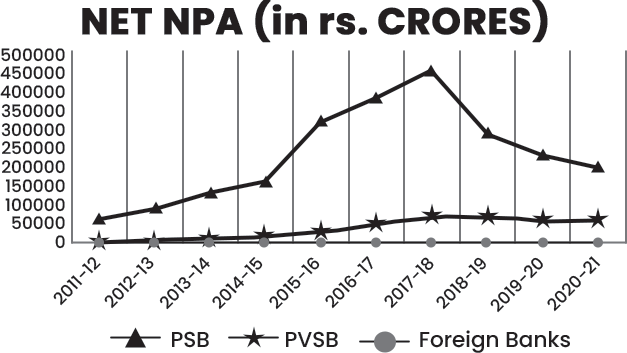
Reasons for NPAs in India
Over-optimism and slow growth: India was growing at a growth rate of 9-10% p.a. in the mid-2000s when huge loans were taken by all sectors but loans given to the infrastructure sector accounted for the most. Banks embraced the risk of taking on riskier projects because
they believed that India’s fast growth trend would continue. Most of the loans that became non-performing assets (NPAs) were granted between 2003 and 2008. The 2008 Great Financial Crisis caused all of the business houses’ and banks’ expectations to abruptly collapse. The Great Financial Crisis had an impact on India as well; the RBI raised interest rates, which in turn led to a rise in non-performing assets (NPA). The companies struggled to pay back their capital and interest, which resulted in an increase in non-performing assets (NPAs).
Government Permissions and Foot-Dragging: Government decision-making was dragged down by a number of governance issues, including the questionable allocation of coal mines and the associated fear of investigations. Cost overruns increased in stalled projects, and their inability to repay debts expanded. The problems of the stranded power plants show that government decision-making has not yet accelerated enough, despite India’s power shortfall.
Malfeasance: One key factor contributing to NPA in India was the bankers’ lack of due diligence. Post-original loan disbursement, the bankers’ performance was likewise subpar. Promoters were rarely held accountable for inflating their invoices to represent the true cost of capital equipment. Public sector bankers kept financing promoters even when private sector banks withdrew, indicating that their monitoring of the health of the promoter and the project was insufficient. Last but not least, an excessive number of loans were given to influential promoters who have a history of defaulting on their debts.
Fraud: The extent of frauds in the public sector banking system has grown, while they are still insignificant when compared to the total amount of NPAs. Frauds differ from typical NPAs in that they result from blatantly illegal behavior on the part of either the borrower or the banking. The investigating authorities claim that the banks are marking transactions as fraudulent long after the crime has really taken place.
Impact of NPA on the economy and profitability of the banks
Banking Sector is the powerhouse of the economy, a strong and growing economy thereby implies that the banking sector must be working well and acting as a catalyst for economic growth. Credit is provided by banks and is then used to fund successful initiatives and national growth. However, the cycle of lending, repaying, and borrowing is affected when money moves out the financial system.
Depositors and other lenders have the right to receive repayments from banks. If these repayments are not made, banks are required to secure additional loans in order to pay off their debts to creditors and depositors. As a result, banks become hesitant to issue further loans for existing or new projects.
• When credit to various sectors of the economy slows down, the economy suffers. Furthermore, non-performing assets (NPAs) compel banks to prioritize credit risk management over other areas of their operations.
• A bank possessing non-performing assets (NPAs) at a high ratio would have to bear the carrying expenses of those assets.
• Some other consequences of NPAs are- high levels of provisioning, reduction in interest income, stress on profitability and capital adequacy, gradual decline in the ability to meet the steady increase in cost, and increased pressure on Net Interest Margin (NIM) thereby reducing competitiveness, steady erosion of capital resources and increased difficulty in augmenting capital resources. Thereby rising NPAs imply an ailing economy.
Six-point strategy to solve non-performing assets problem
• Accountability: Usually, junior executives are held responsible for mistakes, while senior-level executives make big choices on the Credit Sanction Committee. Holding senior executives accountable is crucial for PSBs to tackle non-performing assets (NPAs).
• Corporate Governance: Despite the establishment of the Banks Board Bureau by the government in April 2016 with the aim of attracting talent, corporate governance has not reached the intended standard. Certain concerns still exist and require immediate resolution.
• Stricter NPA Recovery: The government needs to amend the laws and to allow banks greater authority to collect non-performing assets (NPAs). The fear of losing the asset is what prompted the Insolvency and Bankruptcy Code’s imposition of punishment. The current situation permits the RBI to examine a lender but denies them the authority to form an oversight committee due to debtor control modifications to the Banking Regulation Act. In relation to PSBs, the RBI has requested nine more powers under the Banking Regulation Act, such as the authority to appoint and dismiss CMDs, to take over the Board of Directors and apply for the winding up of noncompliant banks, to approve voluntary amalgamation schemes, and more.
• Credit Risk Management: Accurate credit evaluation of the project, clients’ creditworthiness, and their expertise and experience should be conducted. In addition to performing these studies, banks must to create safeguards against outside influences and perform sensitivity analyses. To track early warning signs regarding the projects, an efficient Management Information System (MIS) needs to be put in place. The management should ideally receive timely notifications from the MIS indicating problems so that appropriate action can be done.
• Asset Reconstruction Company: To expedite the resolution of stressed PSB assets, an ARC or asset
management company must be established. Following extensive talks on capital and pricing concerns, the government should take the required actions to investigate the feasibility.
Fraud Management: Over the past three years, the quantity and value of PSB frauds have increased.
Measures taken to reduce NPAs
Over time, the Government of India and the Reserve Bank of India have implemented various measures to decrease non-performing assets (NPAs). These measures include the establishment of Debt Recovery Tribunals (DRTs) in 1993, the Lok Adalat in 2001, the Securitization and Reconstruction of Financial Assets and Enforcement of Security Interest (SARFAESI) Act in 2002 and the most recent one, the Insolvency and Bankruptcy Code (IBC) in 2016.
Securitisation, Reconstruction of Financial Assets and Enforcement of Security Interest Act, 2002 (SARFAESI Act, 2002)
To investigate banking sector reforms, the Central Government formed the Andhyarujina Committee and the Narasimhan Committees I and II. These committees evaluated whether these sectors’ legal frameworks needed to be changed. The SARFAESI Act, 2002, was based on the recommendations of these committees, which also suggested new laws for securitization and allowing financial institutions to store securities and sell them quickly without going through the legal system.
Important terms
Taking over the financial assets (loans) i.e., acquiring the asset from the Banks and Financial Institutions by the Securitisation Company is called “Securitisation”.
Taking over or acquiring financial assets (loans) from the Banks and Financial Institutions by the Asset Reconstruction Company is called “Reconstruction of Financial Assets”.
Important Provisions
The Act incorporates a provision for taking over the management of the borrower’s business in the manner as prescribed in the Act. This is a unique provision rarely found in any law.
The Act prohibits the borrower from delaying and defeating the secured creditor. The borrower who is liable to pay the debt can approach any court of law, not below the rank of High Court and DRT.
The Civil Courts such as Taluka Court or District Court have no jurisdiction whatsoever in respect of action taken by the secured creditor under the Act.
Debts which are time-barred cannot be recovered under the Act.
The Act supersedes all laws in India. This is also a
unique provision. The borrower is not entitled to invoke provisions of other laws in his defence to delay and deny the rightful secured creditor from exercising his rights under the Act.
• The Appeal can also be filed by the borrower or the guarantor against the decision of Debt Recovery Tribunal in Debt Recovery Appellate Tribunal (D.R.A.T.) subject to payment of 50% of the amount as claimed by the Bank or the Financial Institution or as determined by DRT whichever is less.
• The Act also contains provisions in respect of establishment of the Securitisation Company, Asset Reconstruction Company and Central Registry.
Shortcomings and lacunae in the SARFAESI Act
• Despite its many benefits, the SARFAESI Act is not without flaws. Being inapplicable to unsecured creditors is one of the Act’s major shortcomings.
• After the asset is put up for auction, the bank has no control over what happens to it. The bank cannot continue in accordance with the prior conditions if there are no bidders for the asset at the auction.
• One of the Act’s provisions allowed the bank to hold a particular asset for a maximum of seven years. However The Act does not outline what happens if the bank receives no reasonable bid within the allotted period.