Paleolithic Age
• Etymology: Paleo means old and lithic means stone.
• Time Range: It ranges from 5,00,000 BCE to 9,000 BCE and coincides with the Ice age. The Paleolithic culture in India developed during the Pleistocene period of Geological time scale.
• Geographical Spread: It was found in all parts of India except Indus and Ganga basin
• This age is divided into upper, middle and lower paleolithic periods.
• Humans started residing in India from 500,000 years ago. Various paleolithic sites contain tools and remains of that era.
• Sources of study: Archaeological sites, geological sediments, animal bones and fossils, stone tools, bone tools, rock paintings and artefacts.
• Wild plants and animals grow naturally and independently. When they are domesticated, their lifestyle and physical characteristics (such as self-propagation) change. Consequently, the seeds of domestic plants become smaller in size. In the case of domesticated animals, they lose their ferociousness.
• Man in this age had no knowledge of agriculture, house building, pottery, or any metal.
• It is characterized by the use of unpolished stone tools such as hand axes, cleavers, choppers, blades, burin, and scrapers.
• Human Species: The Paleolithic tools were usually made of “Quartzite”, thus the Paleolithic man in India is also known as “Quartzite Man”.
• Lower Paleolithic Age: Existence of Homo Erectus
• species.
• MiddlePaleolithic Age: Existence of Homo Neanderthal species.
• Upper Paleolithic Age: Existence of Homo Sapien species.
• On the basis of the type of the stone tool used by people, the Palaeolithic Age in India is divided into three phases as follows:
• Lower Paleolithic Period: (Between 5,00,000 to 1,50,000 BCE)
• It covers the greater part of the ice age.
• Bori in Maharashtra is considered to be the earliest Lower Palaeolithic site.
• Tools used:
• The first Palaeolithic tools were identified at the site of Pallavaram near Chennai by Robert Bruce Foote in 1863, where climate was humid and suitable for paleolithic human. He found many pre-historic sites in South India.


• According to anthropological evidence, hand axe, stone cutting tools, cleavers, choppers were used for hunting, butchering and skinning the animals.
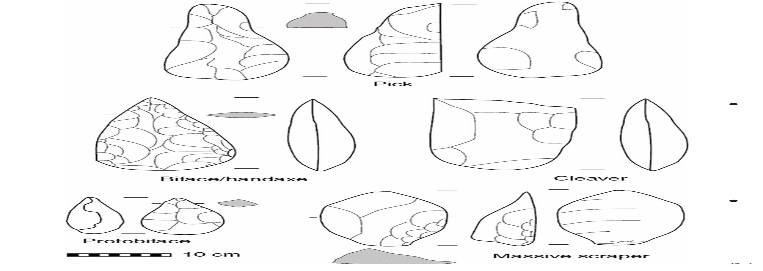
Acheulian: This is used to refer to a kind of stone tool. The industries of Palaeolithic cultures are divided into the Early, Middle and Late Acheulian Industries. The early Acheulian tools include polyhedrons, spheroids, hand axes, cleavers and flake tools.
Levallois Technique: Tool making technique in which flakes around the stone used to be removed.
Sites:
Lower Palaeolithic tools are widely distributed across India, though they are absent in certain areas, including parts of the Indus and Ganges valleys, southern Tamil Nadu, and the hilly regions of the Western Ghats.
Notable Palaeolithic sites where Acheulian tools have been discovered include Athirampakkam, Pallavaram, and Gudiyam near Chennai, Hunsgi Valley and Isampur in Karnataka, and Bhimbetka in Madhya Pradesh.
•
The Valley of the River Son (also known as Sohan), located in Punjab (present-day Pakistan), along with Kashmir, the Thar Desert, and Belan Valley in Uttar Pradesh, are prominent Palaeolithic sites. Other key locations include the Didwana Desert in Rajasthan, Chirki-Nevasa in Maharashtra, Nagarjunakonda in Andhra Pradesh, and the caves and rock shelters of Bhimbetka near Bhopal. Excavations at Didwana have uncovered not only Lower Palaeolithic stone tools but also those from the Middle and Upper Palaeolithic periods.
• Settlements: In some areas, prehistoric settlements have also been discovered. These sites can be identified by the presence of stone tools. Early human ancestors crafted large stone blocks and pebbles, using another hard stone to shape them into tools. Items like hand axes, cleavers, and choppers were made by striking off chips through a process called flaking. Settlements were typically located near these tool-making sites.
Occupation: Hunting and gathering
• People of the Lower Palaeolithic culture hunted animals and gathered roots, nuts, and fruits.
• They consumed the flesh and bones of animals hunted by predators.
• Evidence from sites like Bhimbetka in Madhya Pradesh and Gudiyam near Chennai shows that they lived in open-air areas, river valleys, caves, and rock shelters.
Linguistics:
• Sign Language existed.
• The pre-historic human ancestors, who belonged to the species of Homo erectus, did not have a complex language culture like us, the Homo Sapiens.
Mid Palaeolithic Period: (Between 1,50,000 and 35,000 BCE)
• Tools Used:
• Middle Palaeolithic industries primarily relied on flakes or small pieces of stone, which have been discovered across various parts of India, showing regional differences.
• Anthropological evidence indicates that, compared to the Lower Palaeolithic period, lighter stone tools, such as flake tools, became more prominent.
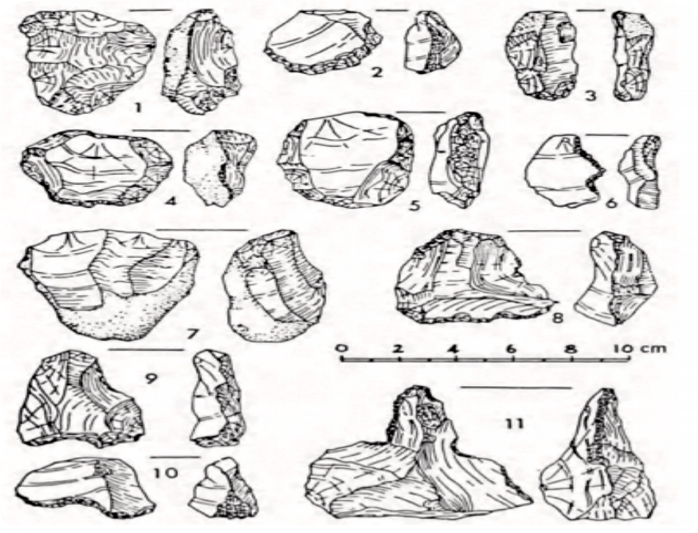
• The tool types from the Middle Palaeolithic period include hand axes, cleavers, choppers, scrapers, borers, points, projectile points (or shouldered points), and knives made from flakes.

• Upper Paleolithic Period: (Between 35,000 and 10,000 BCE)
• Tools Used:
• According to anthropological evidence, more sharpened Blades and Flake stone tools are found.
• Blade and Bone tool technologies became prominent.

• Climatic Conditions: Ice age was about to end during this era.
• Sites:
• In India, the Middle Palaeolithic phase was first identified by H.D. Sankalia on the Pravara River at Nevasa. After this discovery, several sites of this period have been identified such as Narmada, Godavari, Krishna, and Yamuna River valleys.
• Settlements: It got enhanced as compared to Lower Palaeolithic era. Majorly open air, cave and rock shelter sites were dominant. After about 4,00,000 years BP (Before Present), changes took place in the lithic technology and the species of human ancestors diverged. The species of Homo Neanderthals existed in this period.
• Burial Sites: Tools were found in the region around Soan Valley and Ganga Plains.
• The main features of the Indian Middle Palaeolithic period include the following:
• The tools became smaller.
• The decrease in the use of hand axes in relation to other tools.
• Use of core preparation techniques in stone tool production.
• Use of chert, jasper, chalcedony and quartz as raw materials to make stone tools.
• Microliths (tiny stone tools) were introduced in this period and these tools were made using different varieties of silica-rich raw materials.
• Climatic Conditions: More Humid conditions existed because Ice Age was coming to an end.
• Sites: Meralbhavi in Karnataka, Kurnool caves and Godavarikhani in Telangana, Baghor I and Baghor III of Son Valley in Madhya Pradesh and Patne in Maharashtra are some of the Upper Palaeolithic sites of India.
• Ostriches: Large quantities of ostrich eggshells were found at Patne in Maharashtra.
• Settlements: Caves and open-air space used by Homo sapiens who existed in this period.
• Art:
• Evidence of art in the Upper Palaeolithic period appears in the form of paintings. Beads and ornaments of this period have also been found. Green colour paintings of Bhimbetka.
• Earliest evidence of Shrine: Found in Baghor.


• This Age came to an end with the end of the ice age around 10,000 BC.
• Discovery of fire in upper paleolithic age