• Pallavas:
| Earlier Pallavas (275 - 560 A.D.) |
| Simha Varman I (275-300 A.D.) |
| Skanda Varman I (300-335 A.D.) |
| Vishnu Gopa (335-350 A.D.) |
| Kumar Vishnu I (350-370 A.D.) |
| Skanda Varman II (370-385 A.D.) |
| Vira Varman (385-400 A.D.) |
| Skanda Varman III (400-436 A.D.) |
| Simha Varman II (436-460 A.D.) |
| Skanda Varman IV (460-480 A.D.) |
| Nandi Varman I (480-510 A.D.) |
| Kumar Vishnu II (510-530 A.D.) |
| Buddha Varman (530-540 A.D.) |
| Kumar Vishnu III (540-550 A.D.) |
| Simha Varman III (550-560 A.D.) |
| Later Pallavas (560 - 897 A.D.) |
| Sivaskanda Varman (560-575 A.D.) |
| Simha Vishnu (575-600 A.D.) |
| Mahendra Varman I (600-630 A.D.) |
| Narsimha Varman I (630-668 A.D.) |
| Mahendra Varman II (668-672 A.D.) |
| Parmeshwar Varman I (672-695 A.D.) |
| Narsimha Varman II (695-722 A.D.) |
| Parmeshwar Varman II (722-730 A.D.) |
| Nandi Varman II (730-795 A.D.) |
| Danti Varman (795-846 A.D.) |
| Nandi Varman III (846-869 A.D.) |
| Aparajit Varman (869-897 A.D.) |
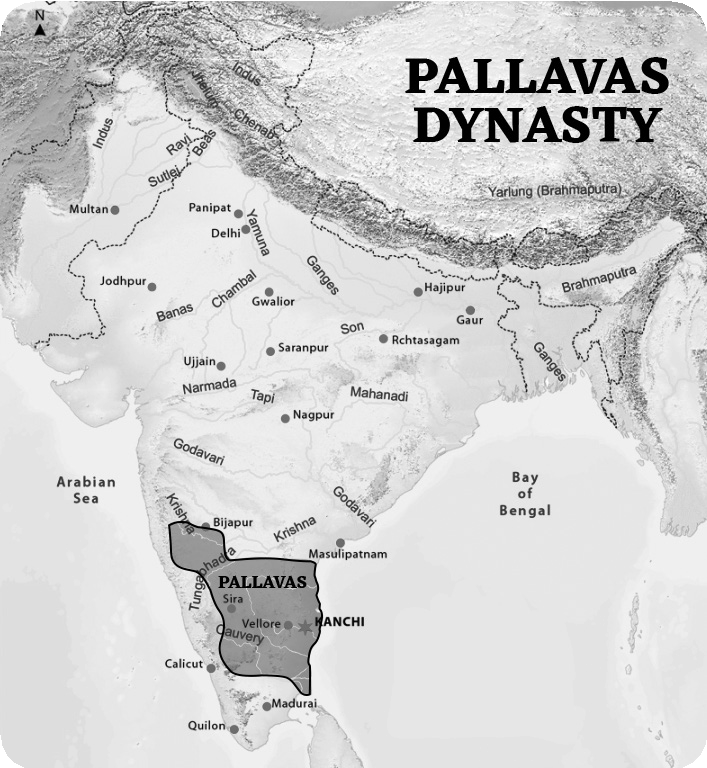
After Ikshvakus, Pallavas came into the ruling system. Their region extended to Tamil Nadu and Andhra Pradesh.
Capital: Kanchi
Pallavas initially were in regular conflict with Kadambas
of Karnataka.
The Pallava-Chalukya conflict continued during the subsequent decades, with some intermittent peace.
The Pallavas were associated with Tondaimandalam, the land between the north Pennar and north Vellar rivers
• The founding Pallava ruler was Simhavishnu. Simhavishnu is believed to have conquered the Chola country up to the Kaveri and consolidated his dynastic rule, started by his father Simhavarman. Simhavishnu, vanquishing the Kalabhras, conquered the land up to the Kaveri, thereby coming into conflict with the Pandyas. He propagated Vaishnavism. He adores the title Avanisimha which means lion of the Earth.
• Simhavishnu’s successor Mahendravarman I (590- 630 A.D.), whom Appar (Nayanar Saint), converted from Jainism to Saivism, was a patron of arts, and a poet and musician in his own right.
• Mahendravarman-I had many titles like Gunabhadra,
• Lalitankura and Shatrumalla.
• Pulkesin -II defeatedhim. During Mahendravarman’s reign, the army of Pulikesin II annexed the northern part of Pallava kingdom and almost reached the Pallava capital of Kanchipuram.
• Narasimhavarman -I defeated Pulkesin II. He took over Badami (Vatapi) and adopted the title of Vatapikondan.
• Huen Tsang visited Kanchi during the period of Narasimhvarman.
• Mamallapuram city was built by Narasimhvarman-I.
• Subsequently, during the reign of Narasimhavarman I (630-668 A.D.), the Pallavas managed to settle scores by winning several victories over the Chalukyas with the aid of their ally Manavarman, a Sri Lankan prince, who later became ruler of the island kingdom.
• During the reign of his grandson, Paramesvaravarman I (670-700 A.D.), Vikramaditya of the Chalukya kingdom invaded the Pallava country.
• Paramesvaravarman fought against him with the support of the Gangas and Pandyas. As a result, the Pallavas came into conflict with the Pandyas in the south.
• In the early ninth century, the Rashtrakuta king, Govind III, invaded Kanchi during the reign of Pallava king Dantivarman.
• Dantivarman’s son Nandivarman III aided by western Gangas and Cholas, defeated the Pandyas at the battle of Sripurambiyam or Thirupurambiyam.
• Aparajita, grandson of Nandivarman III, lost his life in a battle fought against Aditya I of the Chola kingdom who invaded Tondaimandalam.
This sealed the fate of the Pallavas. Thereafter, control over Tondaimandalam passed into the hands of the Cholas
Pallava Administration:
• Under the Pallavas, kinship was held to be of divine origin and was hereditary.
• The king took high-sounding titles, some of which, such as Maharajadhiraja, were borrowed from north Indian traditions.
• The king was assisted by a group of ministers, and in the later Pallava period this ministerial council played a prominent part in state policy.
• Some of the ministers bore semi-royal titles and may well have been appointed from among the feudatories.
• Sabha: Basic assembly in village
• Urrar: Informal gathering of the entire village.
• Nadu: Group of villages.
• Eripatti: Tank Land.
• Sudesi, Nanadesi, Ainurruvar: Guilds founded by traders.
• Ayyavole-parameswariyar: Members of the guild.
Village Life
• In the village, the basic formal unit of administration was the assembly called Sabha, which decided upon all matters relating to the village, including endowments, land, irrigation, cultivation of crops, criminal justice, census and other records.
• The Sabha worked closely with the Urar, an informal assembly of the entire village.
• Higher up was a district council that worked with nadu or district administration.
• The village headman was the link between the village assembly and the official administration.
• Village courts handled petty criminal cases. At a higher level, in towns and districts, courts were presided over by government officials.
•
The king remained the supreme arbiter of justice who looked at appeals and his decision was final.
Tank Irrigation
• A special category of land, Eripatti or tank land, was donated by individuals, to maintain the village tank (built by the villagers), which stored the rainwater to be used during annual long, dry spells.
• Almost all Pallava period inscriptions on rural affairs called for regular maintenance of the tank. Water was distributed by canals that had sluices installed to control the water level and stop overflowing at the source.
• The water distribution was supervised by a special tank committee of the village.
• The tank water was shared by all cultivators. Water taken in excess of allotted to a particular cultivator was taxed.
• After tank irrigation, wells were considered next in importance.
Revenue and Taxation
• Most information on land revenues and taxation is found in copper plates having records of the land grants.
• Revenue came almost exclusively from rural sources, mercantile and urban institutions being largely unplanned. Two categories of taxes were levied on the village.
• The land revenue paid by the cultivator to the state varied from 1/6th to 1/10th of the produce and was collected by the village and paid to the state collector.
• In the second category were local taxes, also collected in the village but utilized for services in the village itself. The tax money was spent repairing irrigation works, illuminating the temple, etc.
• When the state land tax was inadequate, the revenue was supplemented by additional taxes on draught cattle, toddy drawers, marriage-parties, potters, goldsmiths, washermen, textile manufacturers, weavers, brokers, letter-carriers, and the makers of ghee.
• The loot and booty obtained in war added to the revenue of the state. Pallava considered war to be very important and a series of sculptures depicting the important events connected with the reign of Nandivarama Pallava, notably Pallava troops attacking a fort are seen in the Vaikunta Perumal temple at Kanchipuram. This fort is depicted in the sculptures as having high ramparts with soldiers attacking it and elephants standing near it.
Trade
• Kanchipuram was an important trading center in the Pallava period. Merchants (traders of commodities) had their own organizations such as Manigramam. The merchants had to obtain a license to market their goods.
• Barter system generally prevailed but later the Pallavas issued gold and silver coins.


• In foreign trade, spices, cotton textiles, precious stones and medicinal plants were exported to Java, Sumatra, Cambodia, Sri Lanka, China and Burma. Mamallapuram was an important seaport.
• Traders founded guilds and called themselves as Sudesi, Nanadesi, Ainurruvar and others. Their main guild functioned at Aihole. Foreign merchants were known as Nanadesi. It had a separate flag with the figure of a bull at the centre, and they enjoyed the right to issue vira-sasanas. The jurisdiction of this guild stretched over the entire south-east Asia. The chief of this guild is registered in the inscriptions nemely Pattanswamy, Pattnakilar, and Dandanayaka. Its members were known as Ayyavole-parameswariyar.
• Maritime Trade
• Three major kingdoms: Kambuja (Cambodia), Champa (Annam), and Srivijaya (the southern Malaya peninsula and Sumatra).
• On the West Coast, the initiative in the trade with the West was gradually passing into the hands of the foreign traders settled along the coast, mainly Arabs.
• Indian traders were becoming suppliers of goods rather than carriers of goods to foreign countries, and communication with the West became indirect, via Arabs, and limited to trade alone.
Society
• Brahmins as learned scholars in literature, astronomy, law and others functioned as the royal counselors. Not only were they in the teaching profession, but they were also involved in agriculture, trade and war.
• They were exempted from paying taxes and capital punishment.
• The next important social group which ruled the state was called Sat-nakshatras (quality kshatriyas).
• Not all the kshatriyas were of warring groups; some of them were involved in trading as well. They also enjoyed the right to read the Vedas, a privilege denied to lower varnas.
• The trading group maintained warriors for protection and founded trade guilds. The people who were at the bottom of society worked in agriculture, animal husbandry, and handicraft work.
• People engaged in scavenging, fishing, dry-cleaning and leather works were positioned outside the varna system.
• The caste system was prominent in this era.
• Most scholars agree that Aryanisation or the northern influence on the south picked up pace during the Pallava period. This is evident from the royal grants issued by the kings. The caste structure was firmly established. Sanskrit came to be held in high esteem.
• Kanchipuram continued to be a great seat of learning.