Power Sector in India
Power is among the most critical components of infrastructure, crucial for the economic growth and welfare of nations. For the Indian economy to grow
steadily, sufficient power infrastructure must exist and be developed.
India’s power sector is one of the most diversified in the world. Sources of power generation range from conventional sources such as coal, lignite, natural gas, oil, hydro and nuclear power, to viable non-conventional sources such as wind, solar, agricultural and domestic waste.
India stands 4th globally in Renewable Energy Installed Capacity, 4th in Wind Power capacity and 5th in Solar Power capacity (as per International Renewable Energy Agency - Renewable capacity statistics 2023). India is the only country among the G20 nations that is on track to achieve the targets under the Paris Agreement.
India is the third-largest producer and consumer of electricity worldwide, with an installed power capacity of 417.67 GW as of May 31, 2023.
As of May 31, 2023, India’s installed renewable energy capacity (including hydro) stood at 173.62 GW, representing 41.4 per cent of the overall installed power capacity. Solar energy is estimated to contribute 67.08 GW, followed by 42.87 GW from wind power, 10.25 GW from biomass, 4.94 GW from small hydropower, 0.55 from waste to energy, and 46.85 GW from hydropower.
Electricity: growth in installed capacity fueled by renewables
Among energy sources, thermal sources comprise the most (56.8 per cent) share of total installed capacity in utilities, followed by renewable energy resources with
• per cent and hydro with 11.2 per cent.
“India’s Power Sector Transformation: A Journey Towards Sustainable Energy and Universal Access”
Renewable Energy Installed Capacity
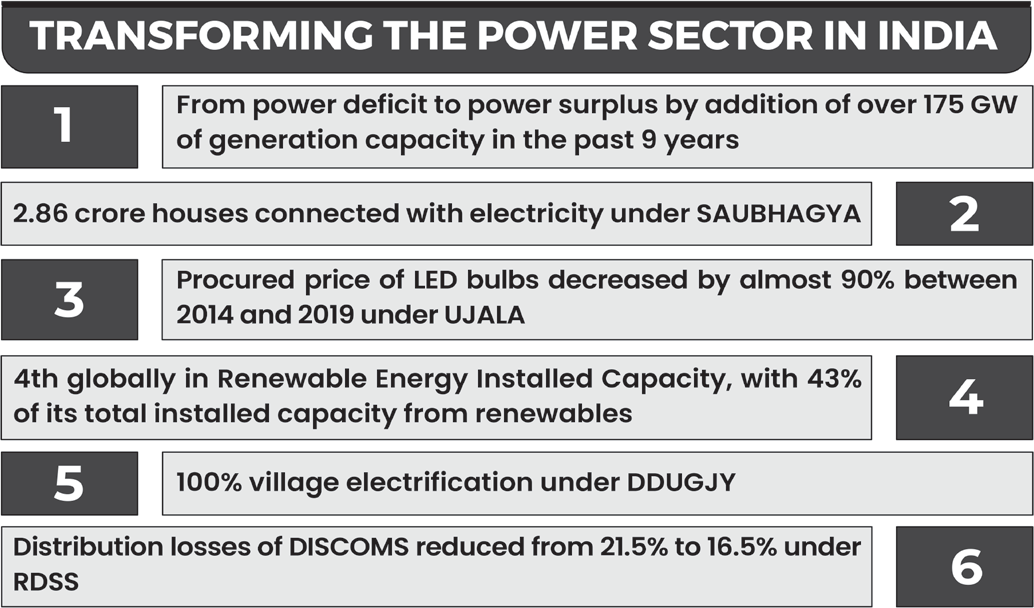
India’s journey towards a greener future has gained global recognition. With the addition of over 175 GW of generation capacity in the past nine years, India has transitioned from a power deficit to a power surplus nation.
The country’s commitment to renewable energy sources has played a pivotal role in achieving this feat. The remarkable growth of solar and wind energy capacity has cemented India’s position as a global leader in renewable energy adoption.
India stands 4th globally in Renewable Energy Installed Capacity, with 43% of its total installed electricity capacity coming from non-fossil energy sources.
Pradhan Mantri Sahaj Bijli Har Ghar Yojana (SAUBHAGYA)
India’s commitment to power generation and universal electrification has been a driving force
behind its transformation. This initiative stands tall as a symbol of success, achieving universal household electrification, covering every village and district in the country.
• The International Energy Agency (IEA) has called this the fastest expansion of access anywhere in the world in the history of power. The availability of power in both rural and urban areas has significantly increased.
Deen Dayal Upadhyaya Gram Jyoti Yojana (DDUGJY)
• To improve the quality and reliability of power supply in rural areas DDUGJY program achieved 100% village electrification.
Unnat Jyoti by Affordable LEDs for All (UJALA)
scheme
• The government’s efforts in promoting energy efficiency have also yielded remarkable results. Under this scheme, the procured price of LED bulbs decreased by almost 90%.
• This initiative not only brought down electricity costs for households but also encouraged domestic manufacturing of LED bulbs, supporting the “Make in India” campaign.
• As a result, India has witnessed widespread adoption of energy-efficient lighting solutions, contributing to reduced energy consumption and a greener environment.
Restructured Distribution Sector Scheme (RDSS)
To enhance the efficiency of power distribution, the government has implemented this initiative. The RDSS has significantly reduced distribution losses of DISCOMs.
These initiatives focus on reducing technical and commercial losses, improving metering and billing systems, and promoting energy efficiency.
The integration of smart grids, advanced metering infrastructure, and demand response mechanisms has enhanced grid stability and allowed consumers to actively manage their energy consumption.
The transformation of India’s power sector since 2014 is a remarkable story of progress and resilience. With achievements like universal electrification, the rapid expansion of renewable energy, improved distribution, and enhanced energy efficiency, India has set an inspiring example for the world.
The commitment of the Government of India, coupled with the participation of stakeholders, has propelled the nation towards a future powered by sustainable, affordable, and reliable energy.