Proposed Solutions
• Various comprehensive approaches to natural disaster mitigation have been suggested, aiming to incorporate the multiple physical causes of natural hazards, corresponding engineering solutions, and the interconnected socio-economic, political, and cultural challenges.
• There is a growing recognition that humans are not merely victims of natural disasters but also play a role in exacerbating their impacts. This occurs through unsustainable exploitation of natural resources, contributions to climate change, and inefficiencies within political and economic systems, all of which amplify the adverse effects of hazardous natural events.
• Therefore, in order to address this complex paradigm, the steps must include
• A long-term focus is needed on capacity building
• Ensure equitable distribution of economic resources
• Reduction in poverty
• Participation of local communities
• Incorporating local knowledge and practices
• Standardize practices, with local government, local NGOs, and communities affected by disasters.
• Internalizing the Culture of Disaster Prevention and Preparedness
• Continuity through Post-project community initiatives
• Coordination among various organisations and projects to end silos and eliminate duplication of efforts
Incident Response System (IRS)
• The Incident Response System (IRS) serves as an efficient framework to minimize reliance on unplanned emergency measures. It encompasses all tasks associated with disaster management, regardless of their complexity.
• The IRS is designed to function as a structured team comprising multiple sections, ensuring a comprehensive approach to response efforts. It assigns specific roles to designated officers, providing them with the necessary training to effectively fulfill their responsibilities.
IRS Organisation
• The IRS operates through Incident Response Teams (IRTs) deployed in the field. In accordance with the administrative framework and the Disaster Management Act of 2005, Responsible Officers (ROs) are appointed at both the State and District levels to oversee incident response operations.
• However, the RO has the authority to delegate responsibilities to an Incident Commander (IC), who then leads the response through IRTs.
• These teams are pre-assigned at different levels, including the State, District, Sub-Division, and Tehsil/Block. Upon receiving an Early Warning, the RO will activate the appropriate teams.
• If a disaster occurs without prior warning, the local IRT will take immediate action and coordinate with the RO for additional assistance if necessary.
• To ensure seamless coordination across District, State, and National levels, a Nodal Officer (NO) is appointed, particularly for managing air support activation during response operations.
• Apart from the RO and NO, the IRS consists of two primary components:
• a) Command Staff
• b) General Staff
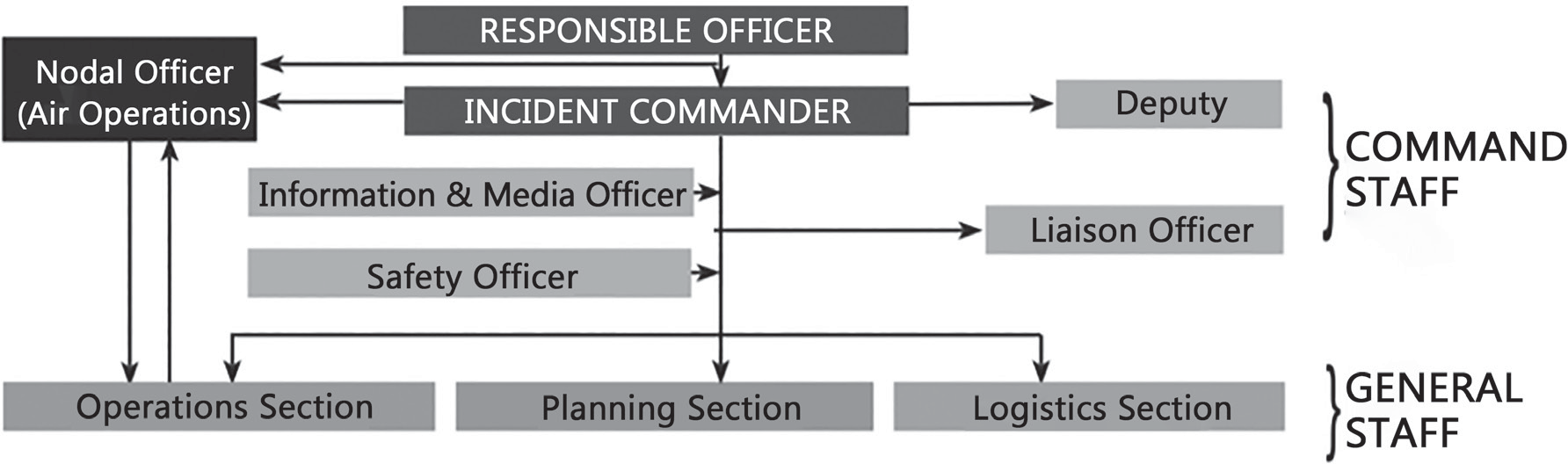
Figure: Incident Response System (IRS) Organization Model The Dahsala or Zabti System
Incident Response Team (IRT)
• The ROs of the State and Districts will constitute IRTs from among officers at the State and District level respectively.
• The members of IRTs will be properly trained and sensitized regarding their roles during the pre-disaster phase itself. Selection of different section chiefs will be guided by the nature and type of disaster.
• The headquarters IRT will provide continuous support to the on-scene IRT(s) and if required join them or take over response on the directions of the RO.