RADIO FREQUENCY IDENTIFICATION (RFID)
• RFID technology uses radio waves to passively identify a tagged object.
An RFID tag consists of a tiny radio transponder; a radio receiver and transmitter.
Unlike a barcode, the tag doesn’t need to be within the line of sight of the reader, so it may be embedded in the tracked object.
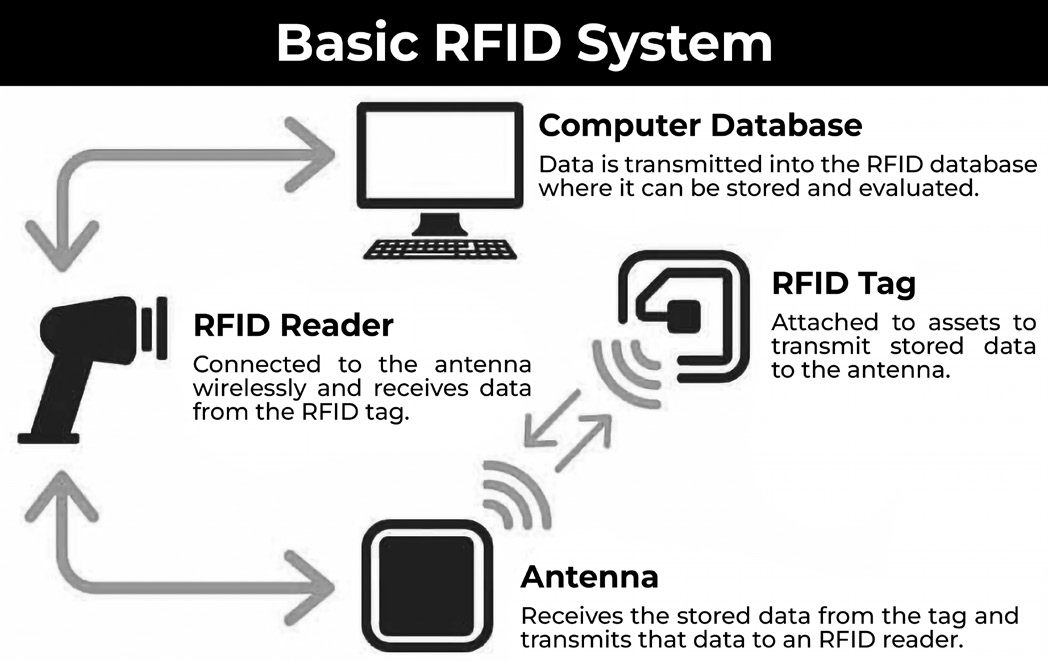
Functioning of RFID
In the RFID system, the RFID reader continuously transmits radio waves at a particular frequency.
When an RFID tag is attached to an object that is in the radio wave’s range, the tag sends feedback to the RFID reader, which uses the feedback to determine the object’s identity.
Types of RFID
• Passive tags: Passive tags don’t have a power source. The incoming radio waves from the readers are where they get their power. RFID tags that are passive are powered by the reader and do not require a battery.
• Semi-passive tags: Semi-passive tags comprise an internal circuit with a power source, but rely on the radio waves received from the reader to transmit the response.
• Active tags: Active tags have an internal circuit that is powered by a power source. Active RFID tags are powered by batteries. Additionally, it uses its own power source to transmit the answer to the reader.
BARCODE
• A barcode is a machine-readable representation of text and numbers made up of bars and spaces.
• Another name for it is the Universal Product Code (UPC). It is employed to effectively identify and monitor individuals and things.
Comparison with Barcode
• While RFID uses radio waves to transfer data from RFID chips to readers that do not need to be in line of sight, barcodes use light to scan the black-and-white pattern printed on the adhesive tag.
• Barcodes are simple and easy to duplicate, whereas RFID is more complicated and difficult to do so.
• RFID tags are more expensive than barcodes.
Applications
• Logistics and supply chain – RFID’s ability to provide supply chain insight can boost productivity, cut down on mistakes, and enhance quality.
• Inventory tracking – It only takes a few minutes to trace items through the supply chain to the point of scale with the help of an RFID reader.
• Tracking attendees – Long registration lineups can be avoided by using an RFID-based system for conference management.
• RFID based access – In certain locations, increased security is required. RFID control tags can be used to limit access to people who have been pre-approved.
• Real time location system – With this technology, assets and employees may be tracked in real time.
FASTAG
• The FASTag is a reloadable tag that allows tolls to be deducted automatically without the need to stop for a cash transaction.
• Once activated, the tag employs Radio Frequency Identification (RFID) technology and is attached to the vehicle’s windscreen.
• It was first used in April 2016, and on December 1, 2017, the government made it mandatory for all new automobiles and trucks to be fitted with a FASTag before being sold.
• NHAI launched two mobile Apps – MyFASTag and FASTag Partner to facilitate the availability of FASTags.
• The tag is valid for five years and comes in seven different colours — violet, orange, yellow, green, pink, blue, black. Each colour is assigned to a particular category of vehicles.
• Indian Highways Management Company Limited (IHMCL) (a company incorporated by National Highways Authority of India) and National Payment Corporation of India (NPCI) are implementing this program.
• FASTag is presently operational at both, national and state highways.
Advantages
• Ease of payment – No need to carry cash for the toll transactions, saves time.
• Near non-stop movement of vehicles leading to lower fuel cost.
• Other benefits are:
• Environmental benefit: reduced air pollution, reduced use of paper.
• Social benefit: reduced toll payment hassles, analytics for better highway management.
• Economic benefit: reduced effort in management at toll plaza, reduced effort in monitoring centrally.
Limitations
• Technical problems, such as the sensor not reading the tag correctly, could exist. Errors in technology may also result in an incorrect charge to a user.
• Some teething problems, such as people attempting to pay with cash in the FASTag lanes, have prevented them from drastically reducing the wait times at the toll booths.
• The NHAI and banks are the direct sources of FASTags. Since they are bank-neutral, any bank can recharge the ones that NHAI sells. But those that banks sell aren’t, therefore you have to recharge them from the same bank.
Way Forward
• India plans to implement satellite-based tolling systems on national highways by March 2024, according to the Road Transport and Highways Ministry. The introduction
of FASTag has already reduced waiting times at toll plazas.
• The introduction of FASTag has significantly reduced the average waiting time at toll plazas to just 47 seconds, a substantial improvement from the previous average of 714 seconds.