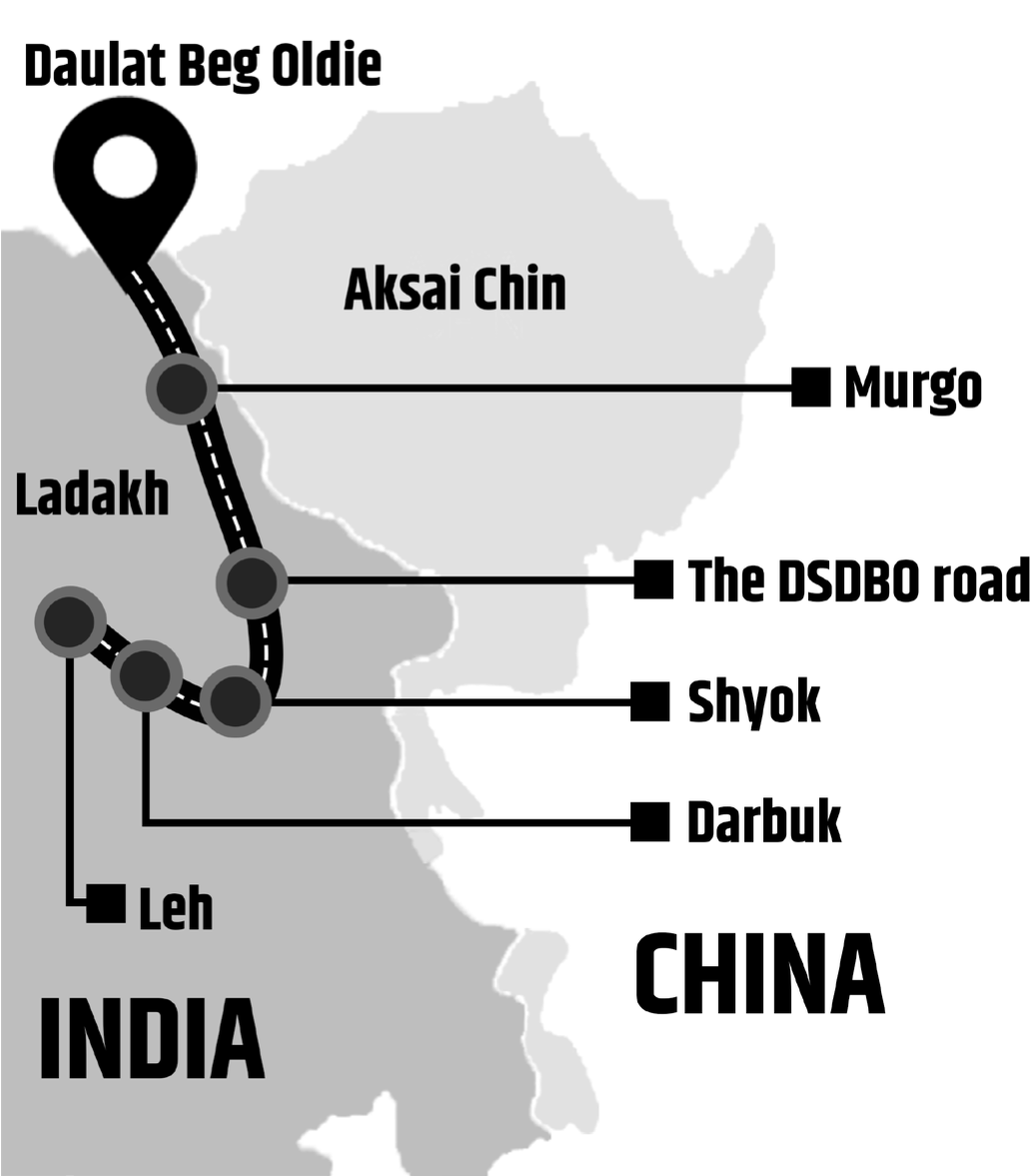
REASONS FOR RECENT CHINESE AGGRESSIONS Daulat Beg Oldie-Darbuk-Shyok Road
• The current impulses of China seem to be guided by 255 km Daulat Beg Oldie-Darbuk-Shyok road.
• It extends up to the base of the Karakoram pass, which is the last military post. Daulat Beg Oldie is the highest airfield in the world.
• This road, when complete, will reduce the travel time from Leh to Daulat Beg Oldie from two days to six hours.
LAC and Article 370
• India released a new map following the changes in Article 370.
• China alleges that India opened up new territory on the map, incorporated part of the areas under the local jurisdiction of Xinjiang and Tibet into its Ladakh union territory.
• And this forced China into the Kashmir dispute, stimulated China and Pakistan to take counter-actions on the Kashmir issue, and dramatically increased the difficulty in resolving the border issue between China and India.
The Brahmaputra Dispute
• India has long expressed concerns over dam-building on the Brahmaputra.
• In 2015, China operationalised its first hydropower project at Zangmu, while three other dams at Dagu, Jiexu and Jiacha are being developed.
• Though these dams are not likely to impact the quantity of the Brahmaputra’s flows because they are only storing water for power generation.
• Moreover, the Brahmaputra is not entirely dependent on upstream flows and an estimated 35% of its basin is in India.
• India does not have a water-sharing agreement with China, but both sides share hydrological data.
Concerns on Brahmaputra
• No Water Sharing agreement
• Chinese construction activities
• Impact on natural flow of the river
• River Pollution
• The issue may escalate into a larger geo-political conflict
Mekong case study
The Mekong flows from China to Myanmar, Laos, Thailand, Cambodia and Vietnam. The Mekong River Commission, which comprises Cambodia, Laos, Thailand, and Vietnam, has said more scientific evidence was needed to establish whether dams caused a 2019 drought.
The eight dams in China, which were built on the Mekong River, or Lancang as it is called in China, have been blamed as the chief culprit in the sharp fall in water levels downstream and the resulting hardships caused to people in lower riparian countries.
The dams have blocked a combined total of over 40 billion cubic metres of water for use in electricity generation, irrigation and other purposes and they are the main cause of unnatural flows of the river, affecting the livelihoods of the people living along the river.
The impacts from dams to food security in the region would is colossal, as the fisheries in Mekong River, which is the main source of food and income for the people in the region, would largely be diminished.
Even though the agricultural sector could get a yield boost in the early years from better irrigation and fewer threats from flood and drought, the lack of sediment influx to downstream agricultural areas would make the soil infertile and reduce the farming yield in the long run.
From this scenario, the severe erosion at the Mekong River Delta in Vietnam and along the riverbank from Vientiane to Stung Treng in Cambodia will occur, forcing the governments of Mekong countries to invest up to $6.8 billion on riverbank reinforcements.
From these outcomes, the food insecurity and poverty will intensify in the region and the poor people in Laos and Cambodia will be the most affected population in this scenario.