Recent Reorganisation of States Chhattisgarh:
Chhattisgarh, now the 26th state of India, was formed on 1 November 2000 after being carved out of Madhya Pradesh.
The idea of a separate Chhattisgarh state has a long history, dating back to the 1920s during the pre-independence era. The State Reorganization Commission, set up in 1955, also considered the demand but ultimately rejected it.
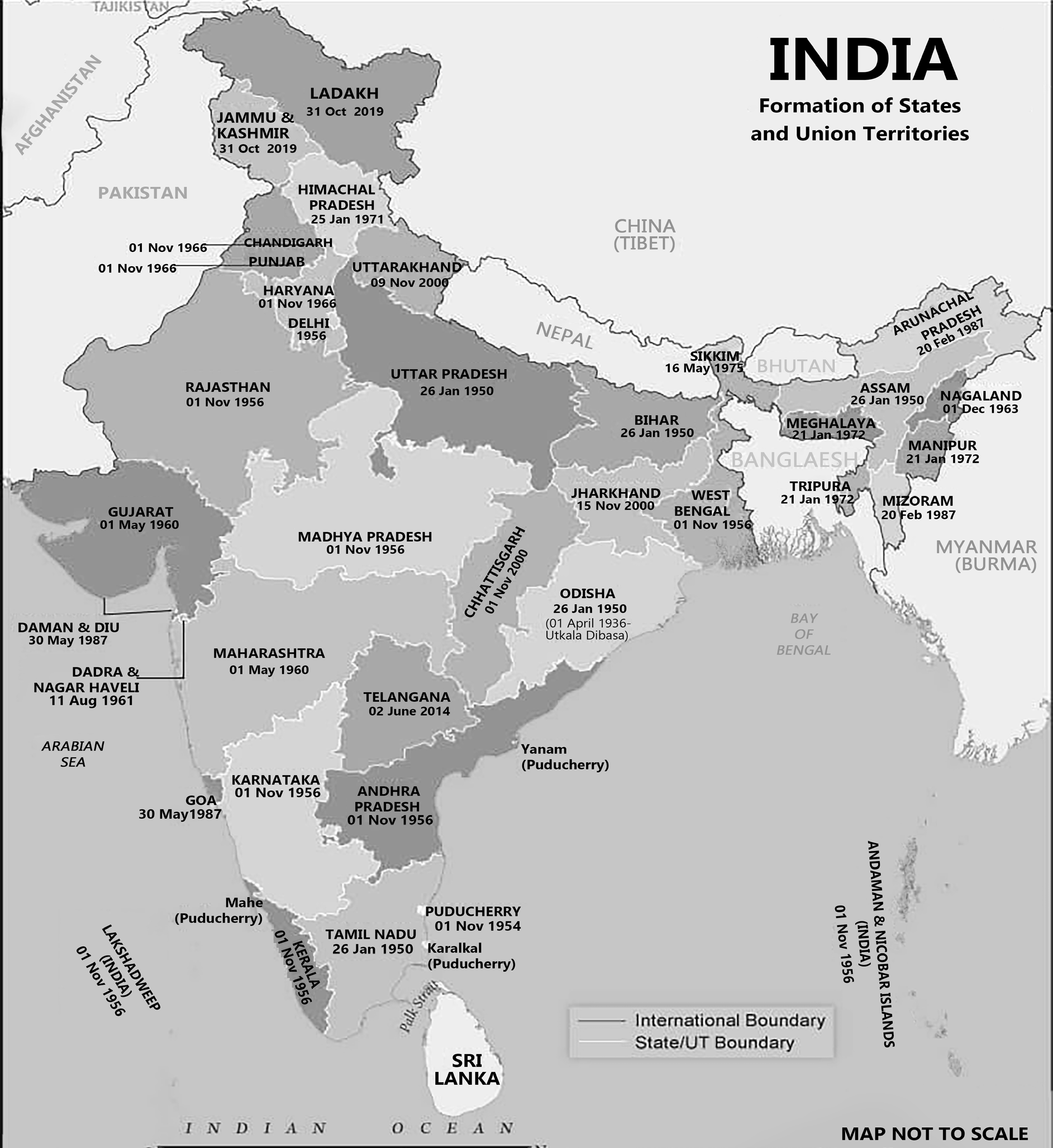
However, in the 1990s, the demand for a separate state gained renewed momentum. The key factors driving this movement included a strong sense of Chhattisgarhi identity, a large tribal population, and the region’s persistent underdevelopment despite its resource-rich status.
The Chhattisgarh Rajya Nirman Manch, led by Chandulal Chandrakar, organized numerous strikes and rallies across the region, garnering support from both the Congress and BJP.
Finally, in 2000, the NDA government recognized the demand and formally carved out Chhattisgarh, making it the 26th state of India.
Uttarakhand:
Uttarakhand, earlier known as Uttaranchal was carved out of Uttar Pradesh on 9th November 2000, as the 27th state of India.
It was the successful culmination of the 70-year-old struggle of the people of the hilly region for a separate state.
Lack of development in geographically unique region (comprising of hills and forest) and rising unemployment gave impetus to the age-old demand for a separate state.
It all started in 1930 when residents of the hill region had moved a resolution by majority vote claiming for a separate Uttarakhand.
Later in 1973, the Uttarakhand Rajya Parishad formed and became a platform for the statehood struggle. This got transformed into Uttaranchal Kranti Dal in 1979.
Later in 1994, the then CM Mulayam Singh Yadav set up a committee for evaluating the demands of Uttarakhand. The committee favoured the formation of the state. Uttaranchal, later to be renamed Uttarakhand in 2006-07, became the 27th state of the union on 9 November 2000.
Jharkhand
Jharkhand, which constituted the tribal areas of Bihar consisting of Chhota Nagpur and the Santhal Pargana, remained subject to the demands for autonomy.
The region has a concentration of several major traditional tribes, like Santhal, HO, Oraon and Munda etc.
With the spread of education & modern activity in the tribal area a movement for a separate state started in the late 1930s & 1940s.
Jharkhand Party was founded in 1950, under the leadership of Jaipal Singh. However, their demand for a separate state got rejected by SRC in 1955.
Later many tribal parties and movements developed to further the demand for a separate state, one of them was Jharkhand Mukti Morcha led by Shibu Soren.
Finally, after a prolonged struggle for their separate state demand, the central government made Jharkhand-28th state of India on November 15th 2000.
Telangana
On 17 September 1948, the Hyderabad state, which included the region of Telangana, was officially merged into the Indian Union. The States Reorganization Commission (SRC) had initially opposed the merger of Telangana with Andhra Pradesh, offering several safeguards to protect the interests of Telangana’s people in the years ahead.
Despite this, in 1956, Telangana was merged with Andhra to create the new state of Andhra Pradesh. However, discontent simmered, and in 1969, agitation erupted under the leadership of Marri Channa Reddy and the Telangana Praja Samiti, though the movement achieved little success for many years.
In 2001, the Telangana Rashtra Samiti (TRS) revived the demand for a separate Telangana state. The movement gained significant momentum, and on November 29, 2009, the TRS launched an indefinite hunger strike. On 9 December 2009, the Indian government announced the beginning of the process for the creation of Telangana. Finally, in 2014, Telangana was granted statehood, becoming the 29th state of India.
Jammu and Kashmir and Ladakh
Article 370 formed the foundation for Jammu and Kashmir’s accession to the Indian Union. Drafted by Prime Minister Sheikh Abdullah, it was included in the Constitution under Part XXI, which addresses Temporary, Transitional, and Special provisions. This article granted Jammu and Kashmir a special status within India.
Sheikh Abdullah had intended for this provision to be permanent, but the central government deemed it unreasonable, classifying Article 370 as a temporary arrangement. Under this article, Jammu and Kashmir was exempted from many provisions of the Indian Constitution and operated under its own separate constitution.
Derived from Article 370, Article 35A granted the Jammu and Kashmir Assembly the authority to define “permanent residents” of the state and specify their unique rights and privileges.
Abrogation of Article 370
Article 370 has created an emotional and psychological barrier of separatism between the people of Kashmir and the rest of India.
Even the businessmen, bureaucracy, judiciary and politicians have misused this article for their despicable purposes.
The poor and down-trodden people have been exploited. The rich have used article 370 to ensure that no financial legislation is passed because if that happens these people would become accountable for all the loots.
Article 370 has also been used to deny the fair share of the economic pie to Ladakh and Jammu region.
But most importantly this special status has been granted to Kashmir at the cost of India’s safety. However, since independence terrorist groups and terrorism have seen a great boom in Kashmir.
It was included in the constitution to develop the state but the misuse of this special status has made the state underdeveloped. Therefore article 370 and article 35(a) were abrogated on 5th August 2019.
With the new reforms, Ladakh has been formulated into a separate Union Territory without a legislative assembly while Jammu and Kashmir will become a Union Territory with an assembly.
There are still long pending demands for state formation on different basis viz. ethnicity, lack of development and administrative inconvenience. Some of the prominent demands for separate statehood are:
Gorkhaland (WB),
Kamatpur state for Koch Rajbangsi (Assam), Bodoland (Assam),
Vidharbha (MH),
Saurashtra (Gujarat),
Fourfold division of Uttar Pradesh in the form of Harit Pradesh, Awadh Pradesh, Purvanchal and Bundelkhand (some parts of UP and MP).
Demands for separate statehood on various grounds show that language is not the sole glue that can bind people together. Now some people are aspiring for the preservation of their ethnic culture in the form of a separate state and on the other hand some people are aspiring for better development after prolonged apathy and backwardness.
The political and administrative reorganization of states and territories in India has indeed been a continuous and evolving process since the mid-nineteenth century. This reorganization has been driven by various factors, including administrative efficiency, linguistic and cultural considerations, political demands, and the need to address regional disparities. Below, mentioned are from different phases of Indian history:
British Colonial Era (Pre-Independence):
The British colonial administration made several administrative and territorial changes for reasons of governance and revenue collection. For instance, the establishment of the Province of Assam in 1874 involved the reorganization of territories in the northeastern region.
Similarly, the creation of the Central Provinces and Berar in 1861 involved the amalgamation of different regions for better administrative control.
Post-Independence Phase (1947-1956):
India underwent significant political and territorial changes after gaining independence in 1947. The most notable reorganization was the partition of India into two independent nations, India and Pakistan, in 1947.
The first major initiative to reorganize states within the Indian Union came with the appointment of the States Reorganization Commission (SRC) in 1953. The SRC’s recommendations led to the reorganization of states on linguistic lines, which was a significant departure from the colonial-era boundaries.
Andhra Pradesh was the first state to be formed on linguistic lines in 1953, followed by several other linguistic reorganizations, such as the creation of Kerala (1956), Karnataka (1956), and Gujarat (1960).
The reorganization process aimed to promote linguistic and cultural homogeneity and foster a sense of identity among the people.
Post-1960s Reorganizations:
Subsequent to the initial linguistic reorganization, there were further state formations and adjustments. For example, in 1966, the state of Punjab was divided into Punjab and Haryana, with the union territory of Chandigarh serving as their common capital.
In 2000, the state of Bihar was bifurcated to create the new state of Jharkhand, which aimed to address the aspirations of the tribal population and promote their development.
Recent Reorganizations:
In 2019, the state of Jammu and Kashmir was reorganized into two separate union territories—Jammu and Kashmir, and Ladakh. This move had significant political and administrative implications.
Demand-Driven Reorganizations:
Some state reorganizations have been driven by political and public demands. For instance, the formation of Telangana in 2014 was a result of long-standing demands for a separate state by the people of the Telangana region.
In summary, the reorganization of states and territories in India has been a continuous and evolving process influenced by a combination of historical, linguistic, cultural, political, and administrative factors. The aim has been to promote good governance, linguistic and cultural homogeneity, and regional development while addressing the demands and aspirations of different communities and regions within the country.
Impacts of formation of new states
The formation of new states in recent times in India has been a subject of debate and discussion, particularly regarding its impact on the economy. It’s important to note that the creation of new states is a complex process influenced by a variety of factors, and its economic implications can vary depending on several circumstances. Here are some key points to consider
when discussing whether the formation of new states is beneficial or not for the economy of India:
Pros of Creating New States
• Regional Development: One of the primary arguments in favor of creating new states is to promote regional development. Smaller states may have a better chance of focusing on local issues, infrastructure development, and targeted economic growth strategies.
• Administrative Efficiency: Smaller states can potentially lead to more efficient governance and administration. Decision-making may be faster, and resources can be allocated more effectively to address local needs.
• Resource Allocation: New states may receive a fairer share of resources and funds from the central government, leading to more equitable development across regions. This can help reduce economic disparities.
• Job Opportunities: Smaller states may attract investments and industries, creating job opportunities and stimulating economic growth. They can have the flexibility to tailor policies to attract specific industries.
• Local Entrepreneurship: The formation of new states can encourage local entrepreneurship and a sense of ownership over development initiatives, which can contribute to economic vitality.
Cons of Creating New States
Administrative Costs: The process of creating new states can be costly, involving the establishment of new administrative structures, government offices, and infrastructure. These initial costs can strain the economy.
Division of Resources: The division of assets, liabilities, and resources among the new states and the parent state can lead to disputes and challenges in resource allocation.
Economic Disruption: The transition period during the creation of new states can lead to economic disruption, affecting trade, businesses, and livelihoods.
Fragmentation: Excessive division can lead to fragmentation, making it difficult to maintain a cohesive economic policy and strategy at the national level.
Potential for Conflict: In some cases, the creation of new states has been accompanied by ethnic, linguistic, or regional tensions, which can disrupt economic activities and stability.
In conclusion, whether the formation of new states is beneficial or not for the economy of India depends on various factors, including the specific circumstances, the size of the new states, their governance capabilities, and their economic strategies. While creating new states may offer opportunities for regional development and efficient governance, it also presents challenges related to administrative costs, resource allocation, and economic disruption. The impact of such decisions should be carefully assessed and managed to ensure
that they contribute positively to India’s overall economic development and regional equity.