RECENT UPDATES (CURRENT AFFAIRS)
Chronological events between India and Pakistan
• 2014 - As a goodwill gesture all leaders of SAARC countries were invited in swearing-in ceremony of Prime Minister of India.
• 2014 - Both countries in New Delhi held talks expressing willingness to begin a new era of bilateral relations.
• 2015 - PM Modi makes a surprise visit to the Pakistani eastern city of Lahore.
• 2016 - In January, JeM terrorists dressed as soldiers launch a fatal attack on the Pathankot airfield in Punjab, India. The strike comes a week after Prime Minister Modi paid an unannounced visit to his Pakistani counterpart, Nawaz Sharif, in an attempt to restart bilateral talks. In September, JeM militants stormed an army base in Uri, Indian Administered Jammu and Kashmir, killing 17 Indian soldiers. On September 29, India launched its first direct military reaction to the Uri attack, conducting 'surgical strikes' on suspected terrorists across the LoC in Pakistanadministered Jammu and Kashmir. After that India held that it will not engage with Pakistan diplomatically and that terror and talks cannot go together.
• 2017 - The Indian Army bombed Pakistani Army check posts in Nowshera in May to prevent terrorist infiltration into Jammu & Kashmir. In July, terrorists attacked Hindu pilgrims in Jammu & Kashmir, killing at least seven and injuring 16, the worst attack since 2000. In December, Indian Army commandos killed three Pakistani soldiers in the LoC, two days after four Indian Army men were killed in an ambush.
• 2018 - The Indian Army claims to have killed 138 Pakistan Army personnel in 2017 due to tactical operations and retaliatory cross-border firings along the LoC in Jammu & Kashmir. In May, India and Pakistan agreed to implement the 2003 ceasefire pact. In June, the UN Office for the High Commissioner for Human Rights issued the first-ever report detailing human rights abuses in Kashmir, displaying a pro-Pakistan bias and categorizing terrorist organizations as armed groups and leaders.
• 2019 - On 14 February, 40 Indian Central Reserve Police Force members were killed in a suicide bombing in Pulwama, Jammu & Kashmir. Pakistan-based terrorist group JeM claimed the attack and released a video identifying the bomber. India hiked tariffs on Pakistani imports to 200% two days later. Two terrorists, including a JeM commander, were killed in an exchange of gunfire with the Indian Army. Pakistani Prime Minister Imran Khan expressed willingness to negotiate with India, while Indian Prime Minister Narendra Modi pledged a strong response. On 26 February, the Indian government carried out non-military pre-emptive strikes targeting JeM's training camp near Balakot. Pakistan warned against response to India's aerial bombings.
• 2020 - India reiterates its "Neighborhood First Policy" and seeks normal relations with Pakistan in an environment free of terror and bloodshed.
• 2021 - India and Pakistan reaffirmed their commitment to a cease-fire along the Line of Control in Jammu & Kashmir on 25 February, with top officials agreeing to strictly observe the truce and continue communication through a hotline. Despite Pakistan breaching the ceasefire agreement in May, the region's stability remains active.
• 2022 - Financial Action Task Force (FATF) has removed Pakistan from the list of countries under “increased monitoring” (Grey List)
• 2023 - India and Pakistan's foreign ministers clashed over Kashmir at the Shanghai Cooperation Organization summit, causing potential tensions and affecting peace efforts.
• 2025 - At the 2025 Shanghai Cooperation Organization (SCO) Defense Ministers' conference in China, India declined to sign a joint declaration. Because the proposed statement included occurrences in Pakistan but did not mention the Pahalgam terror assault in Jammu and Kashmir, the conclave concluded without a joint communique
Non-nuclear Aggression Agreement
• Both India and Pakistan have exchanged their list of nuclear installations.
• The exchange was in accordance with the Agreement on Prohibition of Attacks against Nuclear Installations and Facilities between Pakistan and India.
• The exchange is done each year on January 1, under the Agreement on the Prohibition of Attack against Nuclear Installations and Facilities, also referred to as the Non Nuclear Aggression Agreement.
• It was signed on December 31, 1988, and entered into force on January 27, 1991, provides that the two countries inform each other of nuclear installations and facilities to be covered under the pact on the first of January of every calendar year
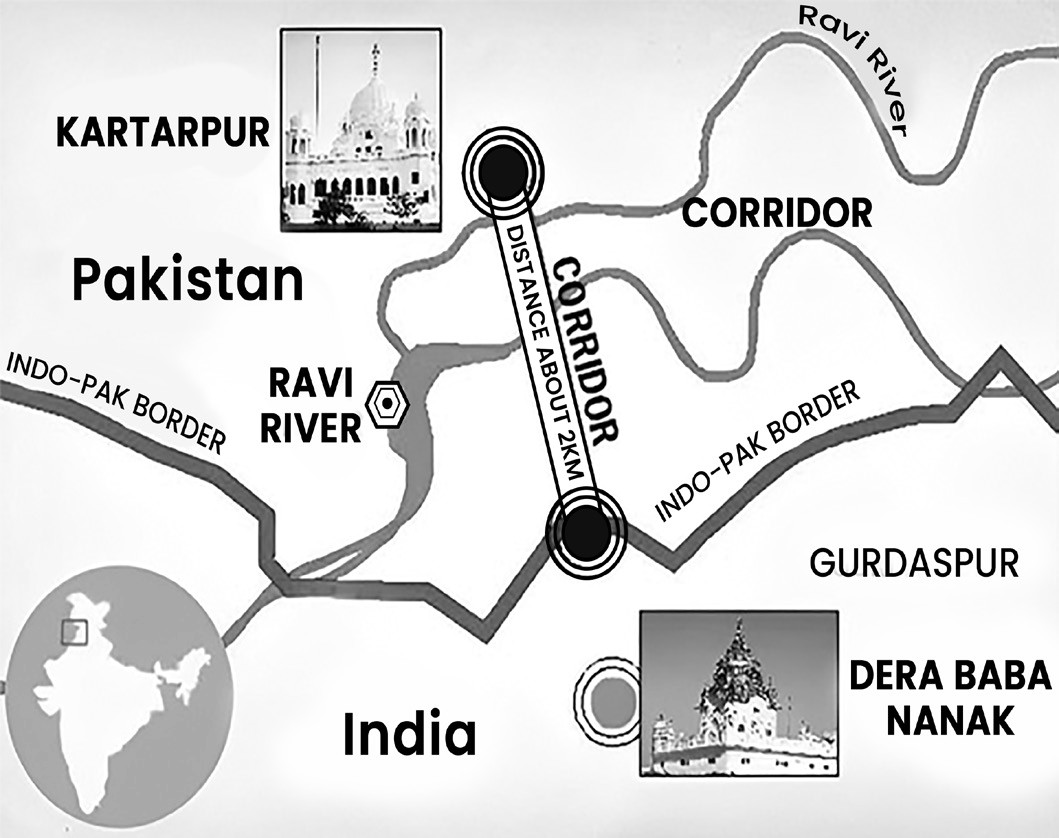
| SCOPE OF COOPERATION BETWEEN INDIA AND PAKISTAN A bilateral protocol signed in 1974 between Pakistan and India regarding visits to places of worship. This convention controls visits to religious shrines between the two countries. The arrangement allows three Hindu pilgrimages and four Sikh pilgrimages to visit 15 shrines in Pakistan each year, while five Pakistani pilgrims to visit 7 shrines in India. The Kartarpur Corridor project, which connects India and Pakistan, became operational in November 2019. The Kartarpur corridor connects the Darbar Sahib Gurdwara in Narowal district of Pakistan with the Dera Baba Nanak shrine in Gurdaspur district in India’s Punjab province. The agreement will facilitate visa-free movement of Indian pilgrims who would just need a permit to cross over to Pakistan. The talks continued through one of the most difficult years in the relationship is equally remarkable; there were three rounds of technical-level meetings to ensure both sides complete the infrastructure needed before November 2019, the 550th anniversary of Sikhism’s founder Guru Nanak. |
About Gurudwara Darbar Sahib
It is 16th century Gurdwara located on the banks of the river Ravi in Shakargarh in Narowal district of Punjab province of Pakistan.This gurudwara was established by the first Sikh Guru in 1522. It is located about 3 to 4 km from Indo Pak border in Pakistan in Punjab.
It is important for Sikhs as Guru Nanak Dev, the founder of Sikhism and its first guru had assembled Sikh community and lived for 18 years until his death in 1539.
SOME IRRITANTS SURROUNDING KARTARPUR CORRIDOR
The Kartarpur corridor project is an issue that has been raised by India for several decades. However, in the case of Pakistan, these have not been as transparent, with the military establishment’s surprise backing only raised doubts on whether Islamabad has an ulterior motive. 1. Allowing Separatist groups to function
In a dossier handed over during the last round of talks on Kartarpur, India spelt out its apprehensions over Pakistan allowing separatist Khalistani groups to try and influence pilgrims.
One of the of specific concern is the ‘Referendum 2020’ plan by the Sikhs for Justice group (banned by India).
2. Drugs and Arms Supply
• The other irritant is the possible use of the corridor for drugs and arms movement; there are many routes and tunnels at the border between the two nations across the Punjab border.
• The terror threat by Pakistani Punjab-based anti-India groups such as the Lashkar-e-Taiba and the Jaish-eMohammad is also a constant concern.
With such strictures in place, New Delhi’s decision to embark on a course that will need regular and repeated India-Pakistan meetings is nothing short of a breach of its otherwise firm “no talks without terror ending” policy.
A RANGE OF POSSIBILITIES
• Other faith-based corridors – The obvious extension from this would be for having other faith-based “corridors” for Hindu, Muslim and Sikh pilgrims in both countries; this would be in addition to the list of 20 shrines (15 in Pakistan, five in India) that were negotiated under the 1974 Protocol on visits to Religious Shrines.
• Template for bilateral negotiations – The template that Kartarpur has given both sides is also worth considering for the format of other bilateral negotiations given that the talks have been immunised from both terror attacks and election rhetoric.

• T he venue of the talks, at the Attari-Wagah zero point, lends itself to more successful outcomes too, away from the glare of the media, without much focus on arrangements for both parties. The two sides can cross over, meet for the duration of talks and return after issuing a joint statement.
WAY AHEAD FOR INDIA PAKISTAN RELATIONS
• For any meaningful engagement between India and Pakistan, cross-border terrorism has to come to an end. So, India must continue to press that “Talks and terrorism can’t go hand in hand.”
• To deal with terrorism emanating from Pakistan, India should keep on mounting international pressure on Pakistan through International as well as regional organizations. For example – Ensure that strict vigilance of Financial Action Task Force (FATF) is kept on Pakistan, which will ensure difficulty in funding of terrorist organisation.
• However, both countries can keep engaging at international forums like SCO and SAARC and continue with Track 2 diplomacy. This will ensure that the window for frontline engagement is always open.
• Initiatives such as the Kartarpur Corridor can improve the relationship between India and Pakistan, so the two countries must explore other avenues.
• India already has military and economic superiority over Pakistan. To increase it further, India must focus on rapid economic development and modernization of its armed forces.
• To prevent any Pakistani propaganda from creating fissures in Indian society, Indian intelligence must keep a vigil on various platforms, and the Indian Government must keep its house in order.
• Since we can choose our friends but not chose our neighbours, India must try to forge a dialogue with Pakistan. This will also uphold our “neighbourhood first policy”.
• India should focus on using soft power and people to people relations to find a solution for a ‘basket case’ [unique] country like Pakistan.
• India Pakistan relations have been and will continue to be tense, at least in the foreseeable future. These tensions can be resolved through negotiations and discussions once a conducive environment for talks is created.
• Tackling ‘Hydra headed’ Pakistan will need creative diplomacy outside the traditional mode.