Relation with Pakistan
Strained relations with Pakistan owing to the bitter experience of partition further spilled into the international realm on the issue of Kashmir. Pakistan supported tribal invasion of Kashmir and the resultant conflict drew international attention. India had accepted the UN resolution on a ceasefire in spite of its advantageous position and agreed to a plebiscite in Kashmir, on two conditions:
• Pakistan should withdraw its forces from the state of J&K.
• The authority of the Srinagar administration should be restored over the whole state.
Above mentioned first conditions were never fulfilled, so there was no plebiscite there. Meanwhile, J&K participated in India’s general elections and then the talk of a plebiscite remained irrelevant.
However, Kashmir remained a in the bilateral relationship, especially for Pakistan. The issue was used to needle India in the UN as Pakistan became an integral part of the US-led Western alliance as a member of the Central Treaty Organization (CENTO) and South East Asia Treaty Organization (SEATO), the Baghdad Pact and a military act with the US in 1954.
The Kashmir conflict however didn’t prevent cooperation between the government of India and Pakistan. Both the government worked together to restore the abducted women to their original families. Also, a long-term dispute over river water sharing was resolved with World Bank’s mediation and India-Pakistan Indus Water Treaty was signed by Nehru and General Ayub Khan in 1960.
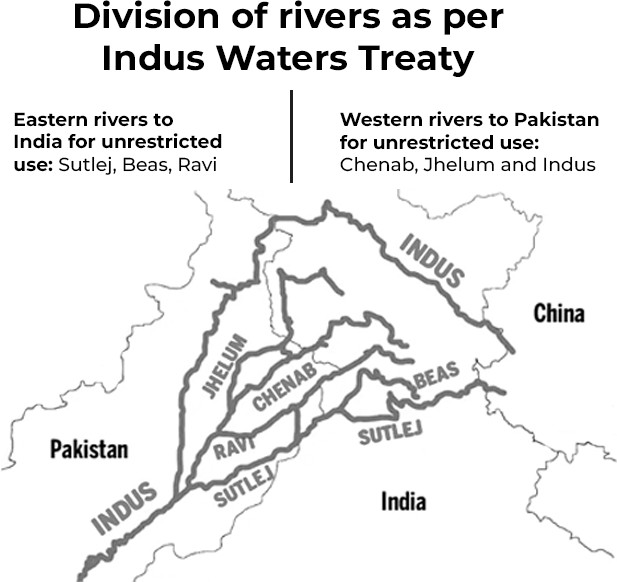
Indus Water Treaty (IWT)
The Indus Water Treaty (IWT) stands out as a rare example of cooperation amidst the long-standing hostility between India and Pakistan. Brokered by the World Bank, the treaty allocates the waters of the Indus River system, defining the rights and responsibilities of both nations.
The Indus River originates in the southwestern Tibet Autonomous Region of China, flows through the Kashmir region, and then enters Pakistan, eventually emptying into the Arabian Sea. It is fed by several tributaries, most notably the Jhelum, Chenab, Ravi, Beas, and Sutlej rivers, which flow through the eastern Punjab Plain. The partition of India and the creation of Pakistan resulted in a unique situation: India controlled the headworks, while the canals carrying the water ran through Pakistan.
In 1951, David Lilienthal, former head of the U.S. Atomic Energy Commission, visited the region and proposed that India and Pakistan should work together to jointly develop and manage the Indus River System, with support from the World Bank. The World Bank agreed to facilitate the process, and a solution benefiting both sides was reached.
The Indus Water Treaty was signed on September 19, 1960, by Prime Minister Jawaharlal Nehru and President Ayub Khan. Under the treaty, Pakistan was allocated the waters of the western rivers—the Indus, Jhelum, and Chenab—while India received the waters of the eastern rivers—the Ravi, Beas, and Sutlej.
A Permanent Indus Commission was established, with
one commissioner from each country, to oversee the implementation of the treaty. Additionally, a dispute
settlement mechanism was included to address any issues that might arise.
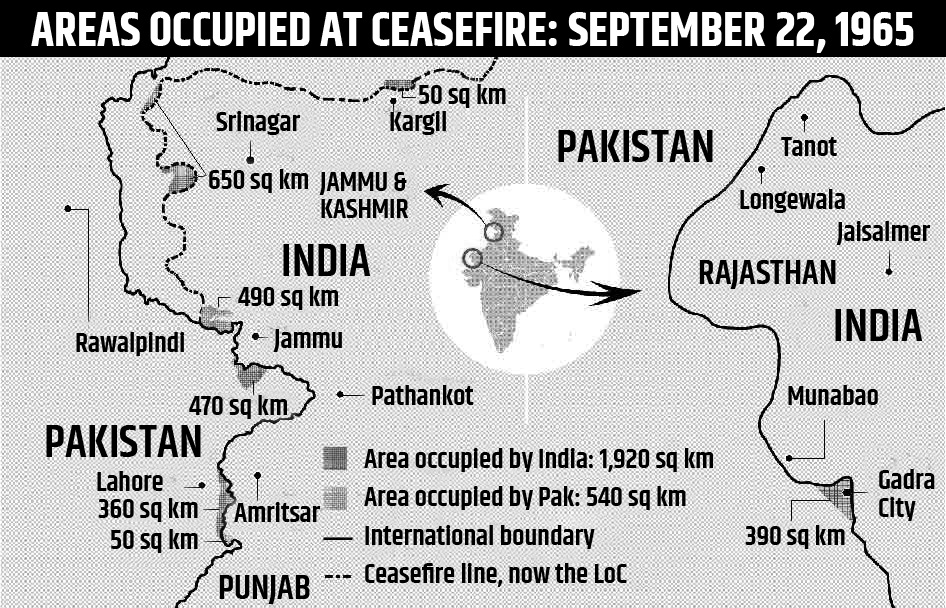
1965 War
Pakistan continued to seek the accession of Kashmir, even after its defeat by Indian forces in 1947. The first Kashmir war in 1948 convinced Pakistani strategists that they could only engage in asymmetrical warfare against India.
In April 1965, Pakistan initiated an armed incursion in the Rann of Kutch area of Gujarat. Later, in August and September of the same year, Pakistan launched a larger offensive under “Operation Gibraltar” in Jammu and Kashmir, expecting local support for their cause. However, the plan failed as the local population did not back Pakistan.
Pakistan’s strategy was to fuel sabotage and guerrilla activities in Jammu and Kashmir, sending around 30,000 trained infiltrators with the aim of inciting a popular uprising and sabotaging infrastructure.
In response, to relieve pressure on the Kashmir front, Prime Minister Shastri ordered Indian forces to carry out a counter-offensive along the Punjab border. India emerged victorious once again, and hostilities were brought to a halt with the intervention of the United Nations.
Following Soviet mediation, Prime Minister Shastri and Pakistan’s General Ayub Khan signed the Tashkent Agreement in January 1966. Although India won the war, it placed a heavy strain on India’s economy.
Tashkent Agreement
Under the Tashkent Agreement, India and Pakistan agreed to withdraw their forces to pre-conflict positions (as of August 5, 1965) by February 25, 1966.
Both sides also pledged not to interfere in each other’s internal affairs, to discourage propaganda, and to promote friendly dialogue.
The two governments committed to upholding the Vienna Convention of 1961 on diplomatic relations and agreed to restore their respective High Commissions.
They also decided to resume economic cooperation and trade, aiming to foster friendly and peaceful relations. While the agreement was seen as a success at the time, the underlying Indo-Pakistani tensions continued.
The Tashkent Declaration faced criticism in India, particularly for the absence of a no-war pact.
After signing the agreement, Prime Minister Shastri mysteriously died in Tashkent. Officially, his death was attributed to a heart attack, but various conspiracy theories suggest he may have been assassinated.
1971 war
Pakistan was a geographically divided nation, with its two main parts—West Pakistan and East Pakistan— separated by 1,600 kilometres of Indian territory.
East Pakistan, home to a predominantly Bengali-speaking population, represented 60 percent of Pakistan’s total population.
However, the region’s economy was largely controlled by businessmen from West Pakistan.
Though Pakistan could have been a bilingual nation with Urdu and Bengali as official languages, Urdu was declared the sole official language, and the Bengali language was initially rejected. It was only after large-scale protests that Bengali was officially recognized in 1954.
These linguistic and ethnic tensions, compounded by economic disparities, sowed the seeds of unrest in East Pakistan. By the 1970s, resentment against the dominance of West Pakistan was widespread.
The internal crisis intensified following the 1970 elections. Zulfikar Bhutto’s party won in West Pakistan, while Sheikh Mujib-Ur Rahman’s Awami League triumphed in the East. Despite the League’s significant victory, the ruling West Pakistani establishment ignored the democratic outcome, refused to accept the League’s demand for a federal structure, and responded with violence, arresting Rahman and suppressing dissent.
In response, the people of East Pakistan launched a liberation struggle, demanding the creation of Bangladesh. As ethnic nationalism surged, the Mukti Bahini (Liberation Army) took up arms against the Pakistani military.
With a large influx of refugees into India, the Indian government deliberated and eventually extended both material and moral support to the Bengali cause, which was viewed by West Pakistan as an Indian conspiracy to dismantle Pakistan.
The U.S. and China supported West Pakistan in quelling the movement, while India, seeking protection from the American and Chinese-backed Pakistani forces, signed a 20-year Treaty of Peace and Friendship with the Soviet Union.
Despite diplomatic efforts, the situation deteriorated, leading to a full-scale war in December 1971. India entered the conflict on December 3, after East Pakistan requested military assistance. India employed a combination of air strikes, naval blockades, and ground offensives to meet its objectives.
India’s strategy focused on holding Pakistani forces in the West through defensive action, while launching a rapid and decisive campaign in the East.
The U.S. proposed two resolutions in the UN Security Council calling for a ceasefire and mutual withdrawal of troops, but both were vetoed by the Soviet Union.
With the support of the local Mukti Bahini, the Indian military made swift advances and forced the Pakistani forces to surrender in just 10 days.
Following Bangladesh’s emergence as an independent nation, India declared a unilateral ceasefire. The Shimla Agreement, signed in 1972 by Indira Gandhi and Zulfikar Bhutto, restored peace between the two countries. Under the agreement, India agreed to release all 93,000 Pakistani prisoners of war.
The Shimla agreement had three important principles
Mutual commitment to the peaceful resolution of all issues through direct bilateral approaches.
To build the foundation of a cooperative relationship with a focus on people-to-people contacts.
To uphold the inviolability of LOC in Jammu and Kashmir.
Kargil War of 1999
After the debacle of the 1971 war, Pakistan adopted the tactics of proxy war by sending the terrorists trained by their secret agencies to create havoc and panic in J& K and India.
The two countries had also gone nuclear in 1999 which added a new strategic dimension to their bilateral ties. Kargil was the first conventional war between two countries with nuclear weapons. For this reason, the conflict received worldwide attention.
In 1999, the so-called Mujahideens occupied several points on the Indian side of LOC in the Mashkoh, Dras, Kaksar, and Batalik. Suspecting Pak’s hand behind such activities, Indian forces immediately started reach to such proxy war which is known as the “Kargil conflict”.
Operation Vijay saw a mobilization of around 2 lakh Indian troops. Fighting was carried out in very difficult terrain and extremely harsh weather conditions. After two months of conflict, Indian troops had slowly retaken some 70 to 80 per cent of the ridges that were encroached upon by the infiltrators.
By the end of the war, Pakistan had to withdraw under international pressure. Kargil was a fiasco for Pakistan ‘s armed forces and its political leaders. The infiltration had come within months of a successful peace process when the Indian Prime Minister took a bus to travel to Lahore for a dialogue with his Pakistani counterpart Prime Minister Nawaz Sharif. India saw it as the betrayal of the trust Prime Minister Atal Bihari Vajpayee had reposed in Pakistani leadership