Rise of Totalitarian Regimes
The immediate post-war period brought widespread challenges for nearly all European nations. Countries faced the difficult tasks of rebuilding their economies, resettling war survivors, and dealing with rising unemployment. In several nations, the working class attempted to initiate socialist revolutions modeled on the Soviet example, but these efforts were harshly crushed. In their place, powerful and anti-democratic movements emerged in Hungary, Poland, Italy, Portugal, Germany, and Spain—movements that are broadly classified as ‘Fascist’.
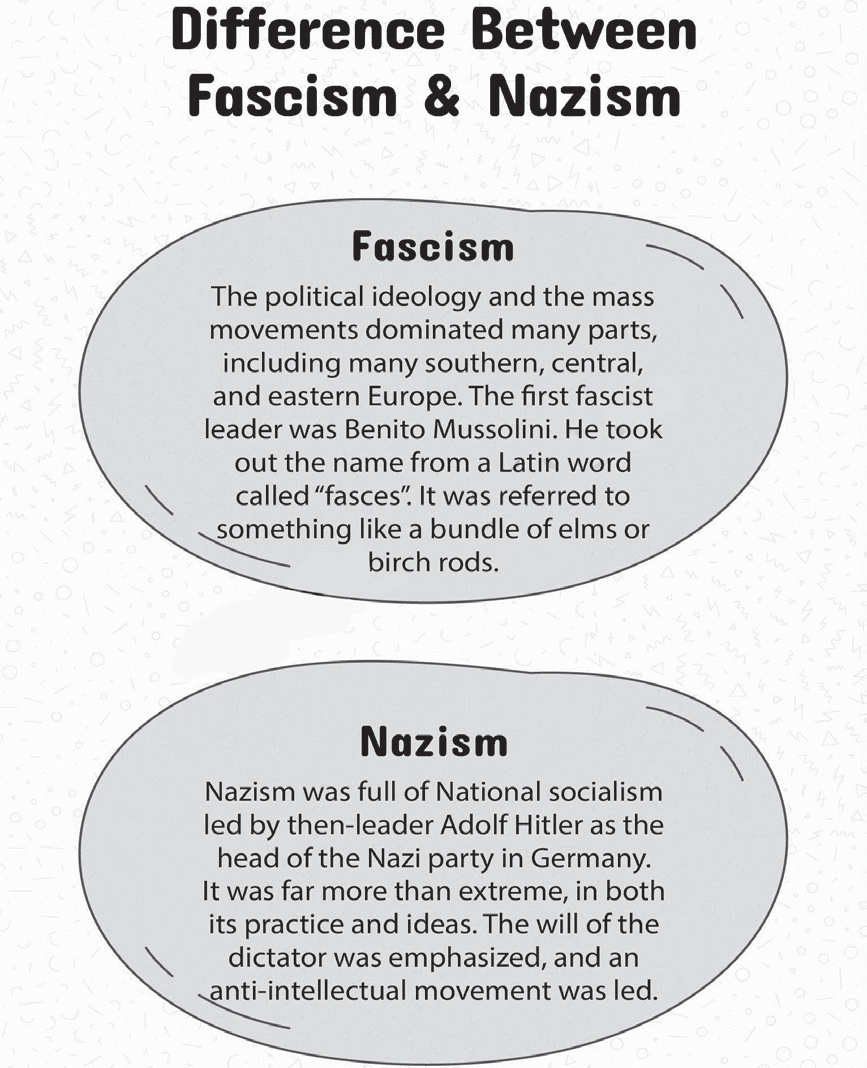
Fascism & Nazism
Fascism and Nazism, though rooted in similar ideologies, emerged in Italy and Germany during the interwar period, eventually becoming key contributors to the outbreak of the Second World War. A Fascist state was established in Italy in 1922, while the Nazis rose to power in Germany in 1933.
• Both movements, though short-lived, left a profound and lasting impact on the world.
• They emerged during the turbulent interwar years and both spread across Europe, embracing authoritarian rule and contributing to the escalation of global conflict.
• The core of their ideology was an intense nationalism, where the nation was seen as a living entity whose well- being superseded that of the individual. In this view, fulfilling duties to the nation was considered more important than individual rights.
• Fascism and Nazism both emphasized militaristic nationalism, preparing for war and territorial expansion. They were founded on racist beliefs, with the Nazis promoting a dangerous doctrine of racial superiority and fostering deep hatred for groups like the Jews, who became targets of their destructive ideologies.
Emergence of Fascism in Italy
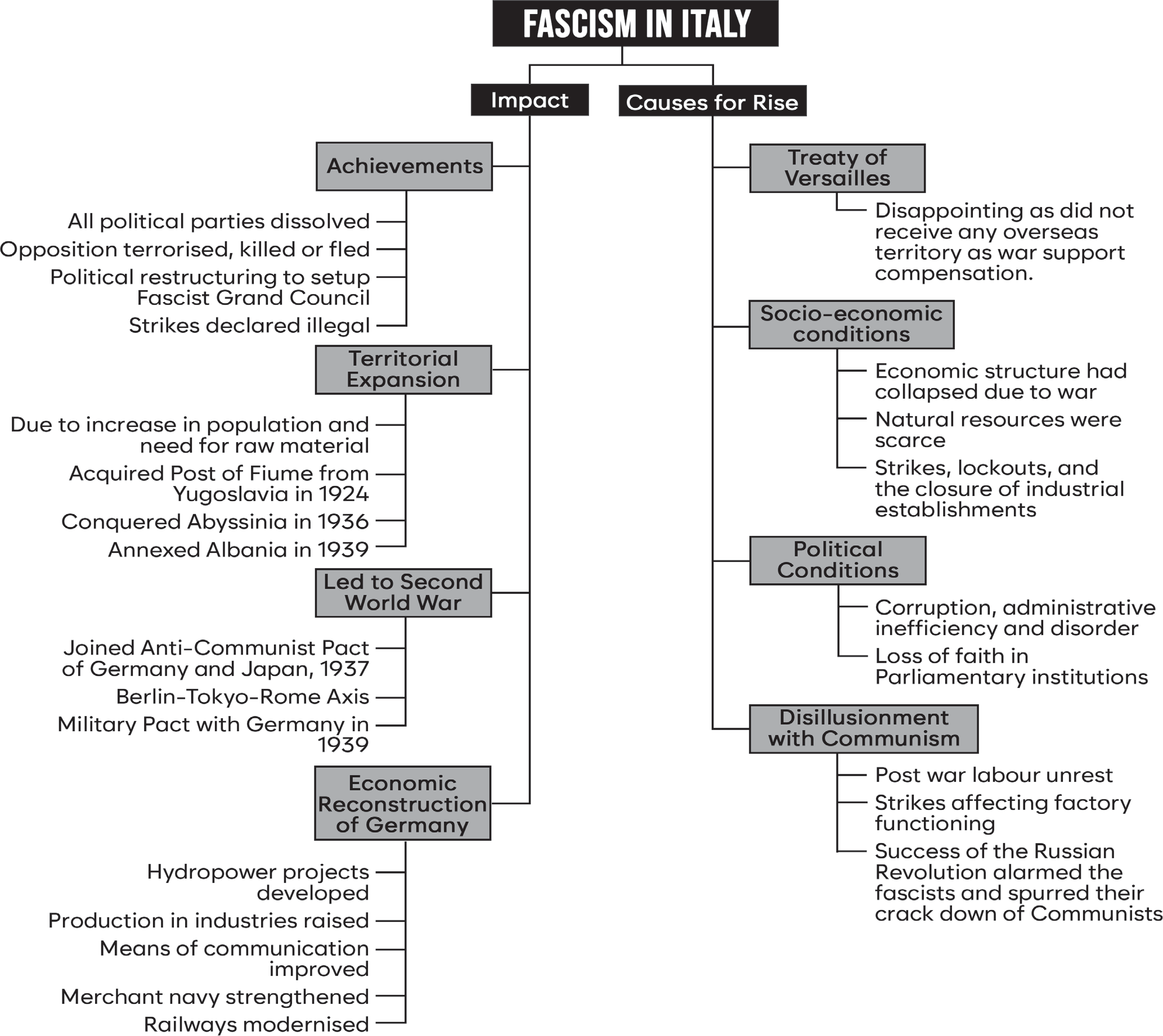
The term “Fascism” originated in Italy and was first associated with the movement led by Benito Mussolini.
• Mussolini and his followers adopted the symbol of a bundle of rods, representing the power of the state.
• The main characteristics of Fascism included a strong opposition to both democracy and socialism, the establishment of a dictatorial regime, and a focus on extreme nationalism and militarism.
• Mussolini gave passionate speeches about the greatness of ancient Rome and called for a restoration of Italy’s lost honor.
• His rhetoric attracted many former soldiers, who joined his private army known as the “Black Shirts.”
Mussolini used the Black Shirts to break up strikes and spread fear among socialists and communists. The Italian ruling class, fearing a socialist revolution, tolerated these actions.
• In 1921, Mussolini formed the National Fascist Party, and the following year, he led 30,000 Black Shirts in a march on Rome. The government capitulated without resistance, and the king appointed Mussolini as the new prime minister.
• By 1928, Mussolini had eliminated all political opposition and began ruling as a dictator, banning non-fascist parties.
• He relied on imprisonment, torture, and violence to suppress socialists and communists. Mussolini created the Fascist Grand Council and adopted the title of II Duce (The Leader), pushing for Italy’s expansion through military aggression.
Hitler and Nazi Germany
• In 1919, Germany adopted a republican form of government under a new constitution, which established a system that included a President, a Chancellor, and an elected Parliament.
Adolf Hitler, who had served as a soldier in the German Army during World War I and had fought with distinction for four years—earning the Iron Cross—was deeply disillusioned by Germany’s defeat. This prompted him to enter politics.
By 1921, Hitler’s compelling oratory and strong organizational abilities had earned him leadership of the National Socialist German Workers’ Party, commonly known as the Nazi Party. Similar to the Fascists, the Nazis had a paramilitary wing known as the "Storm Troopers" or "Brownshirts." By 1930, this force had grown to approximately 100,000 members.
Following the Fascist rise to power in Italy, Corporal Adolf Hitler attempted a similar takeover in Germany in 1923. The coup failed, and Hitler was imprisoned. During his time in jail, he wrote Mein Kampf ("My Struggle"), a book in which he outlined his vision for establishing one of the most brutal dictatorships in modern history.
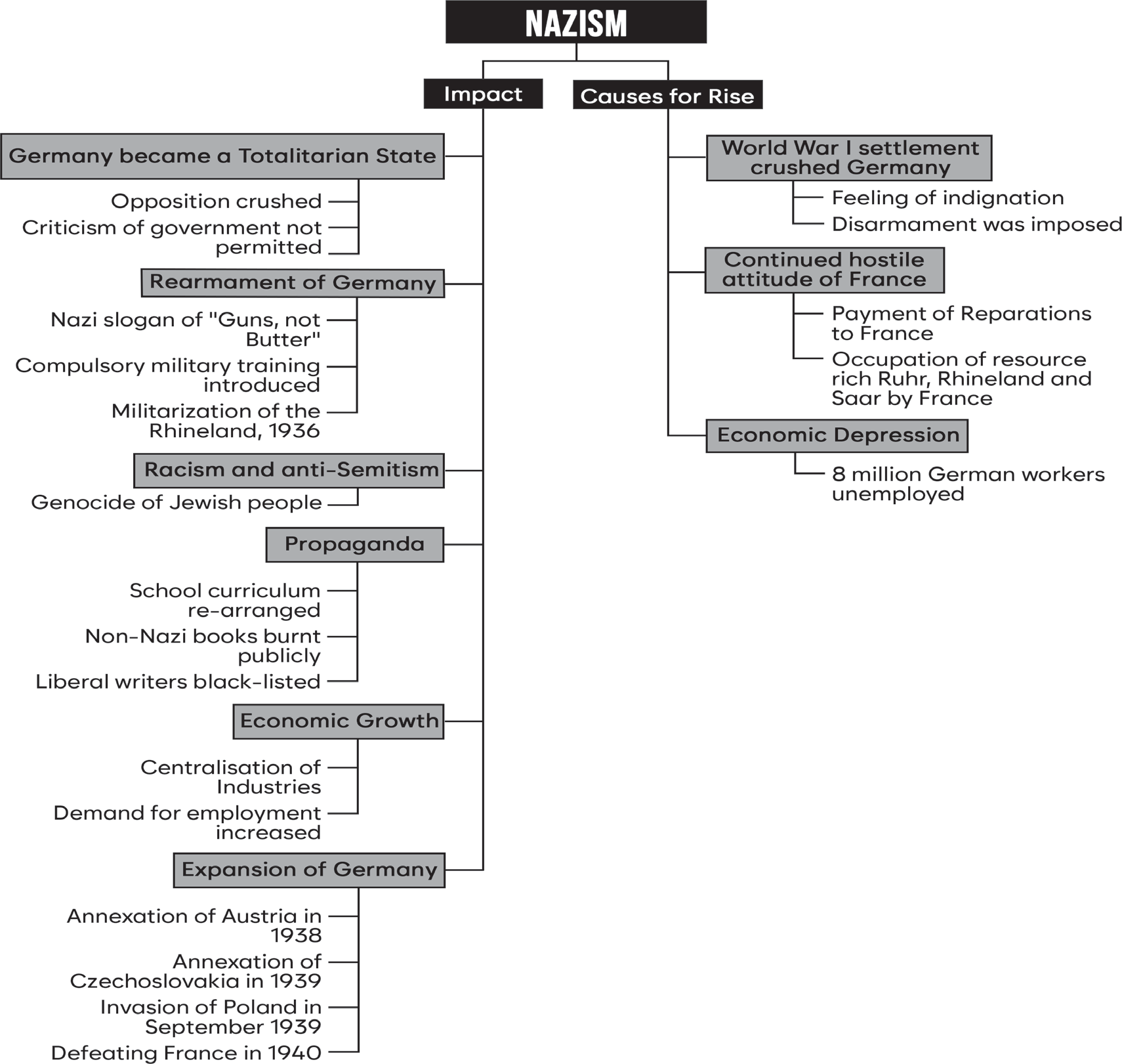
The primary goal of Nazi policies was to erase the shame of the Versailles Treaty and transform Germany into a powerful and feared nation. Like fascism, Nazism rejected democracy, civil liberties, and socialism, using brutal force to suppress any opposition.
• Hitler blamed Jews for Germany’s defeat in World War I, making their extermination a central aim of Nazi ideology.
• He promoted the idea of the superiority of the German race, calling them pure-blood Aryans, and sought to unite all Germans into a Greater Germany. Many people were drawn to this nationalist appeal, supporting Nazi policies.
• The economic crisis of the 1930s played a significant role in Hitler’s rise. The Great Depression led to widespread unemployment, leaving around 8 million Germans without work.
• The Nazi Party, once a minor political group with just 12 seats in the 1928 elections, gained significant momentum as the Communist and Socialist parties failed to unite against them. By 1932, the Nazis became the largest party in parliament. President Hindenburg appointed Hitler as Chancellor and tasked him with forming a new government.
• Once in power, Hitler swiftly established a reign of terror, discarding democratic principles.
• In February 1933, the Nazis set fire to the Reichstag (Parliament building), blaming the communists. Over 60,000 people were arrested or sent to concentration camps.
• By mid-1933, all political parties, except the Nazi Party, were outlawed. Following President Hindenburg’s death in August 1934, Hitler took on the title of President and solidified his total control. He launched a systematic campaign for the total extermination of Jews while simultaneously pushing for military expansion. The rise of Nazism brought the world dangerously close to another war.
• Hitler was so ruthless that he ordered the killings of hundreds of Storm Troopers, who had helped in his rise to power, in one night. June 30, 1934, is known as the night of Long Knives.
Military Fascism in Japan
• Japan was the only Asian country to avoid colonization. By the late 19th century, its expansionist ambitions led to a war with China, and the defeat of China allowed Japan to establish a presence there.
• In 1905, Japan achieved a significant victory over Russia, taking control of Manchuria, which had been Russia’s sphere of influence in China. This marked the first time an Asian country had defeated a major European power. Japan went on to annex Korea, further extending its empire.
• The First World War presented Japan with an opportunity to seize Germany’s possessions in China and its Pacific islands. As Japan’s military grew in influence, it began to dominate the country’s politics.
• This shift led to the collapse of democracy and the rise of extreme nationalism and militarism. Within a few decades, Japan transformed from a peaceful nation into an aggressive military power. By the 1930s, Japan aligned itself with the fascist regimes of Germany and Italy, seeking a new world order.