SCULPTURES OF INDUS VALLEY CIVILISATION
In the second millennium, the arts of the Indus Valley civilization, one of the earliest in the world, emerged.
Sculptures, seals, ceramics, gold jewelry, terracotta figurines and other forms of art have been found at numerous archaeological sites of this civilization.
The primary materials used for sculptures included stone, bronze, terracotta, clay and others.
Stone Sculpture
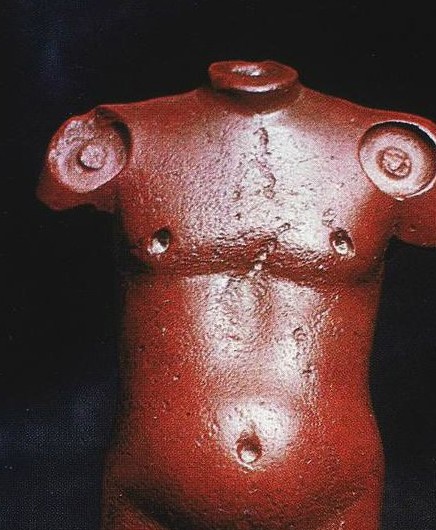
• Male Torso: The Male Torso is a red sandstone figure with socket holes in the neck and shoulders for attaching the head and arms.
• The Male Torso was discovered at Harappa, one of the major town of Indus Valley Civilization
Mal e Torso
• The frontal posture of the torso is deliberately chosen.
• The shoulders are skillfully carved and the abdomen appears slightly prominent.
• This nude male torso is regarded as a significant piece, with its balanced lines comparable to the exquisite art of Gandhara from two thousand years later.
• It was discovered from the Harappa, a major city of the Indus Valley Civilization.
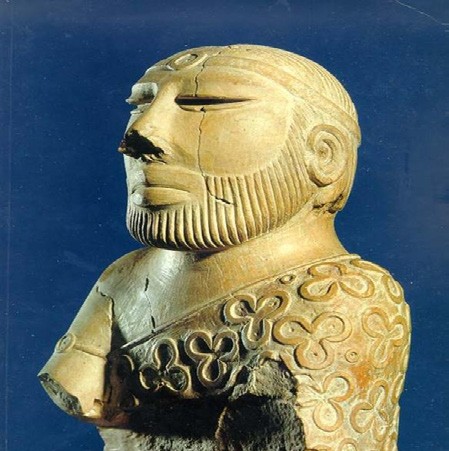
• Bearded Priest: This steatite figure of the bearded man interpreted as a priest or priest king is draped in a shawl coming under the right arm and covering the left shoulder.
• It was discovered from Mohenjo-Daro.
Bea rded Priest
• His shawl is decorated with trefoil patterns.
• His eyes are a little elongated, and half-closed as in meditation. The nose is well formed and of medium size; the mouth is of average size with close-cut
moustache and a short beard and whiskers; the ears resemble double shells with a hole in the middle.
• The hair is parted in the middle, and a plain-woven fillet is passed round the head.
• An armlet is worn on the right hand and holes around the neck indicate a necklace.
•
The shawl on the shoulder of the bearded priest indicates that the handicraft of embroidery was commonly practiced in Indus Valley Civilization.
• It was discovered from Mohenjo-daro in Sindh, present day Pakistan.