SCULPTURES OF MAURYAN AGE
• The Mauryan period saw significant advancements in Indian sculpture.
• Mauryan sculptures can be divided into two categories: court art and popular art.
Court Art:
• During the Mauryan era, stone sculpture reached new heights, and bright polish was applied to the stone surfaces.
• Mauryan art is known for its mirror-like polish and the wide range of creations.
• This art appears in stone pillars, railings, parasols, capitals, animal and human sculptures, and various other motifs.
• The finest examples of Mauryan court art are the numerous monolithic columns with majestic animal capitals.
Mauryan Pillars:
Typically, each column consists of two parts: the shaft and the capital. The shaft, circular and slightly tapered, is made from a single block of stone with graceful proportions.
The capital, also monolithic, is divided into three sections: an inverted lotus (often called a ‘bell’), an abacus, and a crowning sculpture.
• Both the shaft and capital are finely chiselled with remarkable precision.
• The bell is decorated with stylized lotus petals, featuring sharp and thin ridges in the center.
• Stone pillars were erected across the Mauryan Empire, often with inscriptions.
The capital figures atop the pillars include representations of animals like bulls, lions, and elephants.
Each capital stands on a square or circular abacus, which is adorned with stylized lotus designs.
Key sites where these pillars have been found include Basarah-Bakhira, Lauriya-Nandangarh, Rampurva, Sankisa, and Sarnath.
The pillars were carved from two types of stone: spotted red and white sandstone from the Mathura region, and buff- colored, fine-grained sandstone with small black spots from Chunar near Varanasi.
PILLAR EDICTS AND INSCRIPTIONS
• The seven pillar edicts of Ashoka have been discovered in Topra (Delhi), Meerut, Kausambhi, Rampurva, Champaran, and Mehrauli:
• Asoka’s idea of people protection is enshrined in Pillar Edict I.
• Pillar Edict II: Defines Dhamma as having the least sins, the greatest number of virtues, compassion, liberality, honesty, and purity.
• Pillar Edict III: Removes sins such as harshness, cruelty, rage, and pride, among others.
• Pillar Edict IV: Addresses the responsibilities of Rajukas.
• Pillar Edict V: A list of animals and birds that should not be slaughtered on certain days, as well as a separate list of species that should not be killed at all.
• Dhamma policy is the sixth pillar edict.
• Asoka’s work towards Dhamma policy is documented in Pillar Edict VII.
Minor Pillar Inscriptions
• Inscription on the Rummindei Pillar: Asoka’s visit to Lumbini and the exemption of Lumbini from taxation.
• Inscription on the Nigalisagar Pillar in Nepal: Asoka extended the height of Buddha Konakamana’s stupa to twice its original size.

Major Pillar Inscriptions
• Sarnath Lion Capital was erected by Ashoka in Varanasi to commemorate Dhammachakrapravartana or Buddha’s first discourse.
• Single lion on Vaishali Pillar in Bihar, with no inscription
• Uttar Pradesh’s Sankissa Pillar
• Champaran, Bihar: Lauriya-Nandangarh
• Champaran, Bihar: Lauriya-Araraj
• Uttar Pradesh’s Allahabad pillar
Lion Capital at Sarnath
The Mauryan pillar capital found at Sarnath popularly known as the Lion Capital, which is now our national symbol, is considered to be the finest example of Mauryan sculptural tradition.
It consists the shaft, which is broken in many parts now, a lotus bell base, a drum on the bell base with four animals proceeding clockwise and the figures of four majestic lions.
The capital without the crowning wheel and the lotus base has been adopted as the National Emblem of Independent India.
The four voluminous roaring lion figures firmly stand on a circular abacus which is carved with the figures of four animals – a striding elephant, a galloping horse, a walking bull and a prancing lion.
Four lions placed back-to-back face the cardinal directions, indicating the spread of dharma.
These are formal and stylised and are reminiscent of the Persian tradition
Pillar at Vaishali
• The Asokan pillar at Vaishali is different from the earlier
• Ashokan pillars because it has only one lion capital.
• Location of this pillar is contiguous to the site where a Buddhist monastery and a sacred coronation tank stood.
• The lion faces north, the direction Buddha took on his last voyage.
Asoka Pillar at Allahabad
In Allahabad, there is a pillar with inscriptions from Ashoka and later inscriptions attributed to Samudragupta and Jehangir.
• The pillar is located inside the Allahabad Fort. It is assumed that the pillar was first erected at Kaushambi an ancient town some 30 kilometres west of Allahabad that was the capital of the Koshala kingdom.
• The Ashokan inscription is in Brahmi and is dated around 232 BC.
Pillars at Lauriya-Nandangarh and Lauriya-Areraj
The column at Lauriya-Nandangarh, 23 km from Bettiah in West Champaran district, Bihar has single lion capital. The hump and the hind legs of the lion project beyond the abacus
• The pillar at Lauriya-Areraj in East Champaran district, Bihar is devoid of any capital.
Popular Art
• The popular art of the Mauryan period is characterized by images of Yakshas and Yakshinis. Yakshas are nature spirits, often benevolent and associated with fertility, while Yakshinis are their female counterparts.
• Yakshas are also linked to one of the ancient tribes of India and are considered guardians of natural treasures.
• They feature prominently in Hindu, Jain, and Buddhist literature and are frequently depicted in religious monuments of Buddhism and Jainism.
In India, large statues of Yakshas and Yakshinis, typically in standing poses, have been found in locations such as Patna, Vidisha, and Mathura. A common feature of these statues is their polished surface and finely detailed facial features.
Didarganj Yakshini, Patna
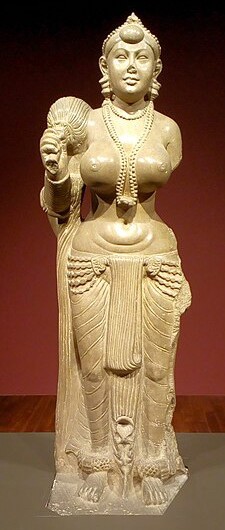
Didarganj Yakshi (Chauri Bearer)
One of the finest examples of popular Mauryan art is the Yakshi figure from Didarganj, Patna. This tall, well- proportioned, free-standing sculpture in sandstone features a polished surface, showcasing the artist's skill in handling both form and material. The Yakshini holds a chauri (flywhisk) in her right hand, while her left hand is broken.
• The sculpture demonstrates the artist’s keen attention to the muscular female form. The folds of muscles are clearly defined, and the tightening of the garment around the belly emphasizes a bulging effect.
• The lower garment is crafted with great precision. Every fold on the legs is depicted through protruding lines, clinging to the legs and creating a slightly transparent effect.
• The figure's torso is portrayed with notable heaviness, reflected in the pronounced breasts and strong, impressive back.
Elephant Sculpture at Dhauli, Odishas
The rock cut sculpture of Elephant in Dhauli, near Bhubneshwar in Odisha represents the fore-part of an elephant carved over the Edicts of Aśoka, including the two specially meant for Kalinga. In the modelling and execution of this elephant figure, one may recognise a note and feeling different from those manifested in the animal figures surmounting the pillar capitals.
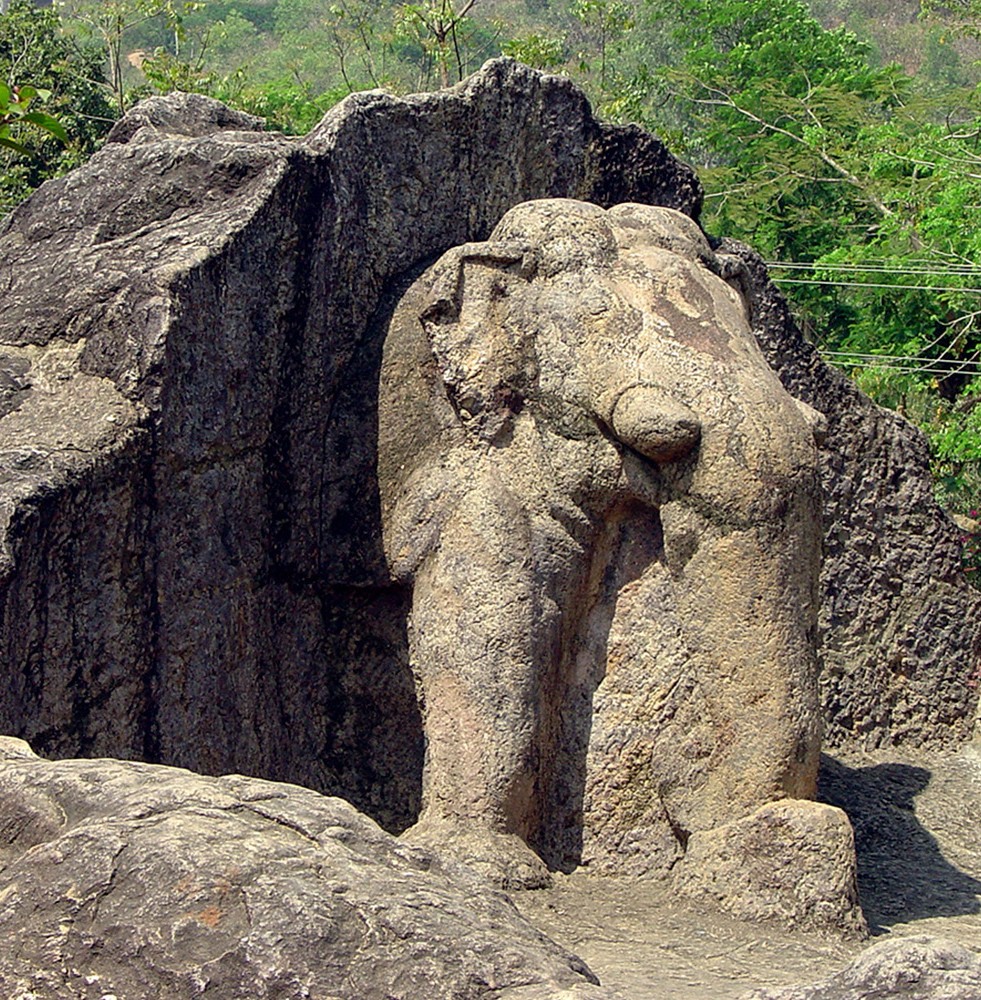
• It represents a fine delineation of bulky volume and living flesh, natural to that animal, along with a dignified movement and linear rhythm that has no parallel except in the elephant figure in relief on the abacus of the Sarnath capital.
Facades of Lomas Rishi Cave
• The rock-cut cave carved at Barabar hills near Gaya in Bihar is known as the Lomas Rishi cave.
• The facade of the cave is decorated with the semi- circular chaitya arch as the entrance.
• The cave was patronised by Ashoka for the Ajivika sect. The Lomas Rishi cave is an isolated example of this period.
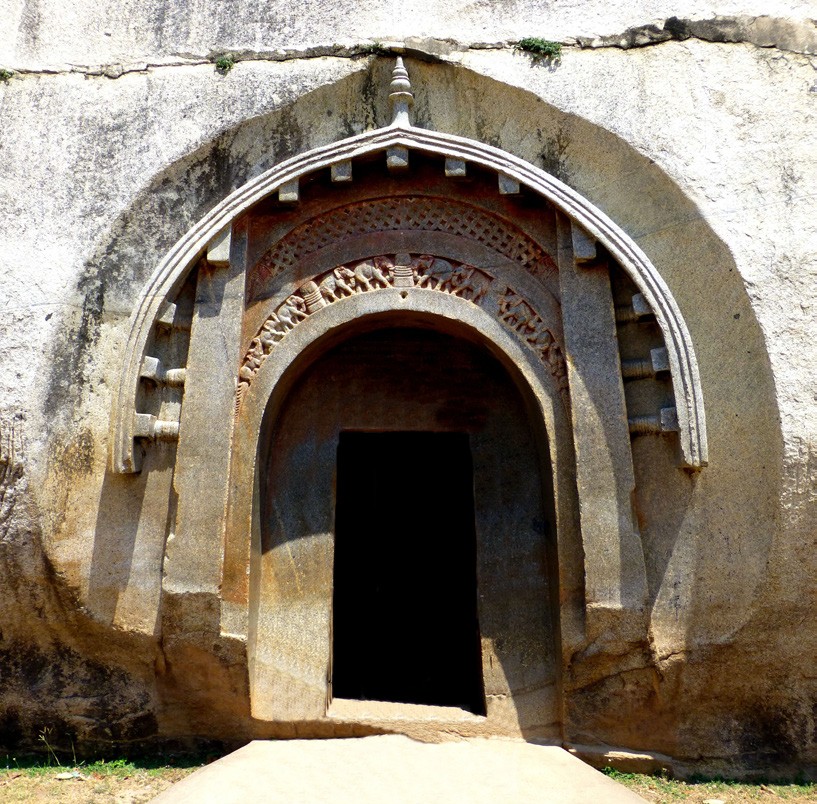
Lomas Rishi cave, Barabar hills