SCULPTURES OF POST MAURYAN AGE
During this age Mathura school, Gandhara School and Amaravati school emerged and flourished. It is mainly associated with Buddhism.
Gandhara School
It flourished in north western parts of Indian subcontinent and emerged in second half of 2nd century. It is also known as Graeco-Buddhist School of art as it is based on Greco- Roman norms and techniques.
• Assimilating various traits of Acamenian, Parthian and Bactrian traditions into the local tradition is a hallmark of the Gandhara style.
• Materials used were blue-grey Mica schist / Grey Sandstone.
• Kushanas and shakas were the chief patrons of the school.
Major Centres: Jalalabad, Hadda, Bamaran, Begram & Taxila were the main centres where art pieces of Gandhara School have been found.
The Buddha image of Gandhara Art: The Gandharan Buddha image was inspired by Hellenistic realism, influenced by Persian, Scythian, and Parthian models.
• In contrast with Mathura School, the Gandhara School images are known for their anatomical accuracy, spatial depth, and foreshortening.
• In this art, Buddha’s curls were altered into wavy hair. The head of the Buddha matched very much with Greek God Apollo.
• Image of Buddha statue (Gandhara style)
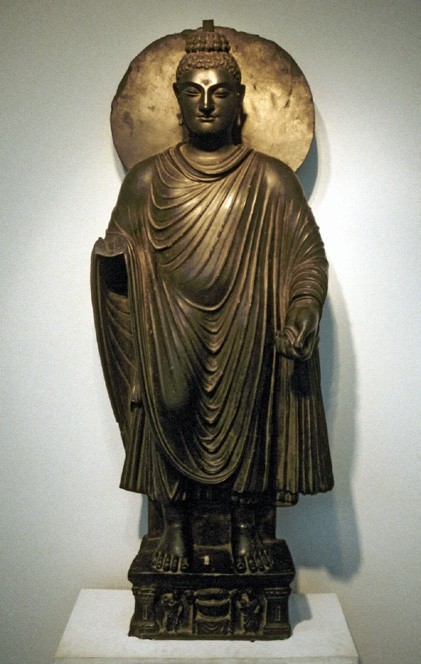
Example: Buddhas of Bamiyan, Afghanistan
Mathura School
The Gandhara and Mathura Schools of Art thrived during the first century AD, particularly under the reign of the Kushan emperor Kanishka. The Mathura School developed organically in India.
The main center for production in the Mathura School was Mathura, with other important hubs in Sarnath and Kosambi. ¾ The primary material used was spotted red sandstone.
Notable masterpieces of the Mathura School include statues of Wema Kadphises, Kanishka, Parkham Yaksha, Maholi Bodhisattva, and seated Kubera. Buddha Images: Before the emergence of this school, Buddha was never depicted in human form at sites like Sanchi, Barhut, or Gaya.
¾ Buddha was represented solely by symbols, such as footprints or wheels.
¾ Artists from Mathura initially continued to use these symbols but gradually began to create a human representation of Buddha, independent from other artistic traditions.
¾ These early human images of Buddha were inspired by Yaksha figures. However, anatomical accuracy was not a priority, and the images combined the 32 major and 80 minor marks (laksana) associated with Buddha. The early Buddha and Bodhisattva images were fleshy and joyful, with little spiritual depth. Their forms were block-like, with smooth, tight-fitting robes that lacked folds
By the second century AD, the figures became more sensual and rotund.
• By the third century AD, the excessive roundness was reduced, and the figures became more refined.
• This trend continued into the fourth century AD, with further reductions in mass and fleshiness, and the flesh appearing more taut. The Buddha’s halo became highly decorated.
As the human form of Buddha evolved, it came to symbolize beauty and heroic ideals.
• Both sitting and standing poses of Buddha and Bodhisattvas were sculpted in the Mathura style.
• The finest examples of standing Buddha images from this school can be found in Sravasthi, Sarnath and Kausambi.
Vaishnava and Shaiva Images
Although Buddhist images dominate the Mathura region, images representing the Vaishnava and Shaiva faiths are also found here.
Jaina Images:
• The Sarvatobhadrika image, featuring four Jinas standing back-to-back, is another notable work from the Mathura School.
• The Standing Buddhas of the Sravasthi, Sarnath and Kausambhi are finest example of Buddha image under this school.
Vaishnava and Shaiva images:
The images of Vaishnava and Shaiva faiths are also found at Mathura but Buddhist images are found in large numbers.
Jaina Images
The Sarvatobhadrika image of 4 Jinas standing back-to-back belongs to the Mathura school.
Amaravati School
The Amaravati school of art developed between the lower valleys of the Krishna and Godavari rivers in
Andhra Pradesh.
A distinct type of art originated and flourished at Amaravati for around six centuries between 200 and 100 BCE.
The ‘narrative art’ is a prominent feature of the Amaravati school.
White marble was most
used common material.
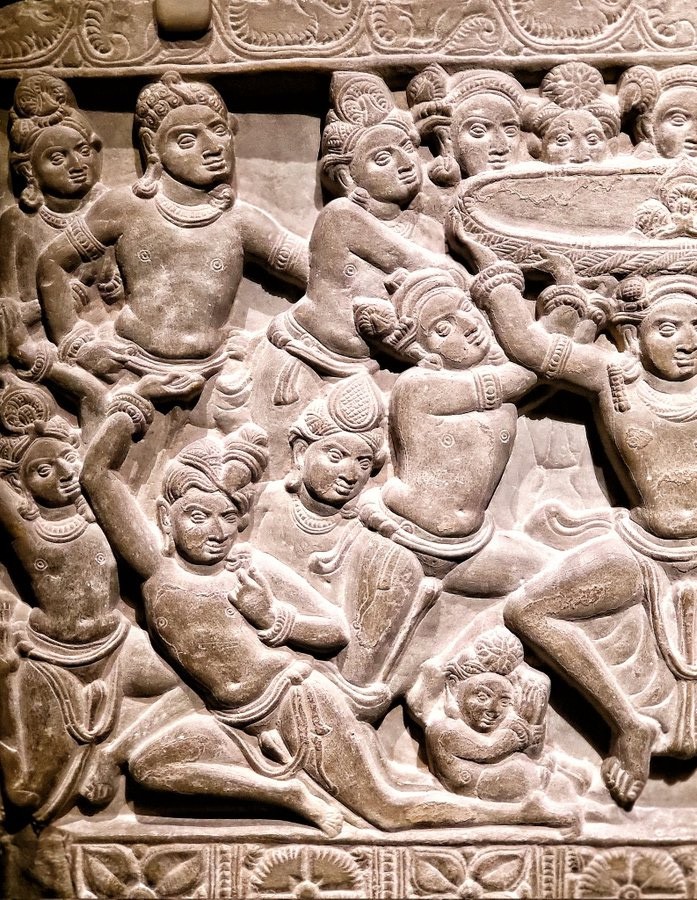
Sculpture of Amaravati School
Satavahanas were the first patrons of this school.
• Along with Satvahans, Ikshavaku and Vakataka
were patrons of this school.
• It was associated with Buddhism only.
• This style included both religious and secular images.
Pallava and Chola buildings evolved from this style later. Amravati, Nagarjunikonda, Goli, Ghantasala, and Vengi are notable locales where this style flourished.