SIKHISM
Thomas Christians in India. The coming of the Portuguese in India during the 14th century opened a new vista in the history of Christianity. Consequently, they established churches on the western coast of India. It was at this time when Portuguese Christian mission under Francis Xavier (1506- 52), a Jesuit priest was sent to India. He became successful in converting a large number of people into Christianity, on the western coast. Emperor Akbar gave freedom to Christian missions to establish their Church, propagate their religion and to celebrate their religious festivals.
Guru Nanak, founder of the Sikh faith, was born in Talwandi, near Lahore in Pakistan in 1469. He was one of the greatest saints of the Bhakti movement. The word ‘Sikh” is derived from the Sanskrit word Shishya, meaning a disciple. Sikhs are disciples of their ten gurus. Guru Nanak (1469–1539) was the first Guru and Guru Gobind Singh (1666–1708), the last. Guru Nanak received his early education in Sanskrit and Persian. In 1496, he had an extraordinary spiritual experience (enlightment), after which he travelled extensively to spread the message of love and brotherhood. Guru Nanak preached through kirtans, bhajans and ragas and people flocked to listen to him. His hymns and songs were compiled in a book called the Adi Granth. He established sangats (people sitting together to listen to the Guru) and pangats (people eating together in langar or free kitchen). According to him, salvation would be achieved by right belief, right worship and right conduct which are all taught by the guru.

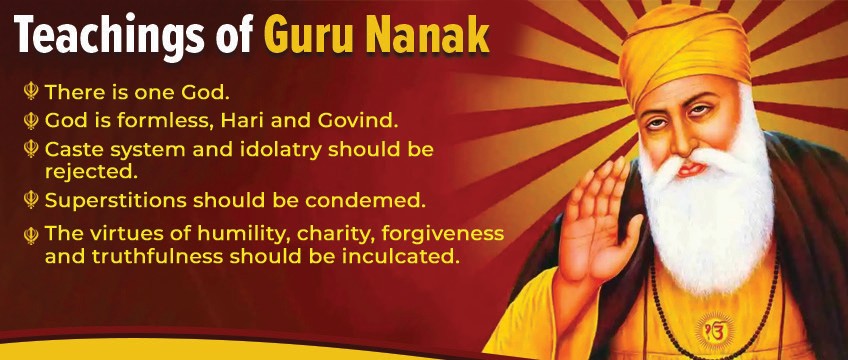
Teachings of Guru Nanak
Ten Sikh Gurus
| NAME | TIME PERIOD | DESCRIPTION |
| Guru Nanak | 1469 – 1539 | He is the first Guru of the Sikhs. Sikhism was founded by him. |
| Guru Angad Dev | 1504 – 1552 | He is the second Guru of the Sikhs. Guru Angad compiled Guru Nanak’s works, adding his own in a new script known as Gurmukhi. The sacred writings of the Sikhs were only written in Gurmukhi. Sikhs’ holy book, Guru Granth Sahib is written in Gurmukhi script. |
| Guru Amar Das | 1479 – 1574 | He is the third Guru of the Sikhs. He bolstered the Sikh movement by establishing the Manjis and Piris institutions. |
| Guru Ram Dass | 1534 – 1581 | He laid the foundation for the holy city of Amritsar, which would later become the Sikh faith’s spiritual capital. |
| Guru Arjun Dev | 1563 – 1606 | He was Guru Ram Dass’s son and successor. He constructed the Harmandir Sahib, also known as the Golden Temple and there he compiled and installed the Guru Granth, the Holy Book. |
| Guru Hargobind | 1595 – 1644 | He constructed Akal Takhat, the Immortal Throne and designated it to be the seat of Sikh temporal sovereignty. |
| Guru Har Rai | 1630 – 1661 | He carried on the work of his forefathers. |
| Guru Har Kishan | 1656 – 1664 | In Delhi, he treated smallpox patients and he is commemorated in the daily Sikh prayer as the one whose mere presence dispels all sorrows. |
| Guru Teg Bahadu | 1621 – 1675 | He is the ninth Guru of the Sikhs. He founded Anandpur Sahib. In 1675, he was executed under the orders of the Mughal Emperor Aurangzeb. |
| Guru Gobind Singh | 1666 – 1708 | The Sikhs were organized into a disciplined, military order of Sikh saints known as the Khalsa (the pure) by the last Guru. Kangha (comb), Kesh (length hair), Kada (iron bracelet), Kachcha (underwear) and Kirpan (knife) are the five emblems of Sikhism. |
The Guru Granth Sahib, the Sikh sacred text, is regarded as the 11th Sikh Guru and immortal. Aside from the songs of the Sikh Gurus, the Guru Granth Sahib also contains the works of Muslim and Hindu saints, some of whom are from the Hindu society’s so-called lower castes. As a result, the Sikh Holy Book can be seen as a singular example of the Sikh faith’s ecumenical character.