Smart Cities Mission
The Indian government launched the Smart Cities Mission, an urban renewal and retrofitting initiative, to create smart cities that are sustainable and hospitable to citizens. The mission will be carried out in cooperation with state governments by the Union Ministry of Urban Development.
Need For the Mission
About 31% of India’s population currently lives in cities, which also generate 63% of the country’s GDP. 40% of India’s population is predicted to live in urban areas by 2030, and they will generate 75% of the country’s GDP. Cities experiencing population growth face challenges in managing their infrastructure and providing services. One initiative in India that seeks to effectively and efficiently address these issues is the Smart Cities Mission.
The following are the main components of a smart city’s infrastructure:
Sufficient supply of water.
Guaranteed power supply.
Solid waste management is a part of sanitation.
Public transport and urban mobility done well.
Affordable housing, particularly for the underprivileged.
Solid digitalization and IT connectivity.
Effective government, particularly e-governance and public involvement sustainable surroundings.
Citizens’ safety and security, especially that of women, children, and the elderly education and health.
Sustainable and inclusive development is the main focus, and the plan is to examine small areas and develop a replicable model that can act as a guide for other aspirational cities.
Coverage
Based on equitable criteria, 100 cities have been distributed among the States and Union Territories (UT) for the mission. The formula assigns the number of statutory towns (a town having a municipality, corporation, cantonment board, or notified town area committee) and the urban population of the State or UT equal weight (50:50). Each State/UT will consequently have a certain number of potential Smart Cities based on this formula, with at least one in each State/UT.
Strategy
The 100 Smart Cities Mission in India includes a pan- city initiative in addition to area-based development components such as city extension (greenfield development), city renewal (redevelopment), and city improvement (retrofitting).
Financing
The Smart Cities Mission in India is a centrally sponsored scheme. It also mandates that, in order to carry out projects under the Smart City Proposal (SCP), state governments and urban local bodies (ULBs) contribute equally. For the projects listed in the Smart City Proposal, states are expected to look for funding from a variety of sources.
ATAL MISSION FOR REJUVENATION AND URBAN TRANSFORMATION (AMRUT)
Atal Mission for Rejuvenation and Urban Transformation (AMRUT) was launched in 500 cities and towns across the country.
Purpose
The purpose of Atal Mission for Rejuvenation and Urban Transformation (AMRUT) is to:
• Ensure that every household has access to a tap with the assured supply of water and a sewerage connection.
• Increase the amenity value of cities by developing greenery and well-maintained open spaces (e.g., parks) and
• Reduce pollution by switching to public transport or constructing facilities for non-motorized transport (e.g., walking and cycling). All these outcomes are valued by citizens, particularly women, and indicators and standards have been prescribed by the Ministry of Housing and Urban Affairs (MoHUA) in the form of Service Level Benchmarks (SLBs).
Thrust areas
The Mission will focus on the following Thrust Areas:
• Water supply,
• Sewerage facilities and septage management,
• Storm water drains to reduce flooding,
• Pedestrian, non-motorized and public transport facilities, parking spaces, and
• Enhancing the amenity value of cities by creating and upgrading green spaces, parks and recreation centers, especially for children.
AMRUT 2.0
The Atal Mission for Rejuvenation and Urban Transformation 2.0 (AMRUT 2.0) was approved as a step towards Atma Nirbhar Bharat and with the aim of making the cities ‘water secure’ and ‘self-sustainable’ through a circular economy of water.
AMRUT 2.0, targets universal coverage of water supply by providing household tap connections in all statutory towns and coverage of sewage/septage management in 500 cities covered in the first phase of the AMRUT scheme.
Mission also has a reform agenda on ease of living of
citizens through reduction of non-revenue water, recycle of treated used water, rejuvenation of water bodies, augmenting double entry accounting system, urban planning, strengthening urban finance etc.
Other components of AMRUT 2.0 are:
Pey Jal Survekshan to ascertain equitable distribution of water, reuse of wastewater, mapping of water bodies and promote healthy competition among the cities /towns.
Technology Sub-Mission for water to leverage latest global technologies in the field of water.
Information, Education, and Communication (IEC) campaign aimed at raising public awareness of water conservation.
HOUSING FOR ALL
Pradhan Mantri Awas Yojana (Urban)
The Ministry of Housing and Urban Poverty Alleviation (MoHUPA) launched the Pradhan Mantri Awas Yojana (Urban) Programme to provide pucca houses with basic amenities to all eligible urban beneficiaries, including slum dwellers across the nation.
Scope
The Mission covers the entire urban area consisting of Statutory Towns, Notified Planning Areas, Development Authorities, Special Area Development Authorities, Industrial Development Authorities or any such authority under State legislation which is entrusted with the functions of urban planning & regulations.
Housing for All” Mission for urban area will provide central assistance to implementing agencies through States and UTs for providing houses to all eligible families/beneficiaries which was earlier from 25.06.2015 to 31.03.2022, has since been extended up to 31.12.2024.
Mission will be implemented as Centrally Sponsored Scheme (CSS) except for the component of credit linked subsidy which will be implemented as a Central Sector Scheme.
Implementation Methodology
The Mission will be implemented through four verticals giving option to beneficiaries, ULBs and State/UT Governments. These four verticals are as below:
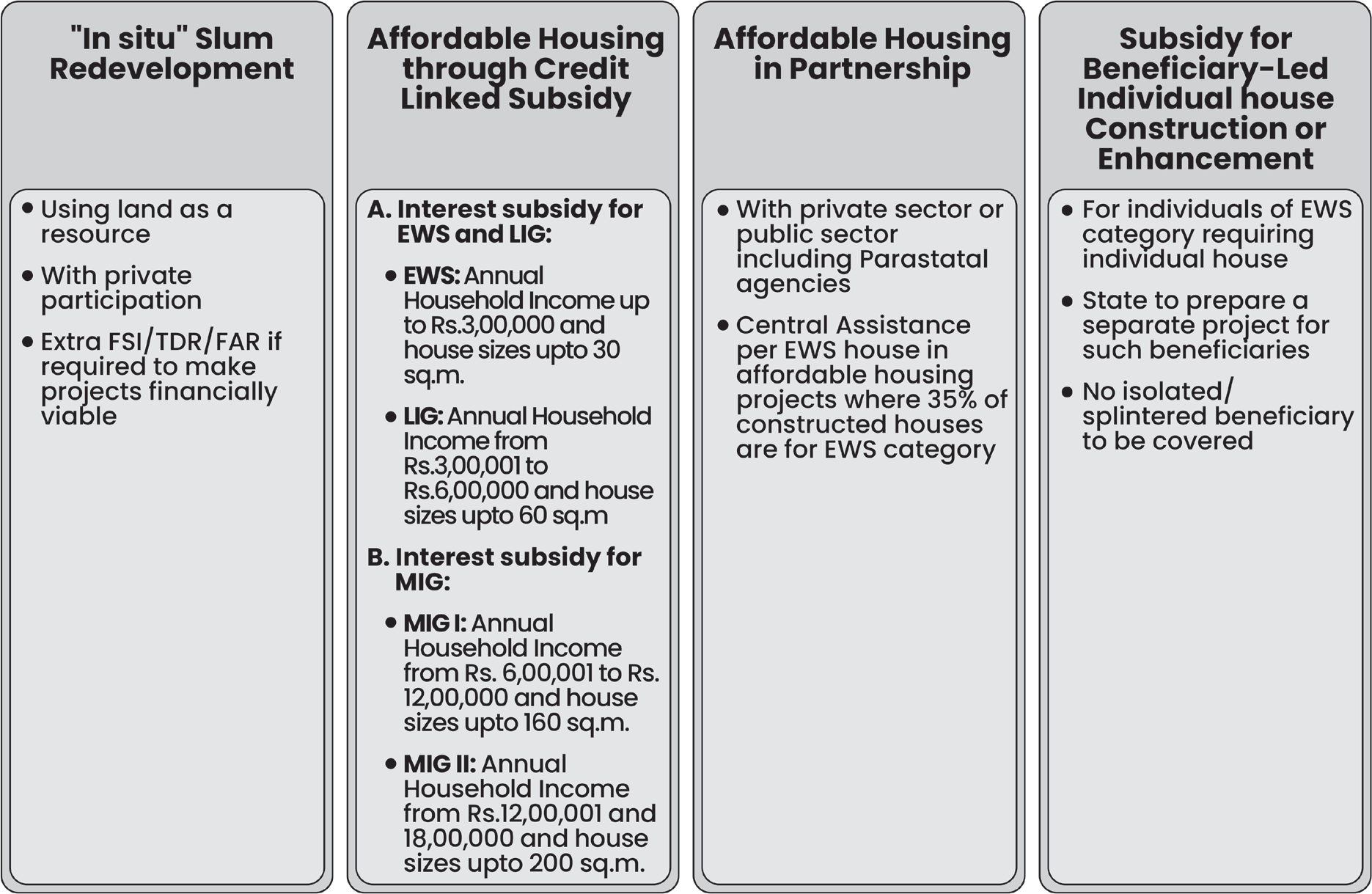
Pradhan Mantri Awaas Yojana (Gramin)
The rural housing programme Indira Awas Yojana was redesigned as Pradhan Mantri Awaas Yojana - Gramin and approved in March 2016 with the aim of achieving “Housing for all by 2022.”
Under the programme, all homeless people and households residing in run-down homes are eligible to receive financial assistance for the construction of pucca houses.
Under PMAY-Gramin Phase I & II, 4.15 crore houses
allocated to states, 3.90 crore sanctioned, 2.99 crore houses completed.
The cumulative target aims to achieve 4.95 crore rural houses by 2029.
Objective
To provide pucca houses to all who are houseless and living in dilapidated houses in rural areas. The overall target is to construct 2.95 crore pucca houses with basic amenities by March, 2024.
Funding Pattern
The Central and State Governments are to split the cost of unit assistance under PMAY in the following ratios: 60:40 for plain areas and 90:10 for hilly and North Eastern states.
The unit assistance given to beneficiaries under the programme is Rs 1,20,000 in plain areas and to Rs 1,30,000 in hilly states/difficult areas /Integrated Action Plan (IAP) for Selected Tribal and Backward Districts.
Through convergence with Swachh Bharat Mission – Gramin (SBM-G), Mahatma Gandhi National Rural Employment Guarantee Scheme (MGNREGS), or any other dedicated source of funding, an additional Rs. 12,000/- is extended for the construction of toilets.
Under MGNREGA, the beneficiary is eligible for 90 or 95 days of unskilled labour.
It would be made easier for the beneficiary to obtain a loan of up to Rs. 70,000 for the optional construction of the house.
Money will be sent electronically and deposited straight into the beneficiary’s account.
Target Group
Beneficiaries of this PMAY scheme will be identified as per data available from the Socio-Economic and Caste Census (SECC) and include
Scheduled castes and scheduled tribes.
•
Non-SC/ST and minorities under BPL.
• Freed bonded labourers.
• Next of kin and widows of paramilitary forces and individuals killed in action, ex-servicemen, and those under a retirement scheme.
National Investment and Infrastructure Fund
The National Investment and Infrastructure Fund, or NIIF for short, is an organisation supported by the Indian government that was founded to give long-term funding to the nation’s infrastructure industry.
Budget 2015 set the ball rolling for its creation and NIIF was set up as an alternative investment fund (AIF) in December 2016 with a planned corpus of Rs. 40,000 crore.
The remainder of NIIF is owned by notable domestic and international investors like Temasek, Abu Dhabi Investment Authority, and HDFC Group, with the Indian government owning 49% of the company. With the Centre’s significant stake, NIIF is considered India’s quasi sovereign wealth fund.
NIIF oversees $3 billion in capital between its three funds: the Master Fund, Fund of Funds, and Strategic Fund.
Its portfolio now includes investments in ports and logistics, real estate and renewables. It is also said to have put in bids for four airports Jaipur, Lucknow, Ahmedabad and Mangaluru in the recent auctions.
It manages USD 4.9 billion in Assets Under Management (AUM) across its funds.
Active Funds under NIIF
• Master Fund – Focused on infrastructure investments.
• Private Markets Fund – A fund of funds supporting private equity managers.
• India–JapanFund – Dedicated to climate, sustainability, and bilateral corridor projects.
• Strategic Opportunities Fund – Concentrated on growth equity investments.