SOUTH ASIAN ASSOCIATION OF REGIONAL COOPERATION (SAARC)
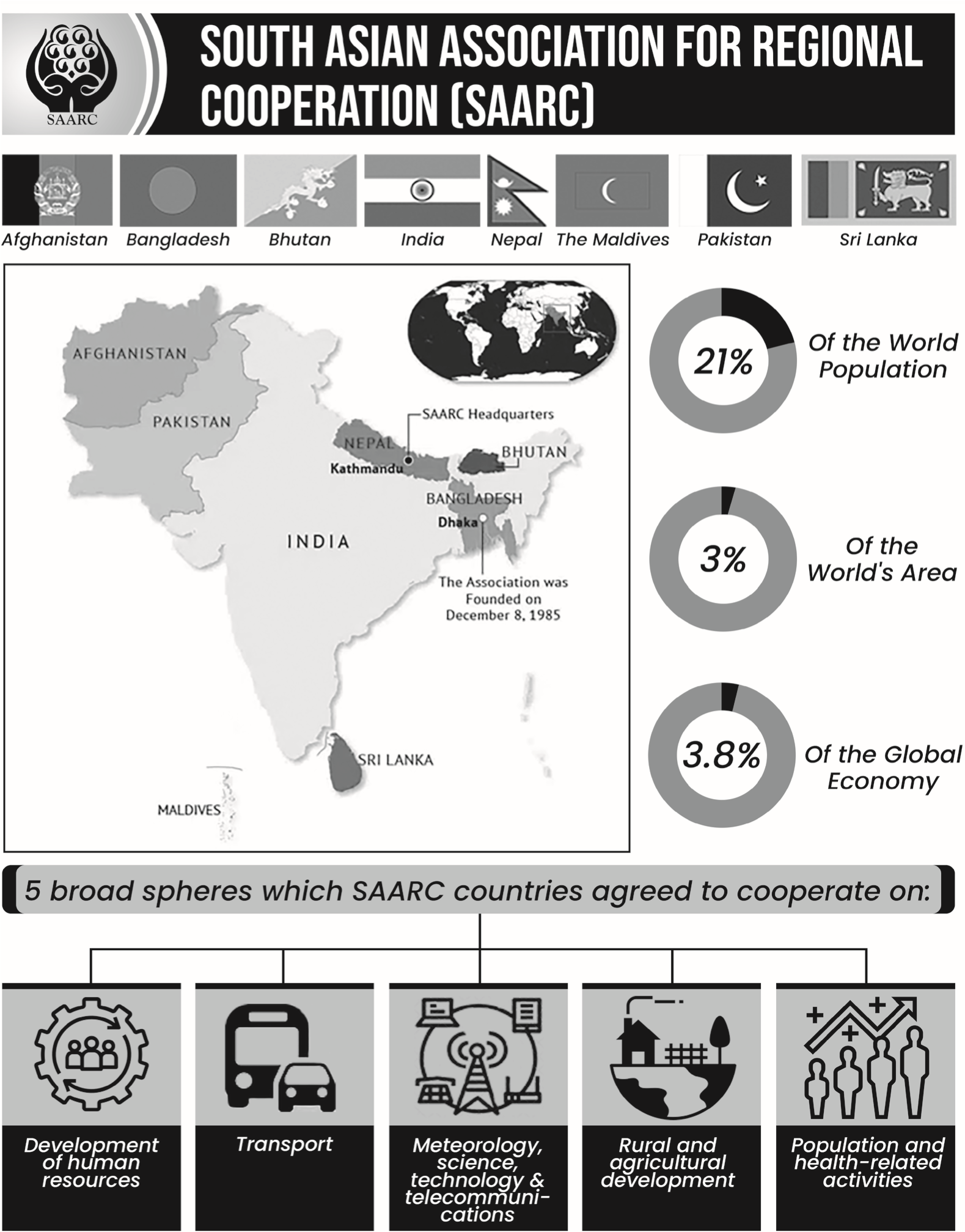
• The South Asian Association for Regional Cooperation (SAARC) is a regional intergovernmental organization and political union of South Asian nations.
• Its member countries are Afghanistan, Bangladesh, Bhutan, India, the Maldives, Nepal, Pakistan, and Sri Lanka.
• India played a key role in founding SAARC, with the goal of fostering greater connectivity and integration within South Asia, while advancing the development and prosperity of all member states.
• SAARC was established in Dhaka on December 8, 1985.
• The organization holds observer status at the United Nations and has also built relationships with various multilateral bodies, such as the European Union.
Principles of SAARC
• Respect for the principles of sovereign equality, territorial integrity, political independence, non-interference in the internal affairs of other States and mutual benefit.
• Such cooperation shall not be a substitute for bilateral and multilateral cooperation but shall complement them.
• Such cooperation shall not be inconsistent with bilateral and multilateral obligations.
Objectives of SAARC
• Promote the welfare of the people of South Asia and to improve their quality of life.
• Accelerate economic growth, social progress and cultural development in the region and to provide all individuals the opportunity to live in dignity and to realize their full potentials.
• Promote and strengthen collective self-reliance among the countries of South Asia.
• Contribute to mutual trust, understanding and appreciation of one another’s problems.
• Promote active collaboration and mutual assistance in the economic, social, cultural, technical and scientific fields.
• Strengthen cooperation with other developing countries.
• Strengthen cooperation among themselves in international forums on matters of common interests, and
• Cooperate with international and regional organizations with similar aims and purposes.
Principal Organs of SAARC
• Meeting of Heads of State or Government
• Meetings are held at the Summit level, usually on an annual basis.
• Standing Committee of Foreign Secretaries
• The Committee provides overall monitoring and coordination, determines priorities, mobilizes resources, and approves projects and financing.
• Secretariat
• The SAARC Secretariat was established in Kathmandu on 16 January 1987.
• Its role is to coordinate and monitor the implementation of SAARC activities, service the meetings of the association and serve as a channel of communication between SAARC and other international organizations.
• The Secretariat comprises the secretary-general, seven directors, and the general services staff.
• The secretary-general is appointed by the Council of Ministers on the principle of rotation, for a non-renewable tenure of three years.
SAARC’s Specialised Bodies
• SAARC Development Fund (SDF) (2010):
• Its primary objective is funding of project-based collaboration in social sectors such as poverty alleviation, development, etc.
• SDF is governed by a Board consisting of representatives from the Ministry of Finance of the Member States. The Governing Council of SDF (Finance Ministers of MSs) oversees the functioning of the Board.
• South Asian University (SAU) (2010)
• South Asian University (SAU) is an international university, located in India.
• Degrees and Certificates awarded by the SAU are at par with the respective Degrees and Certificates awarded by the National Universities/ Institutions.
• South Asian Regional Standards Organization (SARSO) (2011)
• South Asian Regional Standards Organization (SARSO) has its Secretariat at Dhaka, Bangladesh.
• It was established to achieve and enhance coordination and cooperation among SAARC member states in the fields of standardization and conformity assessment and is aimed to develop harmonized Standards for the region to facilitate intra-regional trade and to have access in the global market.
• SAARC Arbitration Council (2007)
• It is an inter-governmental body having its office in Pakistan is mandated to provide a legal framework/ forum within the region for fair and efficient settlement of commercial, industrial, trade, banking, investment and such other disputes, as may be referred to it by the member states and their people.
What is its Importance?
• SAARC comprises 3% of the world’s area, 21% of the world’s population and 3.8% (US$2.9 trillion) of the global economy.
• It is the world’s most densely populated region and one of the most fertile areas.
• SAARC countries have common tradition, dress, food and culture and political aspects thereby synergizing their actions.
• All the SAARC countries have common problems and issues like poverty, illiteracy, malnutrition, natural disasters, internal conflicts, industrial and technological backwardness, low GDP and poor socio-economic condition and uplift their living standards thereby creating common areas of development and progress having common solutions.
SAARC Achievements
• Free Trade Area (FTA): The member countries have established a Free Trade Area (FTA) which will increase their internal trade and lessen the trade gap of some states considerably.
• South Asia Preferential Trading Agreement for promoting trade amongst the member countries came into effect in 1995.
• SAFTA: A Free Trade Agreement confined to goods, but excluding all services like information technology. Agreement was signed to reduce customs duties of all traded goods to zero by the year 2016.
• SAARC Agreement on Trade in Services (SATIS): SATIS is following the GATS-plus ‘positive list’ approach for trade in services liberalization.
• Other initiatives: Establish a SAARC university in India, a food bank and also an energy reserve in Pakistan.
Significance of SAARC for India
Neighbourhood first: Primacy to the country’s immediate neighbours.
Geostrategic significance: Can counter China (OBOR initiative) through engaging Nepal, Bhutan, the Maldives and Sri Lanka in development process and economic cooperation.
Regional stability: SAARC can help in creation of mutual trust and peace within the region.
SAARC offers India a platform to showcase its leadership in the region by taking up extra responsibilities.
Game changer for India’s Act East Policy by linking South Asian economies with South East Asian will bring further economic integration and prosperity to India mainly in the Services Sector.
Associated Challenges
Low frequency of meetings: More engagement is required by the member states and instead of meeting biennial meetings should be held annually.
Broad area of cooperation leads to diversion of energy and resources.
Limitation in SAFTA: The implementation of SAFTA has not been satisfactory a Free Trade Agreement confined to goods, excluding all services like information technology.
Indo-Pak Relations: Escalated tension and conflict between India and Pakistan have severely hampered the prospects of SAARC.
India-SAARC & Covid-19
At the initiative of the Prime Minister, a Video Conference of SAARC Leaders on combating COVID-19 was held on 15 March 2020.
It demonstrated the shared resolve of countries in the SAARC region to fight together the unprecedented challenge of the coronavirus pandemic.
India created a COVID-19 Emergency Fund with an initial offer of USD 10 million to meet the costs of immediate actions.
India’s humanitarian relief in the region includes supply of essential drugs, antibiotics, medical consumables, COVID protection and testing kits, and other laboratory and hospital equipment.
India has developed a ‘SAARC COVID19 Information Exchange Platform¬ (COINEX)’ platform for use by all
SAARC countries to facilitate exchange of specialized information and tools on COVID-19 among designated health professionals.
Way Forward
In a region increasingly influenced by Chinese investments and loans, SAARC could serve as a collective platform to advocate for more sustainable development alternatives, challenge trade tariffs together, or negotiate better conditions for South Asian workers globally.
SAARC embodies the shared South Asian identity of its member countries, both historically and in the present. This identity is rooted in the region’s natural geography, as well as its cultural, linguistic, religious, and culinary connections.
The organization’s potential to promote peace and stability in the region should be fully explored by all member states.
SAARC should be allowed to evolve organically, with greater opportunities for people-to-people engagement, especially considering that the people of South Asia make up a quarter of the world’s population.