Special Economic Zone (SEZ)
Special Economic Zone (SEZ) is a specifically delineated duty-free enclave and shall be deemed to be foreign territory for the purposes of trade operations and duties and tariffs. In other words, SEZ is a geographical region that has economic
laws different from a country’s typical economic laws. Usually, the goal is to increase foreign investments. SEZs have been established in several countries, including China, India, Jordan, Poland, Kazakhstan, Philippines and Russia.
Special Economic Zones - An overview:
India was one of the first in Asia to recognize the effectiveness of the Export Processing Zone (EPZ) model in promoting exports, with Asia’s first EPZ being set up in Kandla in 1965.
With a view to overcome the shortcomings experien-ced on account of the multiplicity of controls and clearances, absence of world-class infrastructure and to attract larger foreign investments in India, the Special Economic Zones (SEZs) Policy was announced in April, 2000.
This policy intends to make SEZs an engine for economic growth supported by quality infrastructure complemented by an attractive fiscal package, both at the Centre and the State level, with the minimum possible regulations.
The Special Economic Zones Act, 2005, was passed by Parliament in May, 2005 which received Presidential assent on June 23, 2005. The SEZ Rules, came into effect on February 10, 2006, providing for drastic simplification of procedures and for single window clearance on matters relating to Central as well as State governments.
The main objectives of the SEZ Act are
Generation of additional economic activity.
Promotion of exports of goods and services.
Promotion of investment from domestic and foreign sources.
Creation of employment opportunities.
Development of infrastructure facilities.
The SEZ Act, 2005 envisages a key role for the State Governments in Export Promotion and creation of related infrastructure.
The category ‘SEZ’ covers a broad range of more specific zone types, including, but not limited to
Free Trade Zones (FTZs)
Export Processing Zones (EPZs)
Free Zones (FZs)
Industrial Estates (IEs)
Free ports
Urban enterprise zones
Incentives for setting up a business in an Indian SEZ
Some incentives for setting up a sourcing or manufacturing platform within an Indian SEZ include
Duty free import and domestic procurement of goods for the development, operation, and maintenance of your company/SEZ unit.
•
100% Income Tax exemption on export income for SEZ units under Section 10AA of the Income Tax Act for the first 5 years, 50% for the next 5 years thereafter.
• Income tax exemption on income derived from the business of development of the SEZ in a block of 10 years in 15 years under Section 80-IAB of the Income Tax Act. (Sunset Clause for Developers has become effective from 01.04.2017).
• Exemption from customs/excise duties for development of SEZs for authorized operations.
• Exemption from the Goods and Service Tax (GST) and levies imposed by the state government (supplies to SEZs are zero rated under the IGST Act, 2017, meaning they are not taxed).
• Exemption from Minimum Alternate Tax (MAT).
• Single window clearances for all state and federal government approvals.
• Exemption in electricity duty and tax on sale of electricity by certain states in India.
• Presence of customs officer in the SEZs to facilitate and expedite the trade processes.
• Some states also offer land to SEZ developers at concessional rates to promote industries in accordance with the state’s prevailing Industrial Policy.
Sagarmala Project
Maritime sector in India has been the backbone of the country’s trade and has grown manifold over the years. To harness India’s 7,500 km long coastline, 14,500 km of potentially navigable waterways and strategic location on key international maritime trade routes, the Government of India has embarked on the ambitious Sagarmala Program which aims to promote port-led development in the country.


Components of Sagarmala Programme
Port Modernization and New Port Development: Developing new greenfield ports and debottling and increasing the capacity of already-existing ports.
Improvement of Port Connectivity: Increasing the ports’ accessibility to the hinterland and maximising the time
and cost of cargo movement by utilising multimodal logistics solutions, such as domestic waterways (inland water transport and coastal shipping).
Creating port-proximate industrial clusters and Coastal Economic Zones can lower the cost and duration of logistics for both domestic and export cargo. This is known as port-linked industrialization
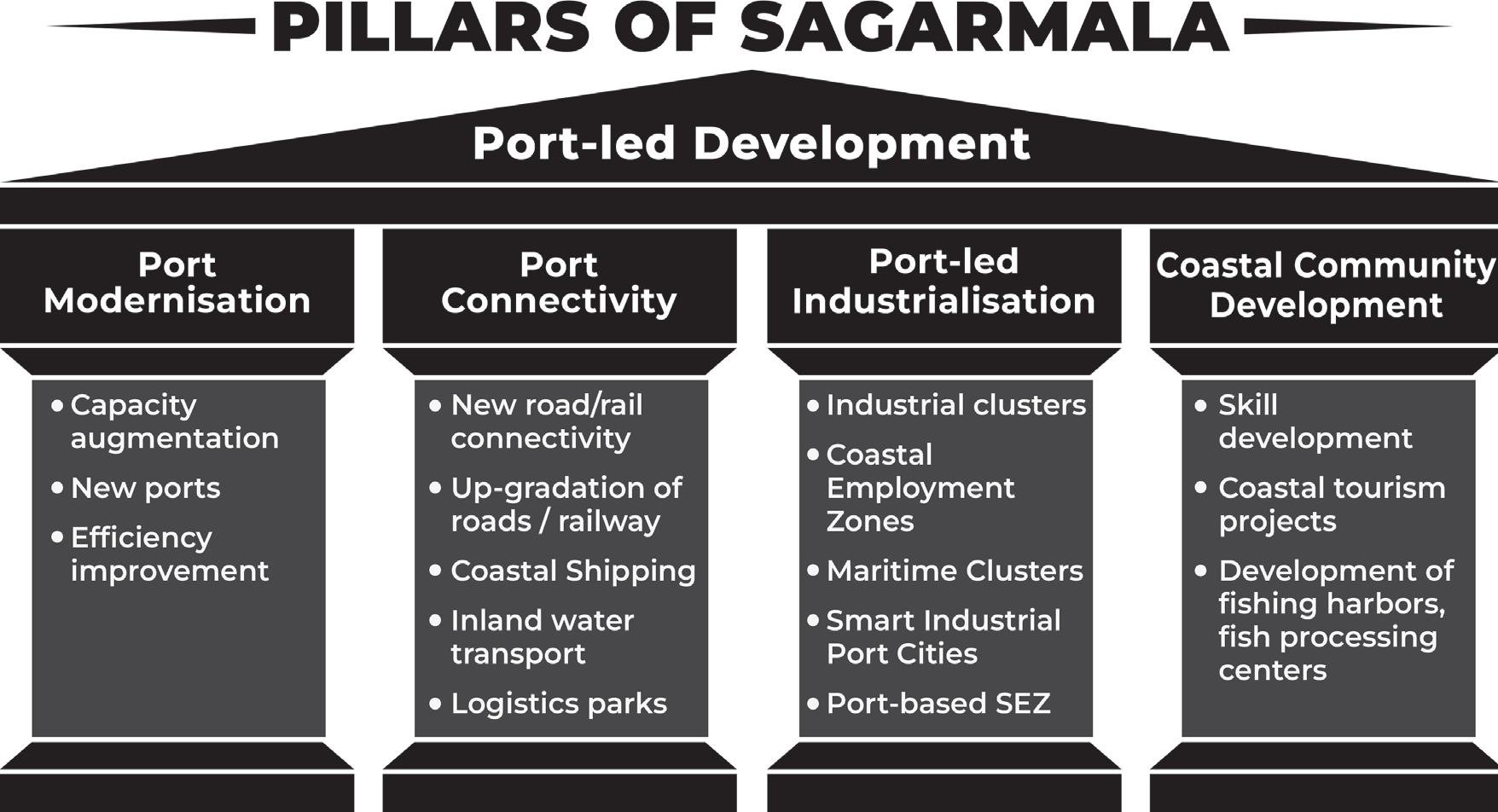

Coastal Community Development: Encouraging the sustainable growth of coastal communities by means of activities such as fisheries development, coastal tourism, skill development, and livelihood generation.
Coastal Shipping and Inland Waterway Transport: Encouragement to transport goods by environmentally responsible, sustainable coastal and inland waterway modes.
Coastal Economic Zones
The Ministry of Shipping has introduced the Coastal Economic Zone (CEZ). The CEZs are categorized to develop the country’s economic status by initiating port- led industrialization. The zones are set up to create a business-friendly environment by making the import and export easy and fast on the environmental clearances.
It consists of a group of coastal districts or districts with strong linkage to ports in the region to utilize the synergies with planned industrial corridor projects.
In order to support manufacturing and create jobs, 14 such industrial clusters will be developed, and CEZ will be one of them.
Each CEZ will consist of multiple CEUs and more than one industrial cluster can be housed within a CEU. Within each industrial cluster there can be several manufacturing units. To accelerate the CEU development process, it is proposed that CEUs be prioritized in locations where land parcels are available in areas close to a deep draught port and with strong potential for manufacturing.
Coastal Economic Units (CEUs): CEUs will be specific industrial estate projects with a demarcated
boundary similar to the DMIC nodes. The CEUs will house the industrial clusters / projects proposed within the CEZ.
Under the auspices of NITI Aayog, an Inter-Ministerial Committee (IMC) was established to oversee the development of CEZs in India.
Multi-Modal Logistics Parks (MMLPs)
Multi-Modal Logistics Parks (MMLPs) is a logistic programme by the government to develop Multi-Modal Logistics Parks across different logistics centers in the country.
The initiative is led by National Highways Logistics Management Limited under Ministry of Road Transport and Highways (MoRTH) and the National Highways Authority of India (NHAI).
These MMLPs will be developed in a hub-and-spoke model (a hub-and-spoke network connects every location through a single intermediary location called a hub) to improve the country’s freight logistics sector.
MMLP development is expected to give tremendous benefits to the transportation sector. Among them are
• Reduced freight expenses overall.
• Lower costs for warehousing.
• Decreased traffic and pollution from cars.
• Improved traceability and tracking of shipments during transportation.
The MMLPs additionally offer value-added services like
customs clearances, IT services, storage, and warehousing solutions.
Design of Multi-Modal Logistics Parks (MMLPs)
The Cabinet Committee on Economic Affairs (CCEA) had authorized MoRT&H to develop 35 Multi Model Logistics Parks (MMLP) across the country.
These 35 MMLPs being implemented by MoRTH are to be developed under Public Private Partnership (PPP) on Design, Build, Finance, Operate and Transfer (DBFOT) mode.
A total five MMLPs at Jogighopa, Chennai, Bengaluru, Nagpur and Indore are expected to complete in FY 2025- 26 and FY 2026-27 which will improve logistic efficiency by decreasing the cost of logistic. It is seen as great achievement in the field of logistics
The National Highways and Logistics Management (NHLML), which is a special purpose vehicle (SPV) and fully owned by the National Highways Authority of India (NHAI), plans to construct the majority of the proposed MMPLs in public private partnership (PPP) mode. The parks will have a 50:50 funding model.
Need for the MMLPs
According to the Asian Development Bank (ADB), India’s Logistics sector is having high cost and lower efficiency compared to other countries. This has reduced the overall efficiency in the economy and increased the cost structure of all commodities.
Compared to other countries road freights in India are higher, while the average speed of freight vehicles is about 50%–60% lower. Following factors adversely affect freight movement in India according to the ADB.
Skewed modal transportation mix: In India, 60% of freight moves by road, which is significantly larger than in many developed economies. Coastal movement and inland waterways are at a nascent stage. Rail transport is marginal, in spite of being 45% cheaper per ton–km than road, due to adverse pricing and rake booking practices and lack of intermodal facilities to enable easy transfer.
Underdeveloped material handling infrastructure: Warehousing landscape is highly unorganized with the presence of a large number of small, private, and unorganized warehouses, providing little or no value- added services. The economies of scale associated with integrated and large warehousing facilities or multimodal logistic parks (MMLPs) is not available to all participants in the value chain, including the small and medium enterprises.
Inefficient fleet mix: Small and inefficient trucks with gross vehicle weight rating of 16–25 metric tons (MT) have lower payloads. Absence of logistics hubs to act as zones for freight consolidation and disaggregation results in higher point-to-point freight movement on
lower sized vehicles, compared to more efficient line haul freight.
• Outdated/inefficient service model: Efficiency is also compromised as many firms try to compete through the factor advantage of low wages which have led to hiring poorly skilled personnel thereby eschewing investments in information technology and equipment technology, and consequently sacrificing productivity gains and service quality.
Fragmented institutional and governance structure: Different parts of the logistics value chain currently are being managed by different ministries including Road Transport and Highways, Shipping, Railways, Civil Aviation, Commerce and Industry, Finance, Home Affairs, and Department of Posts. In addition, a large number of government agencies including Central Drug Standard Control Organization, Food Safety and Standards Authority of India, and Plant and Animal Quarantine Certification Service provide relevant trade clearances and impact the value chain. Globally, leading countries that have achieved efficiency in logistics, like Germany, Japan, the Republic of Korea, and Malaysia, follow a completely integrated approach towards logistics, and the government provides coordinated oversight to the entire logistics value chain