Telecommunications Sector
The telecommunication sector is made up of companies that make communication possible on a global scale, whether through the phone, the internet, over airwaves, or cables.
The biggest businesses in the industry are internet service providers, cable companies, satellite companies, and wired and wireless phone operators.
Investors seeking income and growth can find a common interest in telecommunications companies. Although individual stocks can be quite volatile, the telecom sector overall has exhibited stable long-term growth, as telecommunications have become increasingly essential and impervious to business cycles.
India is the world’s second-largest telecommunications market with a subscriber base of 1.17 billion and has registered strong growth in the last decade.
India has an overall tele-density of 84.86 %, of which, the tele-density of the rural market, which is largely untapped, stands at 58.01 % while the tele-density of the urban market is 134.62 %.
The Telecom sector is the 3rd largest sector in terms of FDI inflows, contributing 6.43% of total FDI inflow, and contributes directly to 2.2 mn employment and indirectly to 1.8 mn jobs.
The rapid steps in the telecom sector have been facilitated by liberal policies of the Government that provide easy market access for telecom equipment and a fair regulatory framework for offering telecom services to the Indian consumers at affordable prices.
India is also the second-largest country in terms of internet subscribers. India is one of the biggest consumers of data worldwide.
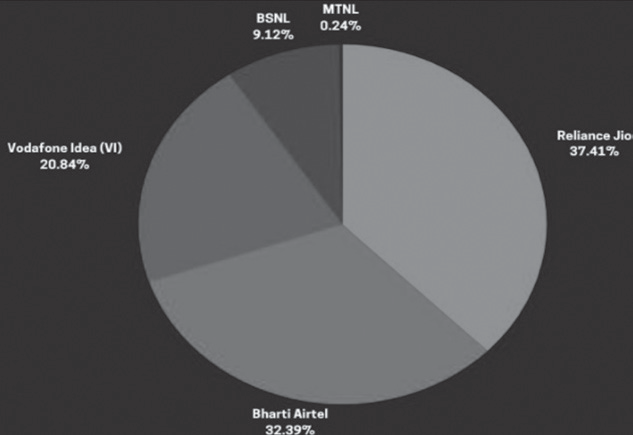
Telecom Market Share FY 2023
Government Initiatives
The government has fast-tracked reforms in the telecom sector. Some of the other major initiatives taken by the government for growth for telecom companies are as follows:
• The Ministry of Communications & Information Technology has launched Twitter Sewa, an online communications platform for registration and resolution of user complaints in the telecommunications and postal sectors.
• In an effort to provide free Internet services to consumers while adhering to net neutrality principles, the Telecom Regulatory Authority of India (TRAI) has published a consultation paper outlining three models for providing free data delivery to users without breaking any laws.
• By giving telecom companies two payment options upfront payment or payment in instalments for obtaining the right to use spectrum, the Indian government has liberalised the terms of payment for spectrum auctions.
• The Department of Telecommunications (DoT) has amended the Unified License for telecom operations which will allow sharing of active telecom infrastructure like antenna, feeder cable and transmission systems between operators, thereby lowering the costs of operations and leading to faster rollout of networks.
• The Telecom Regulatory Authority of India (TRAI) has recommended a Public-Private Partnership (PPP) model for Bharat Net, the central government’s ambitious project to set up a broadband network in rural India, and has also envisaged central and state governments to become the main clients in this project.
• The Ministry of Skill Development and Entrepreneurship (MSDE) signed a Memorandum of Understanding (MoU) with Department of Telecommunication (DoT) to develop and implement National Action Plan for Skill Development in Telecom Sector, with an objective of fulfilling skilled manpower requirement and providing employment and entrepreneurship opportunities in the sector.
• In an effort to stop the rising number of dropped calls, the Telecom Regulatory Authority of India (TRAI) has ordered telecom companies or mobile operators to reimburse customers for any dropped calls.
• Prime Minister Wi-Fi Access Network Interface (PM- WANI): Provision of public Wi-Fi service through Public Data Offices (PDOs) spread across the country to accelerate the expansion of broadband internet services.
Importance of spectrum in telecom
In telecommunications, the term “spectrum” refers to a range of radio waves used for communication purposes comprising of radio and microwave frequencies
Radio frequencies are used for a wide variety of applications, including FM and AM radio broadcasts, television broadcasts, satellite communications, Wi-Fi, Bluetooth and cellular data transmission.
Spectrum Allocation and Regulation: Ensuring Order in the Airwaves
The radio spectrum, being critical for various applications, needs careful regulation to prevent interference between services.
In India, the 2.4 GHz and 5 GHz bands are unlicensed for use in technologies like Wi-Fi and Bluetooth, while the commonly used bands for cellular communication are 800 MHz, 900 MHz,1800 MHz, 2100 MHz, 2300 MHz and 3300 MHz
Telecom Circles and Spectrum Licensing: Managing
Spectrum on a National Scale
In India, spectrum management at the national level is done by dividing the country into 22 telecom circles.
Telecom companies bid for a spectrum license in these circles to offer uninterrupted access across India. This system allows for more granular control over spectrum allocation and ensures nationwide access to telecommunications services.
AGR (adjusted gross revenues) dispute
The telecom sector was liberalized under the National Telecom Policy, 1994 in which licenses were issued to companies in return for a fixed license fee.
In 1999, the government came out with an option of migration to a revenue sharing model.
Revenue sharing model: operators to share a percentage of their AGR as annual license fee and spectrum usage charges.
Definition of AGR soon became a bone of contention: The Department of telecommunications said AGR will include all revenues from telecom and non-telecom services, while telecom players said AGR should only include revenue from telecom services.
The definition for AGR calculation provided by the government was contested in 2005 by the Cellular Operators Association of India (COAI). The telecom companies won a 2015 ruling by the Telecom Disputes Settlement and Appellate Tribunal.
In 2019, the Supreme Court set aside TDSAT’s order and upheld the definition of Department of telecommunications, telcos were asked to pay over Rs 1.4 lakh crore (includes penalties and interest on penalties) combined by January 2020.
Recently the government announced that the definition of AGR will be rationalized and non-telecom revenue will be excluded on prospective basis.