The beginning of the end
Meanwhile, the war in North Africa became a confrontation between the Western Eighth Army, led by General Montgomery, and the German Afrika Korps, commanded by General Rommel, who had been sent by Hitler to support the Italian forces.
In August 1942, Rommel advanced toward Egypt. The decisive battle took place at El Alamein on Egypt’s northern coast in October 1942, resulting in Rommel’s retreat.
By the summer of 1943, the Allies had gained control of North Africa. In July, they launched an invasion of Sicily. Mussolini’s government was overthrown, and Italy surrendered unconditionally. However, German troops quickly moved into northern Italy, rescuing Mussolini, who then established a government under German protection.
On the Eastern Front, the Soviet Red Army forced Hitler’s forces to retreat along the very route they had confidently advanced two and a half years earlier.
Most Eastern European countries—Poland, Romania, Bulgaria, Czechoslovakia, and Hungary—were liberated, and fascist forces were expelled from Greece, Yugoslavia, and Albania.
In June 1944, the Allies opened a Second Front in Western Europe. On June 6, Allied troops landed on the beaches of Normandy on France’s northern coast in a meticulously planned and secret operation that caught the Germans by surprise. Under General Eisenhower’s command, the Allies broke through German defenses and by September had liberated Brussels, Paris, and Luxembourg.
Surrender By the fascist powers
By the spring of 1945, the end of war was in sight. The allied troops had taken over many cities in Italy. In April, there was an uprising in Fascist occupied areas. On April 28, Mussolini was captured and executed, thus putting an end to fascism in Italy.
The downfall of Germany was now certain. The Allied troop entered Germany from three directions – the south, the northwest and the east and as the Soviet army reached Berlin, Hitler committed suicide. On May 7, Germany surrendered unconditionally.
The fall of Japan
The war in Asia and the Pacific continued even after Germany’s surrender. Despite American and British victories in the Pacific and the Far East, Japan still held out On August 6, 1945, U.S. dropped the first atom bomb on the Japanese city of Hiroshima. Fifty thousand people were killed and large parts of the city were leveled to the ground. Two days later, a second bomb destroyed the city of Nagasaki and forced Japan to surrender.
The Second world war came to an end. More than 50 countries had been involved in war.
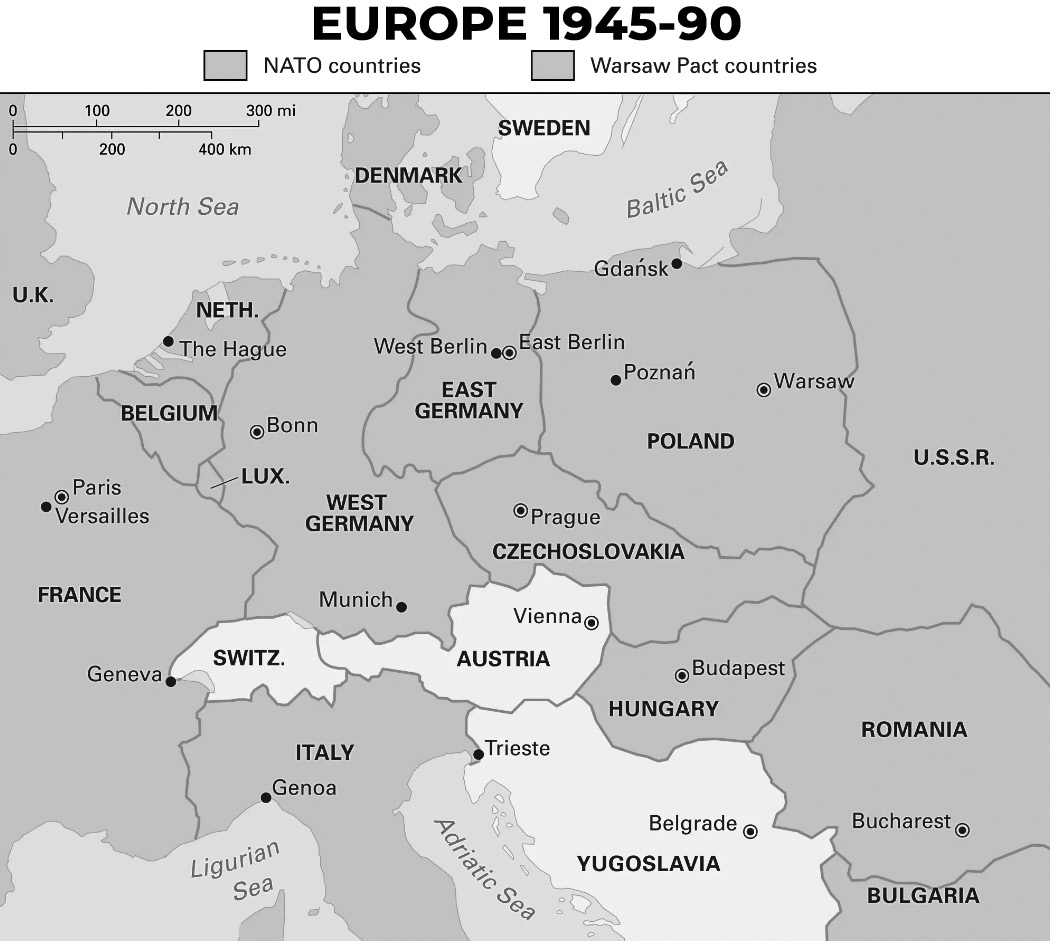
Map of Europe after Second World War