The Electromagnetic Spectrum
The range of all EM radiation types is known as the electromagnetic (EM) spectrum. Electromagnetic radiation includes radio waves from a radio station and visible light from lamps in your home. Radiation is defined as energy that flows and spreads out along its path. The electromagnetic spectrum also consists of various forms of radiation, such as microwaves, X-rays, gamma rays, infrared light and ultraviolet light.
The picture below depicts where you might encounter each section of the electromagnetic spectrum in your daily life.
• Radio: Your radio picks up the radio waves that stations generate and plays your favourite songs. Stars and gases also emit radio waves into space.
• Microwave: Not only does microwave radiation quickly cook popcorn, but it is also utilized by astronomers to understand the composition of neighbouring galaxies.
• Infrared: The infrared light that is released by our skin and hot objects is detected by night vision goggles. Infrared radiation from space is used to map the dust that exists between stars.
• Visible: Visible light is detected by our eyes. Visible light is emitted by stars, fireflies, and light bulbs.
• Ultraviolet: The Sun emits ultraviolet light, which causes skin to burn and turn tan. Additionally, “hot” objects in space release UV light.
• X-ray: X-rays are used by dentists to take pictures of your teeth and by airport security to look through bags. In the universe, hot gasses also release X-rays.
•
Gamma ray: Utilizing gamma-ray imaging, doctors look into your body. The universe is the largest known source of gamma radiation.
Is a radio wave the same as a gamma ray?
Are gamma-rays and radio waves entirely different types of physical objects? They are not essentially different, even if they are created using different methods and detected in other ways. Electromagnetic radiation includes visible light, gamma rays, radio waves, and all other forms of
electromagnetic radiation.
A stream of massless particles called photons, which move at the speed of light in a wave-like pattern, can be used to represent electromagnetic radiation. There is a specific quantity of energy in each photon. The energy contained in photons is what distinguishes the various forms of radiation. Low-energy photons are found in radio waves; microwave photons are slightly more energetic than radio waves; infrared photons are even more energetic than radio waves; finally, visible, ultraviolet, X-ray, and gamma-rays are the highest energy photons of all.
Measuring electromagnetic radiation
There are three ways to describe electromagnetic radiation: energy, wavelength and frequency. Hertz, or cycles per second, is used to measure frequency. Meters are used to measure wavelengths. Electron volts are used to measure energy. There is a precise mathematical relationship between each of these three values used to characterize electromagnetic radiation. However, what is the purpose of having three distinct sets of physical units for each description?
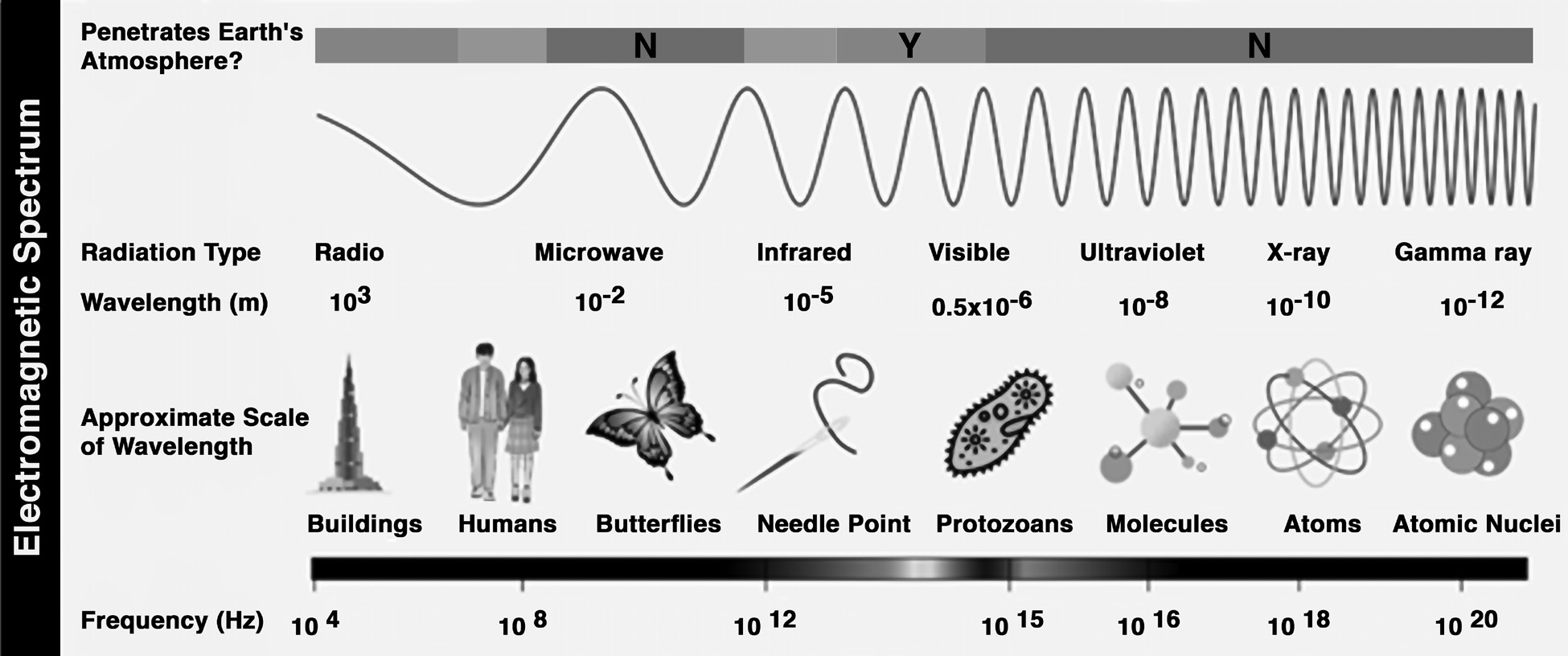
The basic explanation is that scientists prefer not to work with numbers that are larger or smaller than necessary. Saying or writing “two kilometres” is far simpler than “two thousand meters.” In general, scientists work with the simplest units available for the sort of electromagnetic radiation they study.
When studying radio waves, astronomers typically utilize frequencies or wavelengths. The majority of the radio portion
of the electromagnetic spectrum lies between approximately 1 cm and 1 km, or 30 GHz to 300 kHz in frequency. A fairly large portion of the electromagnetic spectrum is radio.
Infrared and optical astronomers commonly utilize wavelengths. Infrared astronomers use microns (millionths of a meter) for wavelengths, therefore their share of the electromagnetic spectrum ranges from 1 to 100 microns.
Optical astronomers work with both angstroms (0.00000001 cm, or 10-8 cm) and nanometres (0.0000001 cm, or 10-7 cm). Violet, blue, green, yellow, orange, and red light have wavelengths ranging from 400 to 700 nanometers. (Because this range is only a small portion of the overall electromagnetic spectrum, the light our eyes can perceive is only a small percentage of the EM radiation around us.) The wavelengths in the ultraviolet, X-ray, and gamma-ray.
Why do we put telescopes in orbit?
areas of the electromagnetic spectrum are extremely tiny. Astronomers studying these parts of the electromagnetic spectrum commonly refer to photons by their energies, which are measured in electron volts (eV), rather than their wavelengths. Ultraviolet radiation has an energy range of a few electron volts to around 100 eV. The energy of X-ray photons range from 100 to 100,000 eV (or 100 keV). Gamma- rays are all photons with energy greater than 100 keV.
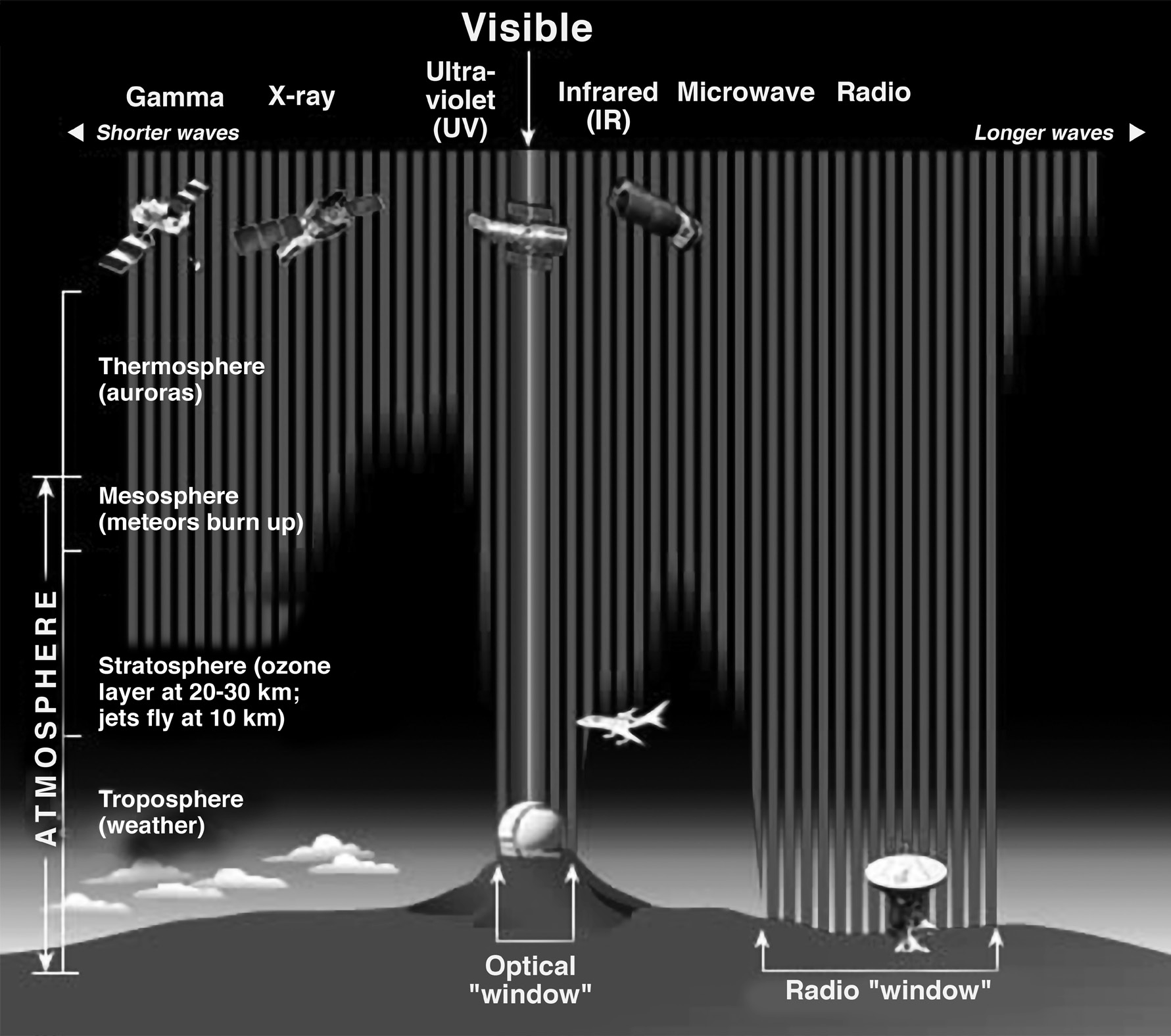
The Earth’s atmosphere prevents the majority of electromagnetic radiation from space from reaching the planet’s surface. This picture depicts how far different sections of the EM spectrum can penetrate the atmosphere before being absorbed. Only bits of radio and visible light reach the surface.
Most electromagnetic radiation from space does not reach the Earth’s surface. Radio frequencies, visible light, and some ultraviolet light reach sea level. Astronomers can observe some infrared wavelengths by mounting telescopes on mountaintops.
Balloon experiments can travel 35 kilometers above the earth and last for months. Rocket flights can transport
instruments all the way above the Earth’s atmosphere, but only for a few minutes before returning to Earth.
Satellite Frequency Bands
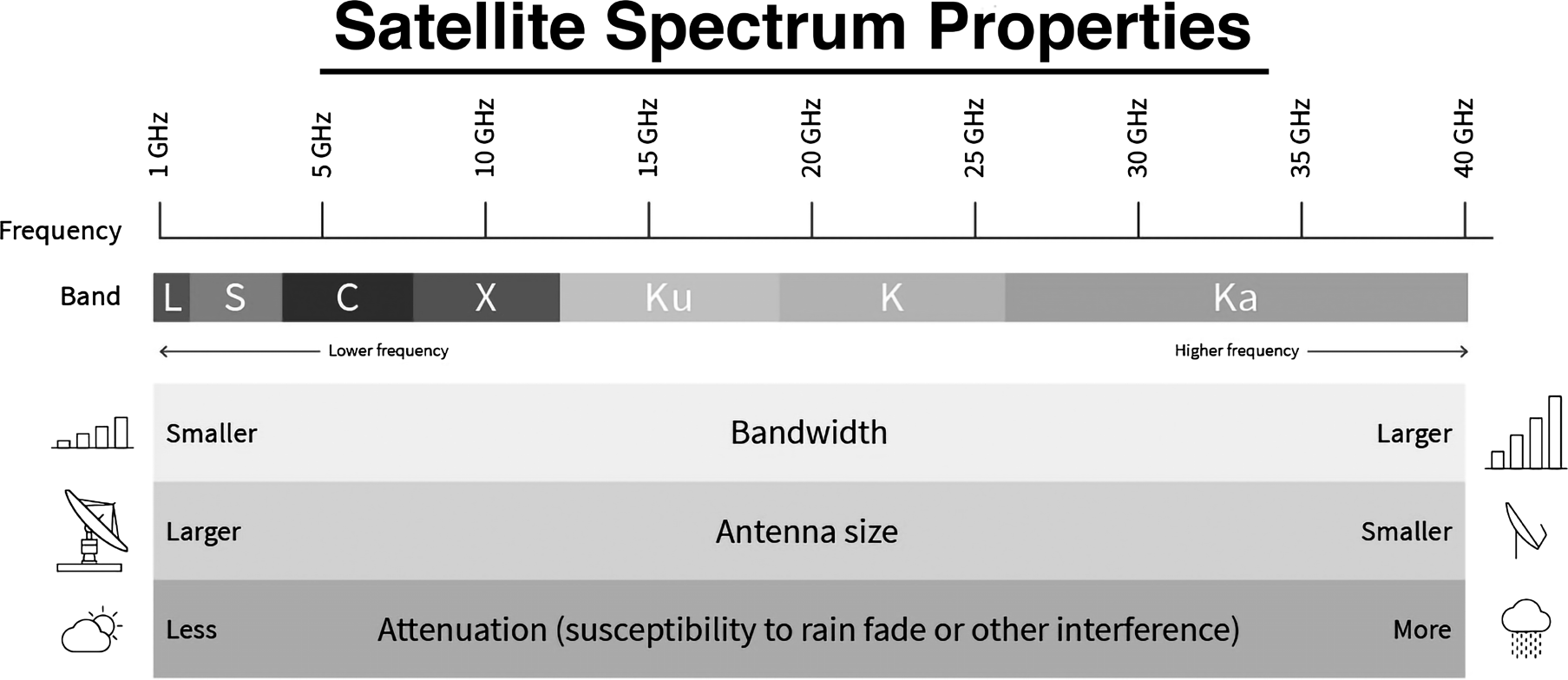
Because there are many different satellite frequency bands available for use, names for each have been established that make them simple to remember. Although higher frequency bands usually offer greater bandwidths, they are also more vulnerable to signal deterioration because of “rain fade,” which is the phenomenon where radio waves are absorbed by atmospheric precipitation such as rain, snow, or ice. The utilization, quantity and size of satellites have increased, and this has made congestion in the lower frequency bands a major problem. Research is underway on new technologies that could enable the usage of higher bands.
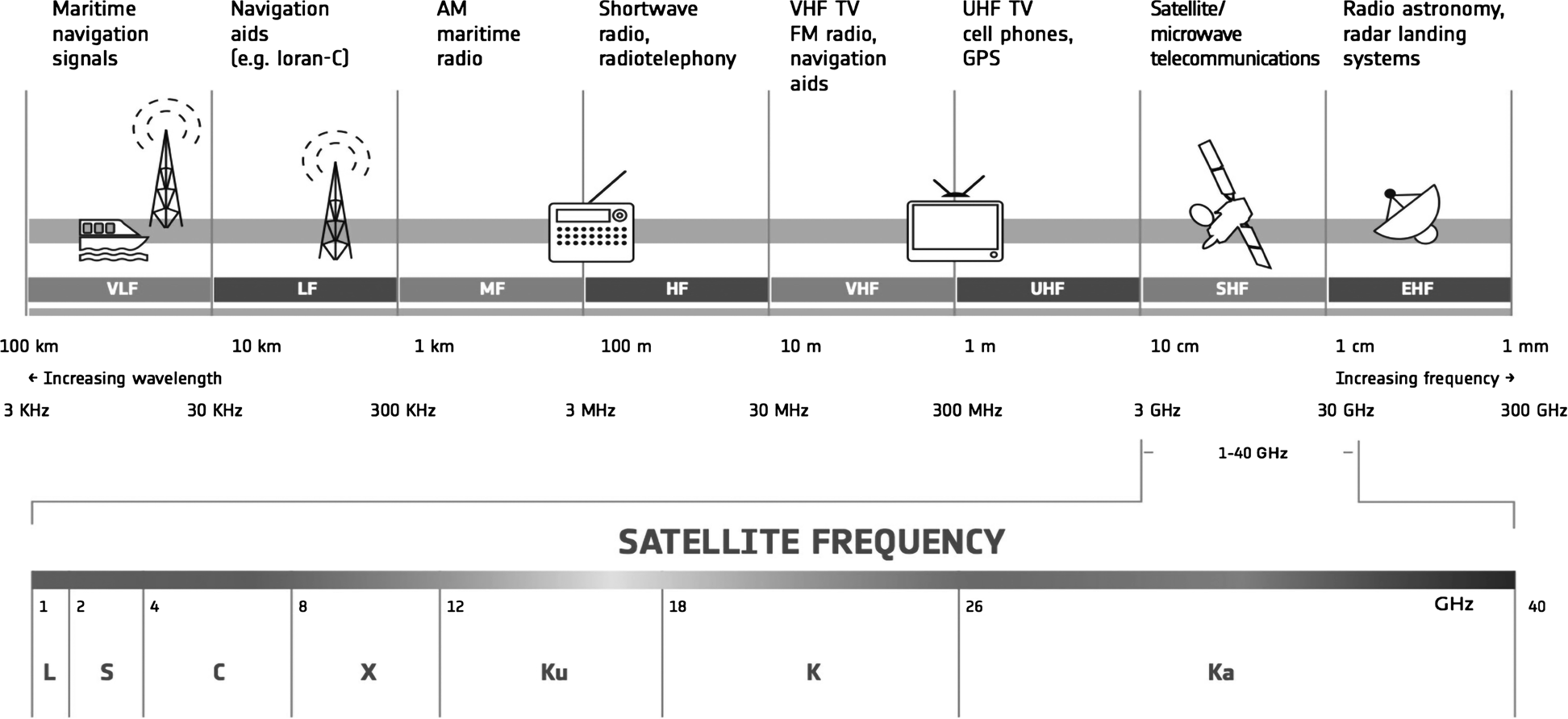
L-band (1–2 GHz)
• Global Positioning System (GPS) carriers; in addition, satellite mobile phones like Iridium; Inmarsat, which offers maritime, terrestrial, and aerial communications; World Space satellite radio.
S-band (2–4 GHz)
• Surface ship radar, weather radar, and a few communications satellites, including NASA’s for connecting to the International Space Station and Space Shuttle. The European Commission granted Inmarsat and Solaris mobile, a joint venture between Eutelsat and Astra, a 2 15 MHz section of the S-band in May 2009.
C-band (4–8 GHz)
It is primarily used for satellite communications, full- time satellite TV networks, and raw satellite feeds. It is commonly used in tropical rainy places because it is less vulnerable to rainfed than Ku band (the original Telstar satellite had a transponder operating in this band, which sent the first live transatlantic TV signal in 1962).
•
band (8–12 GHz)
Mainly utilized by the military. Radar applications include continuous-wave, pulsed, single-polarization, dual-polarisation, synthetic aperture radar, and phased arrays. X-band radar frequency sub-bands are utilized in civil, military, and government organizations for weather monitoring, air traffic control, maritime vessel traffic control, defense tracking, and vehicle speed detection for law enforcement purposes.
Ku-band (12–18 GHz)
• Used for satellite communication. In Europe, direct broadcast satellite services such as Astra use Ku-band downlink frequencies ranging from 10.7 GHz to 12.75 GHz.
Ka-band (26–40 GHz)
• Communication satellites use uplinks in the 27.5 GHz and 31 GHz bands, as well as military aircraft with high- resolution, close-range targeting radar.