The Mauryan State and Polity:
• Megasthenes described the Mauryan state as a centralized state.
• Perhaps the most detailed account of the administration is to be found in the Arthasastra. However, it must be remembered that the Arthasastra was a prescriptive text, which laid down the guidelines for good administration.
• Bureaucracy was very strong and efficient.
• The key priorities for the Mauryan state included collecting taxes as state revenue, administering justice, and ensuring internal security, along with defending against external threats.
• Achieving these objectives necessitated a large and complex administrative system and institutions.
• The bureaucratic structure spanned a hierarchy of settlements, ranging from villages to towns, provincial capitals, and major cities.
• Efficient Taxation
• The bureaucracy required and enabled an efficient system of revenue collection since it needed to be paid out of taxes collected.
• Equally, the very large army of the Mauryan Empire could be maintained only with the revenue raised through taxation.
• Rulers
• King was the head of the administration. The king was assisted by Purohita, who was a person of great importance.
• Samaharta: Revenue collection was his responsibility.
Saptanga Rajya
In the Arthashastra, Kautilya outlines the concept of Saptanga Rajya, which defines the state as consisting of seven interrelated and interconnected elements, known as angas or Prakriti.
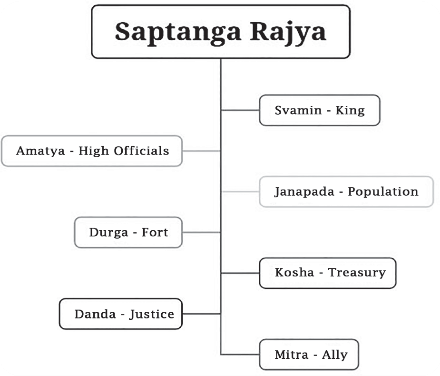
Svamin (king): Soul of all the seven elements and called Dharmapravakta. The King was assisted by a council of ministers. Pativedakas and Pulisani functioned as special reporters of the king and kept him informed of public opinion.
Amatya (all high officials, counselors, and executive heads of departments/ ministers):
• Council of ministers: An advisory body to support the king in daily administration, this council was larger than the Mantraparishad, which was a smaller consultative group of ministers.
• MahaMantrins: The high-ranking ministers.
• Nikayas (trained officials) who looked after ordinary affairs.
• Tirthas: Highest functionaries at the center chaired by Mantrin (chief minister), Purohita (high priest), Yuvaraja (heir-apparent), and Senapati (commander-in-chief).
• Adhyakshas: Superintendents, high-ranking officials next to the Tirthas, concerned mostly with economic functions and some military duties.
• Amatyas: Officials filled the highest administrative and judicial appointments.
• Nagaradhyaksha: The magistrates who looked after towns and cities.
• Baladhyakshas: Officials looking after the military.
• Samahartri:Chief collector of revenue. Superintendents functioned on his orders.
• Samnidhatri: Treasurer.
• Akshapatala: Records-cum-audit office.
• Dauvarika: Chief of the palace attendants.


Janapada (territory and population): The Mauryan Empire was divided into four other provinces, with capitals at Taxila (north-western India), Suvarnagiri (southern India), Tosali (eastern India), and Ujjain (western India). During Ashoka’s reign, a fifth province of Kalinga was added.
• The head of the provincial administration was viceroy, who was in charge of law and order, and collection of taxes for the center.
• The provinces were further divided into divisions headed by Pradeshikas, who had no advisory council.
| State | Capital |
| Uttarapatha | Taxila |
| Dakshinapatha | Suvarnagiri |
| Eastern India | Tosali |
| Avantiratha | Ujjain |
| Kalinga | Tasali/Dhauli |
Durga (Fortified capital): Higher officers called Anta- Mahamattas were responsible for the security of frontier forts. Kautilya gave detailed directions for the construction of the main fort in the capital city. Experts in different branches of military art and science were divided into six boards of five members each:
• The Board of Admiralty: In charge of the navy, though
interestingly Kautilya does not mention the navy,
• The Board of Infantry: Headed by Padadhyaksha ,
• The Board of Cavalry: Headed by Asvadhyaksha,
• TheBoa rdof WarChariots: Headed by
Rathadhyaksha,
• TheBoa rdof WarElephants: Headed by
Hastyadhyaksha,
• The Board of Transport and Supervision of Equipment.
Kosha: Treasury,
Danda/Bala: Justice or force,
Mitra means ally.
• The diplomatic posts mentioned in Arthashastra:
• Nisriharthaduta: Full-fledged ambassador,
• Parimitarthaduta: Officer under Nisriharthaduta,
• Sasanharaduta: messenger.
District and Village Administration:
• At the next level of administration came the districts, villages, and towns.
• Agriculture was then, as it remained down the centuries, the most important contributor to the economy, and the tax on agricultural produce constituted the most important source of revenue.
• Usually, the king was entitled to one-sixth of the produce. In reality, it was often much higher, usually about one- fourth of the produce.
Rajukas: Divisions were divided into districts under officials called Rajukas (derived from Rajju, meaning rope, and probably referring to the measurement of land using ropes). He was assisted by Yuktas (clerks) in accounting, secretarial, and other miscellaneous work.
Sthanika: The District was under their command.
Gopas: They were in charge of 5-10 villages.
Nagarika: Urban administrator.
Gramini: Village administrator.
Administrative policing units were organized at differentlevels:
Sthaniya – Established for a group of about 800 villages.
Dronamukha – Functioned at the level of around 400 villages.
Kharvatika – Operated for about 200 villages.
Sangrahana – Served a smaller cluster of around 10 villages.
• Police centre were found at the following intervals- There was a Sthaniya in the midst of 800 villages, a Dronamukha in 400 villages, a Kharvatika in 200 villages and a Sangrahana in 10 villages.
| Sthaniya | Drona Mukha | Kharvatika | Samgrahana |
| 800 villages | 400 villages | 200 villages | 10 villages |