THE SECOND AFGHAN EMPIRE

• Following a 14-year gap, Sher Shah successfully re-established Afghan rule in India, succeeding the Lodis.
• His reign and that of his successors lasted for 15 years, known as the period of the second Afghan Empire.
Sher Shah Suri’s Reign (1540-1545)
• Sher Shah Suri, originally Farid,
hailed from a family of jagirdars under Jaunpur’s kingdom.
• His father, Hasan Khan Sur, held the jagir of Sasaram in Bihar during the Lodi dynasty’s rule.
• After defeating Humayun, he ascended to sovereign rule in 1540, adopting the title of Sher Shah.
Military Conquests
• Sher Shah led victorious campaigns in Malwa, Chanderi, and Rajasthan, defeating areas such as Marwar, Ranthambhore, Nagor, Ajmer, and more.
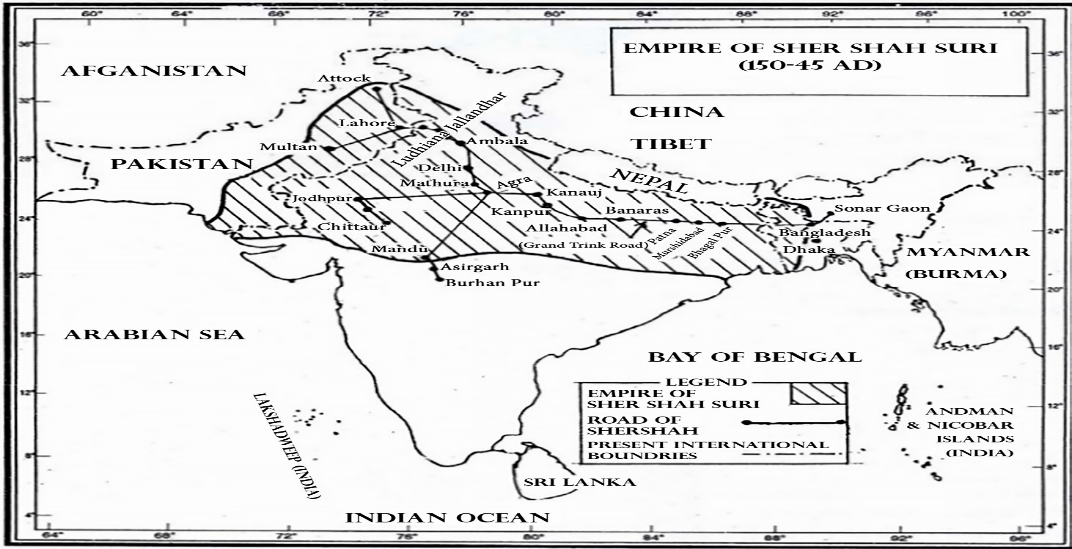
• He quelled rebellions in Bengal and expanded his dominion from Sindh and Punjab to Rajputana in the west and Bengal in the east.
Reforms and Achievements
Sher Shah implemented centralized governance with key ministerial positions:
• Diwan-i-Wizarat (Wazir): Managed Revenue and Finance
• Diwan-i-Ariz: Supervised the Army
• Diwan-i-Rasalat: Dealt with Foreign Affairs
• Diwan-i-Insha: Oversaw Communications
Administrative Structure
• Sher Shah’s empire was divided into forty-seven sarkars.
• Chief Shiqdar (law and order) and Chief Munsif (judge) were the two officers in charge of the administration in each sarkar.
• Each sarkar was divided into several parganas. Shiqdar (military officer), Amin (land revenue), Fotedar (treasurer) Karkuns (accountants) were in charge of the administration of each pargana.
• There were also many administrative units called iqtas.
• The land revenue administration was well organized under Sher Shah. Land survey was carefully done. All cultivable lands were classified into three classes – good, middle and bad. The state’s share was one third of the average produce and it was paid in cash or crop. His revenue reforms increased the revenue of the state.

Sher Shah’s Rupiya
• Sher Shah introduced a new silver coin called Rupiya and a copper coin called Dam. The names on the coins were given in Devanagari script. The ratio of exchange between Rupiya and Dam was fixed at 1 to 64.
Note: Abbas Sarwani, a historian, praised Sher Shah for his excellent administration, which created a safe environment where even the weakest person could travel with valuable items without fear of theft or robbery. This was due to the strict punishments Sher Shah was known to enforce.
In the words of Abbas Sarwani, "Even an old, frail woman could carry a basket of gold ornaments on her head during her journey, and no thief or robber would dare approach her because of the fear of the punishment Sher Shah would impose."
Infrastructure Development
• Sher Shah revolutionized communications by constructing four vital highways and extending the Grand Trunk Road from Chittagong in Bengal to Kabul in Afghanistan.
• Sher Shah enhanced communication by constructing four key highways :
Sonargaon to Sind
Agra to Burhampur
Jodhpur to Chittor
Lahore to Multan
• Rest houses (sarais) were built along these highways to provide convenience for travellers.
• He also restructured the police force, leading to a decrease in crime during his reign.
• Sher Shah began the construction of Purana Qila (Old Fort) in Delhi and his mausoleum in Sasaram.
Cultural Impact
During his reign, Malik Muhammad Jayasi authored the famous Hindi work “Padmavat,” contributing significantly to the cultural landscape.
Unfortunate Demise- While besieging the fort of Kalinjar in Bundelkhand, Sher Shah died in an accidental gunpowder blast in 1545, leaving a notable legacy