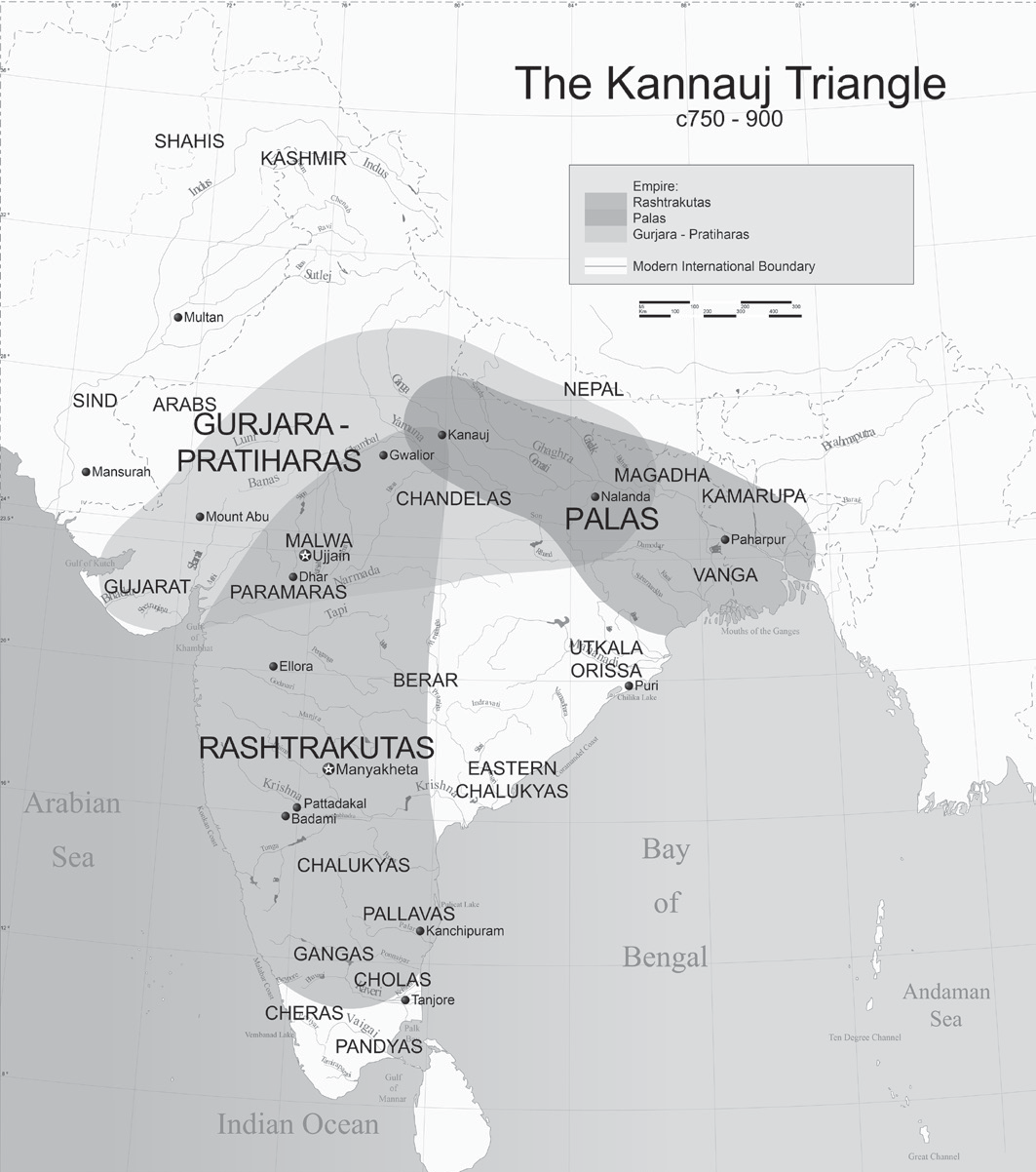
During the period between 800 and 1000 AD in Northern India, after the decline of Harsha’s empire, multiple significant states emerged. While none could unify the entire Ganga valley as Gupta and Harsha did, regions like Gujarat, Malwa, and Rajasthan became pivotal links between different territories. In the South, the Cholas asserted dominance over key deltas, establishing their supremacy.
Three major empires dominated th is era: the Pala, Pratihara, and Rashtrakuta empires. Despit e their conflicts, these empires brought stability, expanded agriculture, developed infrastructure like ponds and canals, and supported arts and temples.
THE STRUGGLE FOR DOMINATION IN NORTH INDIA: THE PALAS
The struggle for control in North India unfolded between the Palas, Pratiharas, and Rashtrakutas. The Pala Empire, initiated by Gopala around 750 AD, unified Bengal and expanded into Magadha (Bihar). His successor, Dharamapala, engaged in conflicts for dominance, with control shifting between the Palas and Pratiharas over regions like Kanauj, Bihar, and modern-day Uttar Pradesh. Although the Palas held sway over Bengal and Bihar for the most part, their power in the north wavered. Eventually, the Palas came to be associated with dominating the present-day Bengal and Bihar (see map).
Devapala, Dharamapala’s successor, expanded the Pala influence into Assam, parts of Orissa, and potentially modern- day Nepal. Arab merchant Suleiman’s accounts describe the Pala Kingdom’s might, citing a large army with thousands of elephants and a substantial force employed in various tasks, even if exaggerated.
Note: of these, the Rashtrakutas lasted the longest and served as a crucial bridge between North and South India, economically and culturally.