The Success of Cooperatives: The Milk Cooperatives and Operation Flood
One of the most successful cooperative experiments in India occurred in the milk sector. What started in Kaira (Kheda) District, Gujarat, eventually led to the nationwide ‘White Revolution.’
Farmers in Kaira, who supplied milk to Bombay, felt exploited by milk traders. They approached Sardar Patel, a leader from their region, to address their concerns.
With the help of Patel and Morarji Desai, the farmers organized into a cooperative union and launched a “Milk Strike,” pressuring the Bombay government to buy milk directly from their union. They officially registered in Anand, Gujarat, in December 1946.
Tribhuvandas K. Patel, a Gandhian freedom fighter, persuaded the farmers to form milk cooperatives and later became the union’s chairman, holding the position for 25 years. Dr. Verghese Kurien served as the union’s CEO from 1950 to 1973.
In 1955, the union named its products “Amul,” which soon competed with multinational dairy companies like Glaxo and Nestle.
The “Anand Pattern” of the Kaira Cooperative Union expanded to other districts in Gujarat by 1974, leading to the formation of the Gujarat Cooperative Milk Marketing Federation Ltd. as the apex body for marketing.
Estimates suggest that 48% of rural household income in the region came from dairying due to the cooperative’s success.
The Kaira cooperative’s success made the nationwide spread of the movement inevitable. In 1964, Prime Minister Lal Bahadur Shastri encouraged all state Chief Ministers to set up cooperative dairies following the “Anand Pattern”. In 1965, the National Dairy Development Board (NDDB) was formed, with Verghese Kurien as its honorary chairman.
Operation Flood or White Revolution
Drawing heavily from the Kaira Union for personnel, expertise and much more, the NDDB launched “Operation Flood”, a programme to replicate the “Anand Pattern” in other milk sheds (regions producing milk that may be supplied to the area of demand) of the country.
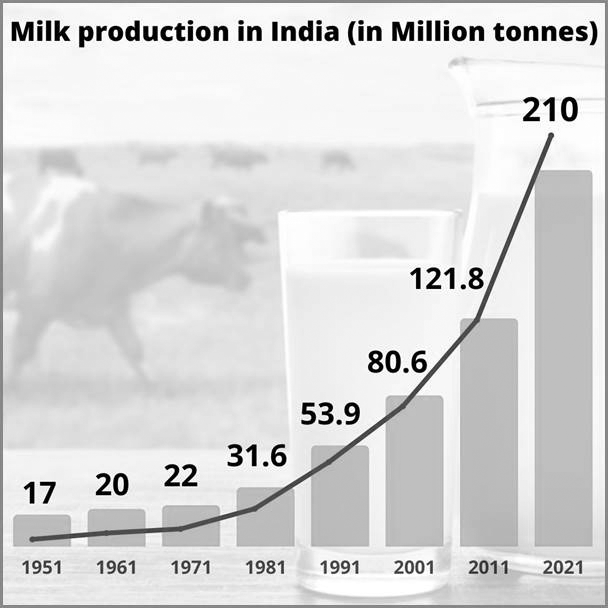
Operation Flood, launched on 13 January 1970, was the world’s largest dairy development program and a landmark project of India’s National Dairy. It transformed India from a milk-deficient nation into the world’s largest milk producer, surpassing the United States of America in 1998.
Operation Flood organised cooperatives of milk producers into a nationwide milk grid with the purpose of increasing milk production, bringing the producers and consumers closer by eliminating middlemen and assuring the producers a regular income throughout the year.
It was not just a dairy programme, but a path to development, generating employment & income for rural households and alleviating poverty. By 1995 there were 69,875 village dairy cooperatives spread over 170 milk sheds all over the country with a total membership of 8.9 million farmers.
A crucial feature of the cooperative movement associated
with the ‘Anand Pattern’ was the democratic mode of functioning of the cooperatives, with a conscious effort being made by the management to keep its ear to the ground and not overlook the interest of the humblest of the cooperative members including the ‘low’ caste and the landless.