Various Terms associated with Megaliths

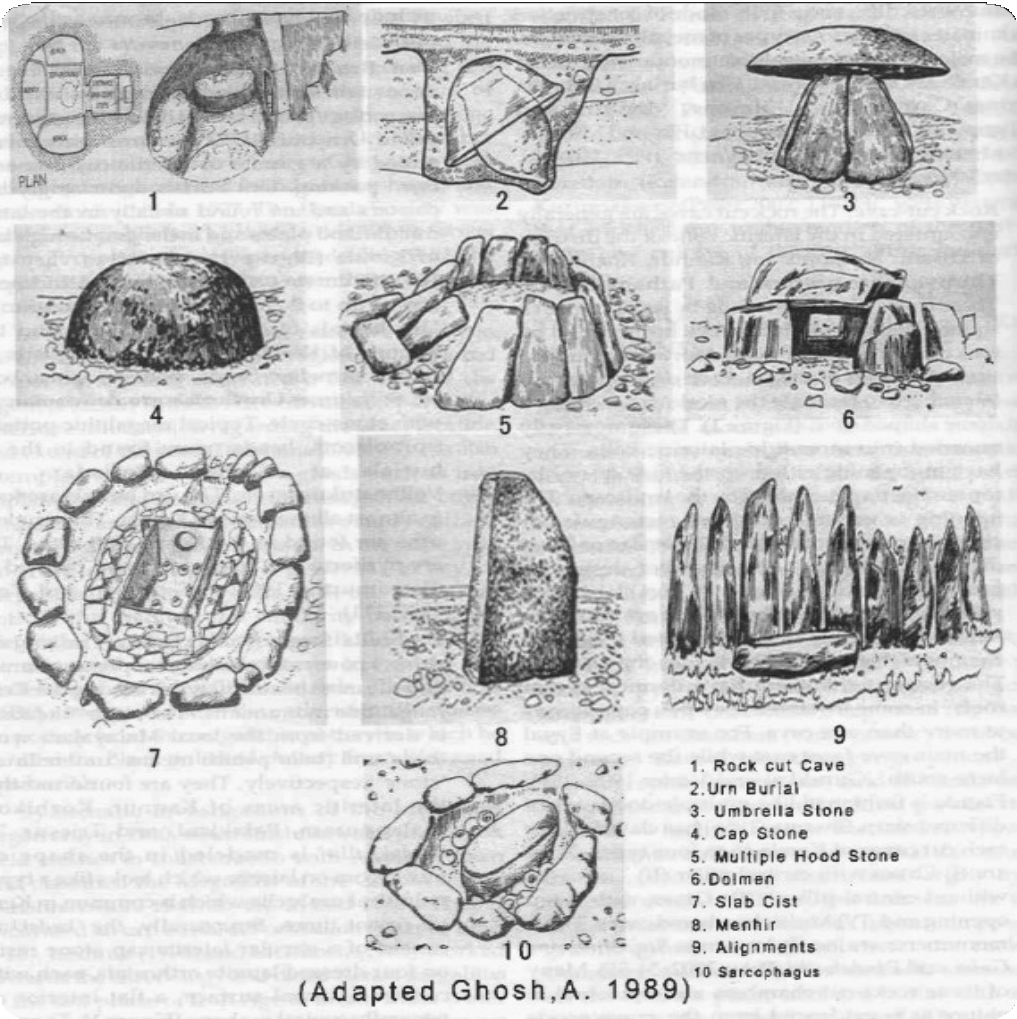
Majo r type of Megalithic monuments found in Kerala
Chamber Tomb: A type of grave from the Megalithic era.
Cist: An underground megalithic tomb constructed with vertical and horizontal stone slabs.
Dolmen: A megalithic tomb built above ground.
Dolmenoid: A partly underground megalithic tomb.
Menhir: A megalithic burial marked by a single, large standing stone.
Barrow: It is a mound or tumulus made of earth. It may be:
•
Circular on plan,
• Oblong or oval on plan.
Barrow may or may not contain stone cist, built on or below the original ground. It may or may not be defined by a circle of stones or a ditch or both.
• Cairns: It is also a barrow but made of heap of stone rubble. It may or may not contain cist and built always on the original ground. In some cases, it is defined by a circle of stones.

Fall of contemporary civilizations like Egypt, Mesopotamia and Greece not Indo-Gangetic Civilization
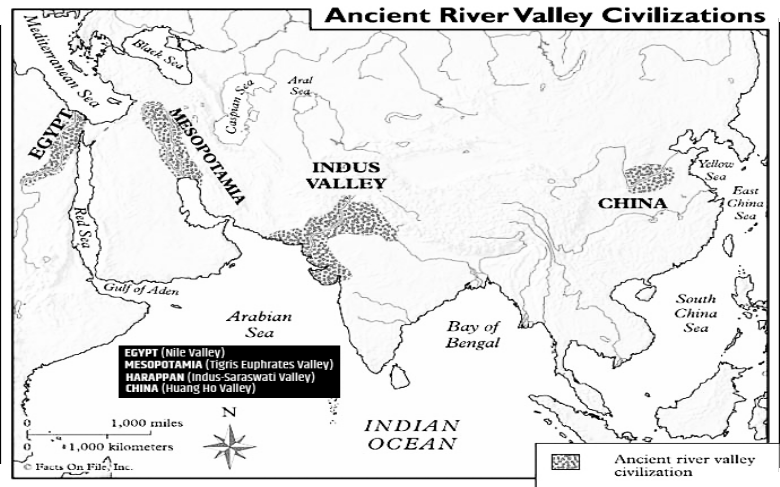
• Western civilizations heavily relied on large-scale slavery, which played a significant role in their decline. In contrast, slavery in India was neither as rigid nor widespread. While there were social outcasts and untouchables, their status was generally better than that of slaves in other regions.
• Western civilizations were largely absorbed by the spread of Christian and Islamic cultures, which reshaped the region. On the other hand, the Indian subcontinent embraced and integrated the cultural elements of successive civilizations.
• A distinctive feature of Indian culture is its ability to remain dynamic and continuous, adapting to change while preserving its core essence. It has consistently discarded what became irrelevant in the modern age, allowing its spirit to endure.
Continuity of Indus Valley Civilization features in Modern Times
• Renowned scholar Jim Shaffer notes that the archaeological evidence shows no clear cultural break between the Vedic period (associated with the Painted Grey Ware culture) and the indigenous protohistoric Harappan culture.
• Weights and measurements: A precise system of weights, typically made from a stone called chert and usually cubical with no markings, was used. The lower denominations followed a binary system (1, 2, 4, 8, 16, up to 12,800), likely for weighing jewelry and beads, while higher denominations followed the decimal system.
• India maintained a currency system based on binary denominations, with 16 Annas equaling 1 Rupee, a system that continued into modern times.
• Agriculture: The Indus Valley civilization employed various irrigation techniques and utilized ploughs and
stone sickles. They were the first to cultivate rice and used the Banawali plowshare for this purpose.
• Rice remains a staple food for most Indians to this day.
• Urban Planning:
• The Indus civilization is famous for its advanced town planning, featuring a grid pattern of housing, narrow lanes between homes, standardized brick sizes, organized civic administration, sophisticated
water management, and an efficient drainage system, including toilets with commodes.
• Many of these features can still be seen in modern cities today, such as the general orientation, internal grid patterns of roads, enclosing fortifications as symbols of authority, garbage bins along main streets, pillared halls, and covered drains.
• Harappan town planning also incorporated auspicious proportions, many of which align with those described in classical Hindu architectural literature and continue to be followed today. For example, the 5:4 ratio can be found in structures like the outer fortifications of Dholavira, the port-town of Lothal near Ahmedabad, Harappa’s granary, large houses in Mohenjo-Daro’s lower city, significant Vedic altars, the king’s palace, Ashoka’s columns, and Delhi’s Iron Pillar.
• Religion:
• The swastika is a classical Indian symbol with possible Indus civilization origins. This symbol is still considered sacred in Hinduism and other religions.
• Phallus worship, such as Harappa’s fertility goddess statue with a woman with a plant growing from her embryo and Male Linga in Harappa. Indication of the practice of fire cult in Lothal in a


later phase and Yoga - Pashupati Mahadeva’s seal indicates the Yogic pose.
• The linga and the trishula (trident), animal sacrifice, and the sacred peepal tree (sacred fig) is still revered.
• Idol worship and use of fire altars for sacrifices and rituals, ponds and sacred baths still practiced.
• Gods having multiple faces, ornamental arches, and yogic postures. Some of their figurines seem to join their hands in a similar fashion, signifying “namaste.”
• Art and Tools:
• Metal sculpting: The Harappans employed the lost-wax technique to craft sculptures from copper, bronze, and gold. One of the earliest examples is the 'Dancing Girl' from Mohenjo-Daro, posed in the tribhanga stance, dating back to 2500 BCE. This technique is still widely used around the world today, particularly in India.
• Oxcarts have mostly survived in shape and size, with very few changes.
• Some plowing techniques have also continued till the present times.
• We still use objects like the frying pans and cooking pots found in Indus cities.
• Children still play with rattles, whistles, and spinning tops.
• Ornaments:
• Bangles, anklets, nose-pins, and ear studs documented at several Indus civilization sites, remain an integral part of ornaments worn by the Indian women of today.
• The married Hindu women applying vermilion at the parting of their hair seem to have Harappan origins (figurines found at Nausharo).
• The traditional techniques of working with metals like gold and bronze, making bangles, and carving ivory in today’s India also derive their roots from the Harappan times.

