VIRUS
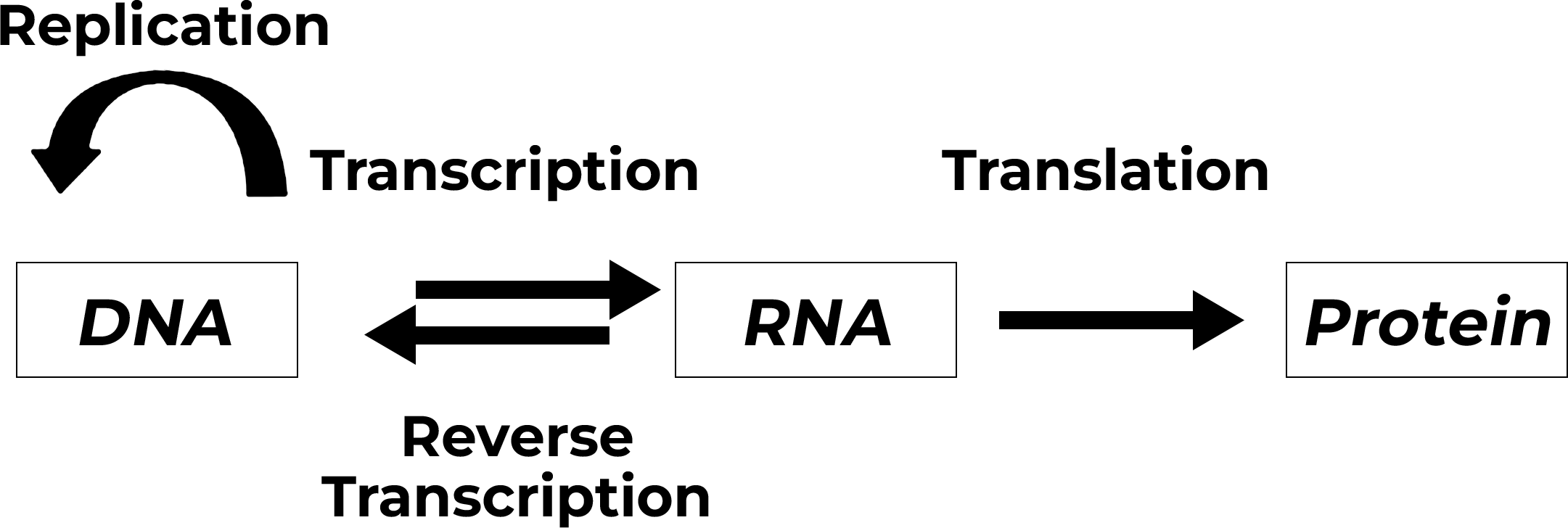
The Central Law of Genetics has an exception. It does not apply in the case of Viruses. This is because viruses are borderline between living and non-living. Viruses have DNA and/or RNA and some proteins as well. Viruses are non- cellular organisms that are characterized by having an inert crystalline structure outside the living cell. Once they infect a cell, they take over the machinery of the host cell to replicate themselves, killing the host. They are smaller than bacteria because they pass through bacteria specific filters. The virus crystals usually contain protein and some genetic material (DNA or RNA). No virus contains both RNA and DNA.
Then why are viruses between living and non-living?
This is because viruses do not have a cellular structure of their own. They can reproduce but not without a host cell. Because they can multiply or reproduce but only when they have a host, they lie in the grey zone between living and non- living.
How do viruses reproduce in the host cells?
Viruses use the Central Law of Genetics that constantly happens in living organism’s cells to multiply. In other words, a virus integrates itself with the genetic material of the host cell to reproduce. Multiplication of virus keeps happening until the cell is full of so many viruses that it bursts. This kills the cell and leads to a release of all those multiplied viruses inside the cell membrane. Thus, a single virus entering a single cell can cause a dramatic multiplication and ultimately kill the host. E.g. COVID-19 Virus
How Viruses infect and multiply?
The Viruses with just RNA participate in the DNA→ RNA→Protein process but they end up converting and integrating their RNA to DNA of the cell. Since these viruses make their RNA to viral DNA, they perform what is called Reverse Transcription. Viruses can do this because they have specialised enzymes (proteins) of their own. The enzyme responsible for reverse transcription leading to the conversion of the Viral RNA to DNA is Reversetransciptase. Viruses also have other enzymes for other specialised purposes. Another example is the enzyme called integrase which primarily integrates the Viral DNA formed after Reverse Transcription to the cell DNA. Lastly, the Virus uses the enzymes Protease and Nuclease.
Viruses that just have RNA end up changing their RNA to DNA (Reverse of Transcription) These types of viruses are called Retroviruses. Ex. HIV (AIDS). An important point to remember is that viruses can only do this inside a host cell and not independently.