WAY FORWARD:
ONE STEP AT A TIME
Self-Reliance Or An Atmanirbhar Bharat
• A mechanism for IMPORT SUBSTITUTION needs to be worked out, by creating such product alternatives which can compete both in quality and cost against Chinese product
Investment In Innovation
• Low R&D expenditure, especially from the private sector, is a key challenge facing the innovation ecosystem in India. • R&D expenditure in India: 0.7% of GDP(2% in China, 1.2% in Brazil & 4.7%in Israel)
• This makes it imperative to think about resource allocation and invest in research and development, which in turn will equip our industries with the requisite technology and skill to fight this trade battle.
Cheaper Loans
• The government must lower the rates at which loans are issued to Indian companies, just like China.
• Recently, finance minister Nirmala Sitharaman announced a stimulus package to address the needs of various sectors battling for survival.
• Now, steps should be taken to ensure these announcements are actually implemented on the ground.
• In addition to this, the government must provide infrastructure, services, etc.. to prepare Indian companies to compete with China.
Liberalized FDI Regime
The FDI regime needs to be further liberalised. 2. India receives only 25% of the FDI that China gets and only 10% of what the US receives. 3. Increase in the levels of FDI may provide the necessary nudge to our industrial sector to surge towards better productivity and efficiency.
Diversifying Our Import Basket
• It would be extremely beneficial if we diversify our import basket, by importing our necessities from a host of other countries and lessening our dependence on China. All these steps, collectively, could take us closer to self-reliance.
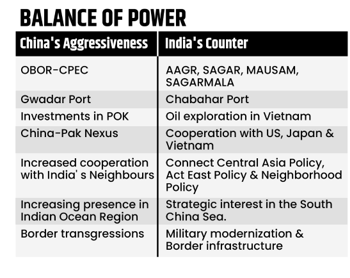
OVERALL RIVALRY AND BALANCE OF POWER
MISCELLANEOUS
One Country, Two Systems
• The One Country Two Systems policy was originally proposed by Deng Xiaoping shortly after he took the reins of the country in the late 1970s.
• It was originally proposed to unify China and Taiwan but rejected by Taiwan. The idea resurfaced when China started talks with Britain and Portugal, who were governing Hong Kong and Macau, respectively, as colonies.
• Under this, China proposed that Hong Kong, and Macau, can have different economic and political systems from that of mainland China, while being part of China.
• Both regions became Special Administrative Regions of China with their own currencies, economic and legal systems. However, defence and foreign affairs would be decided by China.
• Also, Hong Kong has freedom of assembly and speech, and some democratic rights, which are not available in mainland China.
• These freedoms are protected by the Basic Law, a mini constitution that guides relationship between Hong Kong and China. Basic law is valid for 50 years, till 2047 for Hong Kong and 2049 for Macau. But it is unclear what will happen after this term.